
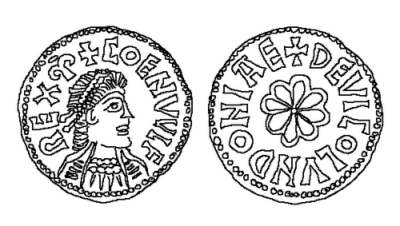
Coenwulf
Coenwulf was a King of Mercia from 796 to 821. Born 8th century. Died 821, in Basingwerk Abbey. Positions held include King of Mercia (796–821).
Facts
13 facts · 0 confirmed by two sources · 1 cited · 12 from one source
Where this comes from
Papalocal keeps its own record. It started from these sources; what each one said is kept here as it was copied, so a change on their side never changes this page by itself. Tap one to read its version.
What Wikidata says · copied November 17, 2026 · revision 2552937437
- Described as
- King of Mercia from 796 to 821
- Other names
- Cenwulf, Kenulf, Kenwulph
- Born
- 8th century
- Died
- 821
- Died in
- Basingwerk Abbey
- Buried in
- Winchcombe Abbey
- Occupation
- monarch
- Positions held
- King of Mercia (796–821)
- Spouse
- Ælfthryth of Mercia · 1 reference
- Children
- Saint Kenelm; Cwenthryth; Burgenhild · 1 reference
- Father
- Cuthberht of Mercia
- Siblings
- Cuthred of Kent; Ceolwulf I of Mercia
- Wikipedias with a page
- 27
Wikidata item Q762675 (wikidata.org/wiki/Q762675), public domain (CC0). Copied November 17, 2026.
What Wikipedia says · copied November 17, 2026 · revision 1348137950
Coenwulf (Old English: [ˈkøːnwuɫf]; also spelled Cenwulf, Kenulf, or Kenwulph; Latin: Coenulfus) was the king of Mercia from December 796 until his death in 821. He was a descendant of King Pybba, who ruled Mercia in the early 7th century. He succeeded Ecgfrith, the son of Offa; Ecgfrith only reigned for five months, and Coenwulf ascended the throne in the same year that Offa died. In the early years of Coenwulf's reign he had to deal with a revolt in Kent, which had been under Offa's control. Eadberht Præn returned from exile in Francia to claim the Kentish throne, and Coenwulf was forced to wait for papal support before he could intervene. When Pope Leo III agreed to anathematise Eadberht, Coenwulf invaded and retook the kingdom; Eadberht was taken prisoner, was blinded, and had his hands cut off. Coenwulf also appears to have lost control of the kingdom of East Anglia during the early part of his reign, as an independent coinage appears under King Eadwald. Coenwulf's coinage reappears in 805, indicating that the kingdom was again under Mercian control. Several campaigns of Coenwulf's against the Welsh are recorded, but only one conflict with Northumbria, in 801, though it is likely that Coenwulf continued to support the opponents of the Northumbrian king Eardwulf.
Coenwulf came into conflict with Archbishop Wulfred of Canterbury over the issue of whether laypeople could control religious houses such as monasteries. The breakdown in the relationship between the two eventually reached the point where the archbishop was unable to exercise his duties for at least four years. A partial resolution was reached in 822 with Coenwulf's successor, King Ceolwulf, but it was not until about 826 that a final settlement was reached between Wulfred and Coenwulf's daughter, Cwoenthryth, who had been the main beneficiary of Coenwulf's grants of religious property.
Coenwulf was succeeded by his brother, Ceolwulf; a post-Conquest legend claims that his son Cynehelm was murdered to gain the succession. Within two years Ceolwulf had been deposed, and the kingship passed permanently out of Coenwulf's family. Coenwulf was the last king of Mercia to exercise substantial dominance over other Anglo-Saxon kingdoms. Within a decade of his death, the rise of Wessex had begun under King Egbert, and Mercia never recovered its former position of power.
From the Wikipedia article “Coenwulf of Mercia” (en.wikipedia.org/wiki/Coenwulf_of_Mercia), by its contributors, under CC BY-SA 4.0 (creativecommons.org/licenses/by-sa/4.0/). Copied November 17, 2026; not changed.
Confirmed Two sources agree. Cited One source, and it names where it got it. One source One source, without a reference of its own. Sources disagree The sources disagree. We show the best-supported value and keep theirs below.
