
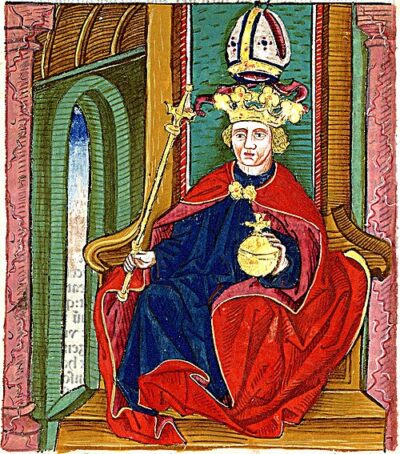
Coloman was a king of Hungary. Born 1070, in Székesfehérvár. Died February 3, 1116, in Székesfehérvár. Positions held include Apostolic King of Hungary (1095–1116) and King of Croatia (1102–1116).
Facts
21 facts · 2 confirmed by two sources · 4 cited · 15 from one source
Where this comes from
Papalocal keeps its own record. It started from these sources; what each one said is kept here as it was copied, so a change on their side never changes this page by itself. Tap one to read its version.
What Wikidata says · copied November 16, 2026 · revision 2569062251
- Described as
- king of Hungary (1095-1116)
- Other names
- Kálmán o Kolomani
- Born
- 1070 · 2 references
- Died
- February 3, 1116 · 2 references
- Born in
- Székesfehérvár
- Died in
- Székesfehérvár
- Buried in
- Székesfehérvár Basilica
- Citizen of
- Hungary
- Occupation
- politician; monarch
- Positions held
- Apostolic King of Hungary (1095–1116) · 1 reference; King of Croatia (1102–1116) · 1 reference
- Political party
- politician before the emergence of political parties
- Spouse
- Felicia of Sicily (1097–) · 1 reference; Euphemia of Kyiv (1104–) · 1 reference
- Children
- Stephen II of Hungary; Boris Kalamanos · 1 reference; Sophia · 1 reference; NN of Hungary
- Father
- Géza I of Hungary
- Mother
- Sophia · 1 reference
- Siblings
- Álmos, Duke of Nitra
- Religion
- Christianity
- Wikipedias with a page
- 45
Wikidata item Q83066 (wikidata.org/wiki/Q83066), public domain (CC0). Copied November 16, 2026.
What Wikipedia says · copied November 16, 2026 · revision 1365321987
Coloman the Learned, also the Book-Lover or the Bookish (Hungarian: Könyves Kálmán; Croatian: Koloman; Slovak: Koloman Učený; c. 1070 – 3 February 1116), was King of Hungary from 1095 and King of Croatia from 1097 until his death. Because Coloman and his younger brother Álmos were underage when their father Géza I died, their uncle Ladislaus I ascended the throne in 1077. Ladislaus prepared Coloman—who was "half-blind and humpbacked", according to late medieval Hungarian chronicles—for a church career, and Coloman was eventually appointed bishop of Eger or Várad (Oradea, Romania) in the early 1090s. The dying King Ladislaus preferred Álmos to Coloman when nominating his heir in early 1095. Coloman fled from Hungary but returned around 19 July 1095 when his uncle died. He was crowned in early 1096; the circumstances of his accession to the throne are unknown. He granted the Hungarian Duchy—one-third of the Kingdom of Hungary—to Álmos.
In the year of Coloman's coronation, at least five large groups of crusaders arrived in Hungary on their way to the Holy Land. He annihilated the bands who were entering his kingdom unauthorized or pillaging the countryside, but the main crusader army crossed Hungary without incident. He invaded Croatia in 1097, defeating its last native king Petar Snačić. Consequently, he was crowned king of Croatia in 1102. According to the late 14th-century Pacta conventa (the authenticity of which is not universally accepted by scholars), he was only crowned after having ratified a treaty with the leaders of the Croatian nobility. For centuries thereafter, the Hungarian monarchs were also the kings of Croatia.
Coloman had to face his brother's attempts to dethrone him throughout his life; Álmos devised plots to overthrow him on at least five occasions. In retaliation, he seized his brother's duchy in 1107 or 1108 and had Álmos and Álmos' son Béla blinded in about 1114. Hungarian chronicles, which were compiled in the reigns of kings descending from his mutilated brother and nephew, depict Coloman as a bloodthirsty and unfortunate monarch. On the other hand, he is portrayed as "the most well-versed in the science of letters among all the kings of his day" by the contemporaneous chronicler Gallus Anonymus. Coloman's decrees, which governed many aspects of life—including taxation, trade and relations between his Christian and non-Christian subjects—remained unmodified for more than a century. He was the first Hungarian king to renounce control of the appointment of prelates in his realms.
- Born, in its opening lines
- c. 1070
- Died, in its opening lines
- February 3, 1116
From the Wikipedia article “Coloman, King of Hungary” (en.wikipedia.org/wiki/Coloman,_King_of_Hungary), by its contributors, under CC BY-SA 4.0 (creativecommons.org/licenses/by-sa/4.0/). Copied November 16, 2026; not changed.
Confirmed Two sources agree. Cited One source, and it names where it got it. One source One source, without a reference of its own. Sources disagree The sources disagree. We show the best-supported value and keep theirs below.
