
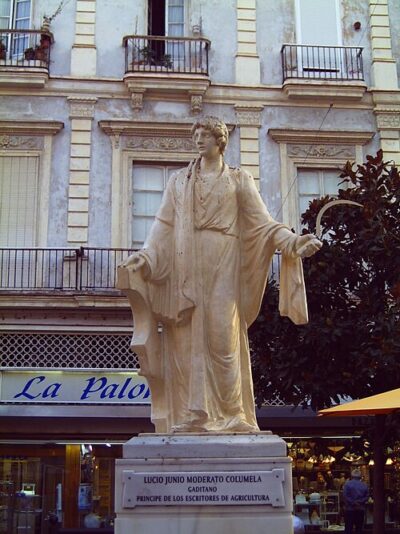
Columella
Columella was a Roman writer on agriculture. Born 4, in Cádiz. Died 70, in Taranto.
Facts
9 facts · 0 confirmed by two sources · 2 cited · 7 from one source
Where this comes from
Papalocal keeps its own record. It started from these sources; what each one said is kept here as it was copied, so a change on their side never changes this page by itself. Tap one to read its version.
What Wikidata says · copied November 16, 2026 · revision 2567491378
- Described as
- Roman writer on agriculture
- Other names
- Lucius Kolumella, Lucius Iunius Moderatus Columella, L. Iunius Moderatus Columella, Lucius Junius Moderatus Columella, Lucius Columella
- Born
- 4
- Died
- 70 · 2 references
- Born in
- Cádiz
- Died in
- Taranto
- Citizen of
- Ancient Rome
- Occupation
- writer · 2 references; poet · 1 reference
- Military branch
- Imperial Roman army
- Military rank
- military tribune
- Wikipedias with a page
- 51
Wikidata item Q318317 (wikidata.org/wiki/Q318317), public domain (CC0). Copied November 16, 2026.
What Wikipedia says · copied November 16, 2026 · revision 1385555894
Lucius Junius Moderatus Columella () was a Roman writer on agriculture in the Roman Empire.
His De re rustica in twelve volumes has been completely preserved and forms an important source on Roman agriculture and cuisine, together with the works of Cato the Elder and Marcus Terentius Varro, both of which he occasionally cites. A smaller book on trees, De arboribus, is usually attributed to him.
In 1794 the Spanish botanists José Antonio Pavón Jiménez and Hipólito Ruiz López named a genus of Peruvian asterid Columellia in his honour.
From the Wikipedia article “Lucius Junius Moderatus Columella” (en.wikipedia.org/wiki/Lucius_Junius_Moderatus_Columella), by its contributors, under CC BY-SA 4.0 (creativecommons.org/licenses/by-sa/4.0/). Copied November 16, 2026; not changed.
Confirmed Two sources agree. Cited One source, and it names where it got it. One source One source, without a reference of its own. Sources disagree The sources disagree. We show the best-supported value and keep theirs below.
