
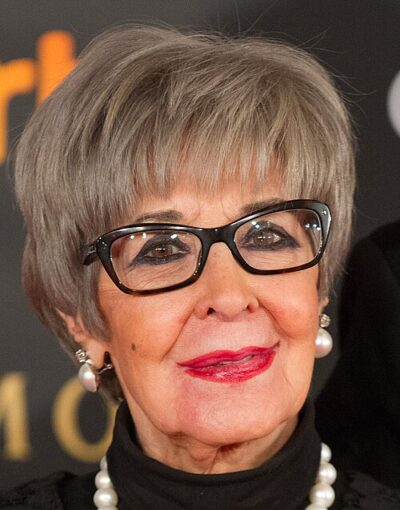
Concha Velasco
Concha Velasco was a Spanish actress-singer. Born November 29, 1939, in Valladolid. Died December 2, 2023, in Majadahonda. Awards include Grand Cross of the Civil Order of Alfonso X the Wise, Honorary Goya Award and National Theater Prize.
Facts
33 facts · 2 confirmed by two sources · 14 cited · 17 from one source
Where this comes from
Papalocal keeps its own record. It started from these sources; what each one said is kept here as it was copied, so a change on their side never changes this page by itself. Tap one to read its version.
What Wikidata says · copied November 17, 2026 · revision 2569734079
- Described as
- Spanish actress-singer
- Other names
- Conchita Velasco, Concepción Velasco Varona
- Born
- November 29, 1939 · 2 references
- Died
- December 2, 2023 · 2 references
- Born in
- Valladolid · 1 reference
- Died in
- Majadahonda · 1 reference
- Cause of death
- lymphoma
- Name at birth
- Concepción Velasco Varona
- Citizen of
- Spain
- Occupation
- actor · 1 reference; television presenter; singer; stage actor; film actor; dancer · 1 reference
- Member of
- Academia de las Artes Escénicas de España
- Instrument
- voice
- Record label
- Belter; Hispavox
- Awards
- Grand Cross of the Civil Order of Alfonso X the Wise (2016) · 1 reference; Honorary Goya Award (2013); National Theater Prize (2016); Valladolid Gold Medal (2017) · 1 reference; Gold Medal of Work Merit (2008) · 1 reference; Gold Medal of Merit in the Fine Arts (1987); Gold Medal of Madrid (2018) · 1 reference; Max Honor Award (2019) · 1 reference; FAD Sebastià Gasch Award (2012) · 1 reference; Medalla de Oro (2003) · 1 reference; Grand Cross of the Order of Isabella the Catholic (2023) · 1 reference
- Field
- acting · 1 reference; singing · 1 reference; dance · 1 reference
- Spouse
- Paco Marsó (1977–2005)
- Religion
- Catholicism · 1 reference
- Wikipedias with a page
- 26
Wikidata item Q270812 (wikidata.org/wiki/Q270812), public domain (CC0). Copied November 17, 2026.
What Wikipedia says · copied November 17, 2026 · revision 1354926577
Concepción Velasco Varona (29 November 1939 – 2 December 2023), known professionally as Concha Velasco, also Conchita Velasco, was a Spanish actress, singer, dancer, television presenter, and theatrical producer. She received numerous accolades throughout her career in film, theater, and television spanning over six decades, including two National Theater Awards presented by the Spanish Ministry of Culture in 1972 and 2016, the Lifetime Achievement Award presented by the Spanish Television Academy in 2009, and the Honorary Goya Award presented by the Spanish Film Academy in 2012.
Some of her credits include leading film performances in Red Cross Girls (1958), Los tramposos (1959), The Fair of the Dove (1963), Television Stories (1965), The Witching Hour (1985), and Beyond the Garden (1996); leading stage performances in ¡Mamá, quiero ser artista!, in several plays that author Antonio Gala wrote for her, and in the Spanish productions of Filumena Marturano and Hello, Dolly!; leading television performances in Teresa de Jesús and Herederos on Televisión Española, Motivos personales on Telecinco, and Gran Hotel on Antena 3; as well as a television presenter in numerous shows for those three networks.
Velasco had been also the recipient of many honours. The Government of Spain honoured her with the Gold Medal of Merit in the Fine Arts in 1987, the Gold Medal of Merit in Labour in 2008, the Grand Cross of the Civil Order of Alfonso X, the Wise in 2016, and the Grand Cross of the Royal Order of Isabella the Catholic posthumously in 2023. The Spanish Film Academy honoured her with its Gold Medal in 2003.
- Born, in its opening lines
- November 29, 1939
- Died, in its opening lines
- December 2, 2023
From the Wikipedia article “Concha Velasco” (en.wikipedia.org/wiki/Concha_Velasco), by its contributors, under CC BY-SA 4.0 (creativecommons.org/licenses/by-sa/4.0/). Copied November 17, 2026; not changed.
Confirmed Two sources agree. Cited One source, and it names where it got it. One source One source, without a reference of its own. Sources disagree The sources disagree. We show the best-supported value and keep theirs below.
