
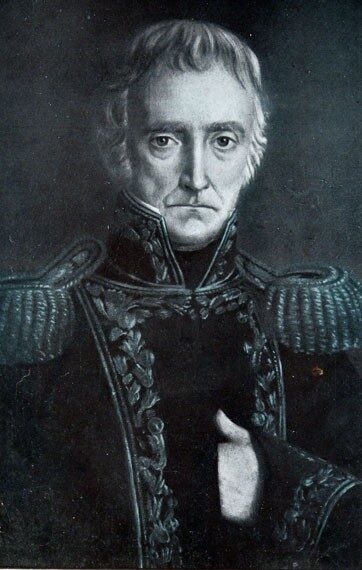
Cornelio Saavedra
Cornelio Saavedra was a Platian general. Born September 15, 1759, in Otuyo. Died March 29, 1829, in Buenos Aires. Educated at National School of Buenos Aires.
Facts
14 facts · 2 confirmed by two sources · 1 cited · 11 from one source
Where this comes from
Papalocal keeps its own record. It started from these sources; what each one said is kept here as it was copied, so a change on their side never changes this page by itself. Tap one to read its version.
What Wikidata says · copied November 18, 2026 · revision 2532857891
- Described as
- Platian general (1759-1828)
- Other names
- Cornelio Judas Tadeo de Saavedra, Cornelio de Saavedra
- Born
- September 15, 1759 · 2 references
- Died
- March 29, 1829 · 3 references
- Born in
- Otuyo
- Died in
- Buenos Aires
- Buried in
- Mausoleum of Meritorious Citizens
- Citizen of
- Argentina · 1 reference; Bolivia
- Occupation
- politician; military personnel
- Political party
- Patriot
- Education
- National School of Buenos Aires
- Spouse
- María Saturnina Bárbara de Otálora y Ribero · 1 reference
- Children
- Mariano Saavedra · 1 reference
- Military rank
- brigadier
- Wikipedias with a page
- 20
Wikidata item Q2361877 (wikidata.org/wiki/Q2361877), public domain (CC0). Copied November 18, 2026.
What Wikipedia says · copied November 18, 2026 · revision 1368686213
Cornelio Judas Tadeo de Saavedra y Rodríguez (September 15, 1759 – March 29, 1829) was an Argentine military officer and statesman. He was instrumental in the May Revolution, the first step of Argentina's independence from Spain, and became the first head of state of the autonomous country that would become Argentina when he was appointed president of the Primera Junta.
Saavedra was the first commanding officer of the Regiment of Patricians created after the ill-fated British invasions of the River Plate. The increased militarization of the city and the relaxation of the system of castas allowed him, as other criollo peoples, to become a prominent figure in local politics. His intervention was decisive to thwart the Mutiny of Álzaga and allow viceroy Santiago de Liniers to stay in power. Although he supported the establishment of a Junta similar those created in Spain during the Peninsular War, he desired that criollos had an important role in it (the mutiny of Álzaga was promoted by peninsulars). He advised against rushed actions as well, and as his regiment was crucial in any action against the viceroy, he denied his help until it was a good strategic moment to do so. The opportunity came in May 1810, and the May Revolution successfully ousted the viceroy.
Saavedra was appointed president of the Primera Junta, which took government after it. The local politics were soon divided between him and the secretary Mariano Moreno. Saavedra wanted gradual changes, while Moreno promoted more radical ones. Saavedra encouraged the expansion of the Junta with deputies from the other provinces; this left Moreno in a minority, and he resigned. A later rebellion made on behalf of Saavedra forced the remaining supporters of Moreno to resign as well. He left the presidency after the defeat of the first Upper Peru campaign, and headed to lead the Army of the North. His absence was exploited by political opponents, who established the First Triumvirate and issued an arrest warrant against Saavedra. Saavedra stayed in exile until 1818, when all the charges against him were dropped.
- Born, in its opening lines
- September 15, 1759
- Died, in its opening lines
- March 29, 1829
From the Wikipedia article “Cornelio Saavedra” (en.wikipedia.org/wiki/Cornelio_Saavedra), by its contributors, under CC BY-SA 4.0 (creativecommons.org/licenses/by-sa/4.0/). Copied November 18, 2026; not changed.
Confirmed Two sources agree. Cited One source, and it names where it got it. One source One source, without a reference of its own. Sources disagree The sources disagree. We show the best-supported value and keep theirs below.
