
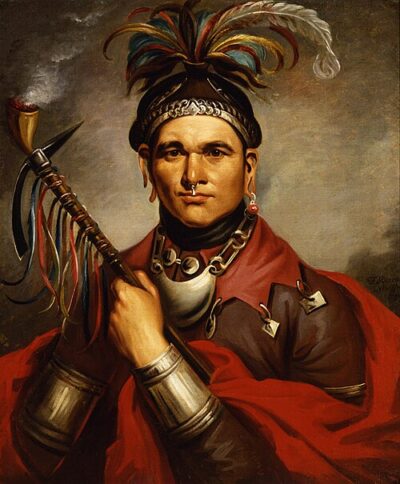
Cornplanter
Cornplanter was a Seneca war chief. Born 1732, in Canawaugus. Died February 18, 1836, in Cornplanter Tract. Positions held include traditional leader or chief.
Facts
13 facts · 1 confirmed by two sources · 3 cited · 8 from one source · 1 where the sources disagree
What’s different
- Born: we show 1732 (Sources disagree). Wikipedia says c. 1752
Where this comes from
Papalocal keeps its own record. It started from these sources; what each one said is kept here as it was copied, so a change on their side never changes this page by itself. Tap one to read its version.
What Wikidata says · copied November 19, 2026 · revision 2553932258
- Described as
- Seneca war chief (1752-1836)
- Other names
- John Abeel, Kaintwakon, Gaiänt'wakê, Gyantwachia, Kaiiontwa'kon, Chief Cornplanter, Charles, Earl Cornplanter, John Abeel III, John O'Bail, Ki-on-twog-ky
- Born
- 1732 · 1 reference
- Died
- February 18, 1836 · 2 references
- Born in
- Canawaugus
- Died in
- Cornplanter Tract
- Buried in
- Corydon Township
- Citizen of
- United States
- Occupation
- politician
- Positions held
- traditional leader or chief
- Children
- Edward Cornplanter · 1 reference
- Father
- Johannes "John" Abeel, II · 1 reference
- Mother
- Aliquipiso, of the Turtle Clan of the Senecca Nation · 1 reference
- Siblings
- Handsome Lake
- Religion
- Longhouse Religion
- Wikipedias with a page
- 13
Wikidata item Q1134261 (wikidata.org/wiki/Q1134261), public domain (CC0). Copied November 19, 2026.
What Wikipedia says · copied November 19, 2026 · revision 1383441257
John Abeel III (c. 1752–February 18, 1836) known as Gayë́twageh in the Seneca language and thus generally known as Cornplanter, was a Seneca war leader and diplomat. As a war leader, Cornplanter fought in the American Revolutionary War on the side of the British. After the war Cornplanter led negotiations with the United States and was a signatory of the Treaty of Fort Stanwix (1784), the Treaty of Canandaigua (1794), and other treaties. He helped ensure Seneca neutrality during the Northwest Indian War.
In the postwar years, Cornplanter endeavoured to learn more about European-American culture and invited Quakers to establish schools in Seneca territory. After the War of 1812 he became disillusioned by his people's poor reaction to European-American society. He had the schools closed and embraced his half-brother Handsome Lake's movement to return to traditional Seneca ways and religion.
The United States government granted him about 1500 acres of former Seneca territory in Pennsylvania in 1796 for "him and his heirs forever," which became known as the Cornplanter Tract. The federal government, however, started construction of the Kinzua Dam on the Allegany River in 1960. When the dam was completed, the Cornplanter Tract was flooded, and most of the few remaining residents moved to the Allegany Reservation of the federally recognized Seneca Nation of Indians. Before flooding occurred the remains of Cornplanter, his descendants, and an 1866 monument to him were relocated.
- Born, in its opening lines
- c. 1752
- Died, in its opening lines
- February 18, 1836
From the Wikipedia article “Cornplanter” (en.wikipedia.org/wiki/Cornplanter), by its contributors, under CC BY-SA 4.0 (creativecommons.org/licenses/by-sa/4.0/). Copied November 19, 2026; not changed.
Confirmed Two sources agree. Cited One source, and it names where it got it. One source One source, without a reference of its own. Sources disagree The sources disagree. We show the best-supported value and keep theirs below.
