
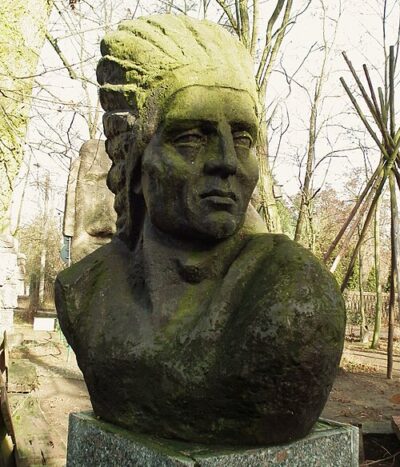
Crazy Horse
Crazy Horse was an Oglala Sioux chief. Born December 4, 1849, in South Dakota. Died September 5, 1877, in Fort Robinson. Positions held include war chief.
Facts
14 facts · 1 confirmed by two sources · 1 cited · 11 from one source · 1 where the sources disagree
What’s different
- Born: we show December 4, 1849 (Sources disagree). Wikipedia says c. 1840
Where this comes from
Papalocal keeps its own record. It started from these sources; what each one said is kept here as it was copied, so a change on their side never changes this page by itself. Tap one to read its version.
What Wikidata says · copied November 16, 2026 · revision 2557847684
- Described as
- Oglala Sioux chief (1840–1877)
- Other names
- His-Horse-Is-Crazy, Among the Trees, Tȟašúŋke Witkó
- Born
- December 4, 1849 · 1 reference
- Died
- September 5, 1877 · 2 references
- Born in
- South Dakota
- Died in
- Fort Robinson
- Cause of death
- stab wound
- Occupation
- politician; traditional leader or chief · 1 reference
- Positions held
- war chief
- Field
- Sioux
- Spouse
- Black Shawl (1871–) · 1 reference
- Father
- Crazy Horse
- Mother
- Rattling Blanket Woman
- Siblings
- Little Hawk
- Lived in
- South Dakota
- Wikipedias with a page
- 61
Wikidata item Q44555 (wikidata.org/wiki/Q44555), public domain (CC0). Copied November 16, 2026.
What Wikipedia says · copied November 16, 2026 · revision 1380745082
Crazy Horse (Lakota: Tȟašúŋke Witkó [tˣaˈʃʊ̃kɛ wɪtˈkɔ], lit. 'His-Horse-Is-Crazy'; c. 1840 – September 5, 1877) was a Lakota war leader of the Oglala band and one of the most renowned Native American figures of the nineteenth century. Known for his commitment to defending Lakota lands and lifeways, he emerged as a central figure in the northern Great Plains during a period of intense conflict with the United States. Crazy Horse resisted U.S. expansion into the Powder River Country, rejecting treaty settlements and reservation life, and became widely respected for both his tactical skill and his personal humility, which included a lifelong avoidance of being photographed.
He played leading roles in several major engagements, including the 1866 Fetterman Fight, in which a combined Lakota, Cheyenne, and Arapaho force annihilated a U.S. Army detachment, and the 1876 Battle of the Little Bighorn, where he helped lead the combined Native forces that defeated the 7th Cavalry under George Armstrong Custer. His reputation as a warrior and strategist earned him admiration among his own people and grudging respect from his adversaries.
After months of pursuit during the Great Sioux War of 1876–1877, Crazy Horse surrendered to U.S. forces in May 1877, seeking to secure the survival of his band amid famine and military pressure. Tensions with military authorities and rival Lakota leaders soon followed. In September 1877, after being brought to Camp Robinson in northwestern Nebraska, he was fatally wounded by a bayonet in the course of an alleged struggle with a guard while being confined to the post guardhouse. His death quickly became the subject of conflicting accounts, but he has since endured as a symbol of Lakota resistance and cultural integrity.
- Born, in its opening lines
- c. 1840
- Died, in its opening lines
- September 5, 1877
From the Wikipedia article “Crazy Horse” (en.wikipedia.org/wiki/Crazy_Horse), by its contributors, under CC BY-SA 4.0 (creativecommons.org/licenses/by-sa/4.0/). Copied November 16, 2026; not changed.
Confirmed Two sources agree. Cited One source, and it names where it got it. One source One source, without a reference of its own. Sources disagree The sources disagree. We show the best-supported value and keep theirs below.
