
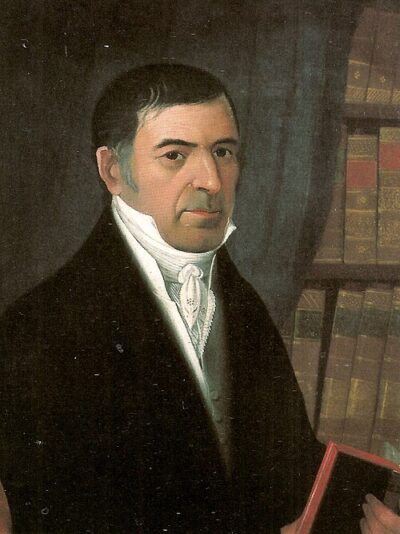
Cristóbal de Mendoza
Cristóbal de Mendoza was a President of Venezuela. Born June 23, 1772, in Trujillo. Died February 8, 1829, in Caracas. Positions held include President of Venezuela. Educated at Central University of Venezuela.
Facts
10 facts · 2 confirmed by two sources · 0 cited · 8 from one source
Where this comes from
Papalocal keeps its own record. It started from these sources; what each one said is kept here as it was copied, so a change on their side never changes this page by itself. Tap one to read its version.
What Wikidata says · copied November 18, 2026 · revision 2522430789
- Described as
- President of Venezuela (1772-1829)
- Other names
- Cristobal Mendoza
- Born
- June 23, 1772
- Died
- February 8, 1829
- Born in
- Trujillo
- Died in
- Caracas
- Citizen of
- Venezuela
- Occupation
- politician; lawyer
- Positions held
- President of Venezuela
- Education
- Central University of Venezuela
- Religion
- Catholicism
- Wikipedias with a page
- 23
Wikidata item Q2497553 (wikidata.org/wiki/Q2497553), public domain (CC0). Copied November 18, 2026.
What Wikipedia says · copied November 18, 2026 · revision 1382067732
José Cristóbal Hurtado de Mendoza y Montilla (23 June 1772 – 8 February 1829), commonly known as Cristóbal Mendoza, was a Venezuelan lawyer, politician, writer, and academic. Cristóbal is best known for serving as the first official President of Venezuela from 1811 to 1812. After earning a master's degree in philosophy in Caracas and his doctor utriusque juris (Doctor of Canon and Civil Law) in the Dominican Republic, early in his professional career he served in various law firms in Trujillo, Mérida, and Caracas. He moved to Barinas in 1796 to practice law, and in 1807 was elected Mayor of Barinas. In 1810, Mendoza joined the insurgent movement started by wealthy Caracan citizens against the Spanish crown, and in 1811 was elected to represent the province of Barinas in the newly founded Constituent Congress of Venezuela. Days later he was appointed the first president of the First Republic of Venezuela, a role he shared as part of a triumvirate. Until his term ended in March 1812, Mendoza began the war for independence against the parts of Venezuela that still supported the Spanish monarchy, authored the Venezuelan Declaration of Independence, and also took part in constructing the first Constitution of the Republic of Venezuela.
In 1813 Mendoza fled a royalist invasion and moved to Grenada, and soon after he joined Simón Bolívar's effort to liberate South America from Spanish rule. Bolivar appointed Mendoza the governor of Mérida in May 1813, and Mendoza was appointed governor of Caracas several months later. Fleeing Venezuela again in 1814 when José Tomás Boves conquered Caracas, Mendoza moved to Trinidad, where from 1819 and 1820 he was an active political writer for the Correo del Orinoco. In 1826, Francisco de Paula Santander appointed Mendoza as Mayor of the Department of Venezuela in the empire of Gran Colombia. After a short exile under General José Antonio Páez, in 1827 Bolivar re-appointed him Mayor of the Department of Venezuela, a role Medoza kept until resigning in the middle of 1828. In commemoration of Mendoza, in 1972, Venezuela enacted National Lawyer Day (Día Nacional del Abogado) on Mendoza's birth date of 23 June.
- Born, in its opening lines
- June 23, 1772
- Died, in its opening lines
- February 8, 1829
From the Wikipedia article “Cristóbal Mendoza” (en.wikipedia.org/wiki/Cristóbal_Mendoza), by its contributors, under CC BY-SA 4.0 (creativecommons.org/licenses/by-sa/4.0/). Copied November 18, 2026; not changed.
Confirmed Two sources agree. Cited One source, and it names where it got it. One source One source, without a reference of its own. Sources disagree The sources disagree. We show the best-supported value and keep theirs below.
