
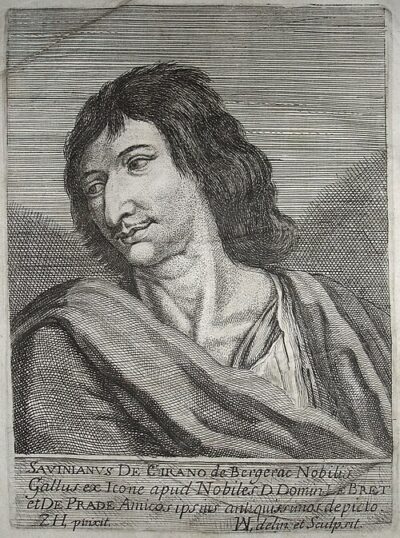
Cyrano de Bergerac
Cyrano de Bergerac was a French novelist and dramatist. Born March 6, 1619, in Paris. Died July 28, 1655, in Sannois. Educated at Lycée Saint-Louis-de-Gonzague.
Facts
13 facts · 2 confirmed by two sources · 5 cited · 6 from one source
Where this comes from
Papalocal keeps its own record. It started from these sources; what each one said is kept here as it was copied, so a change on their side never changes this page by itself. Tap one to read its version.
What Wikidata says · copied November 16, 2026 · revision 2558234159
- Described as
- French novelist and dramatist (1619–1655)
- Other names
- Savinien de Cyrano de Bergerac, Savinien Cyrano de Bergerac, Hercule Savinien Cyrano de Bergerac
- Born
- March 6, 1619 · 9 references
- Died
- July 28, 1655 · 9 references
- Born in
- Paris · 3 references
- Died in
- Sannois · 2 references
- Name at birth
- Hercule Savinien de Cyrano
- Citizen of
- France · 2 references
- Occupation
- playwright · 1 reference; poet; writer · 2 references; philosopher; science fiction writer; novelist
- Education
- Lycée Saint-Louis-de-Gonzague
- Wikipedias with a page
- 69
Wikidata item Q213614 (wikidata.org/wiki/Q213614), public domain (CC0). Copied November 16, 2026.
What Wikipedia says · copied November 16, 2026 · revision 1384070216
Savinien de Cyrano de Bergerac ( SIRR-ə-noh də BUR-zhə-rak, – BAIR-, French: [savinjɛ̃ d(ə) siʁano d(ə) bɛʁʒəʁak]; 6 March 1619 – 28 July 1655) was a French novelist, playwright, epistolarian, and duelist.
A bold and innovative author, his work was part of the libertine literature of the first half of the 17th century. Today, he is best known as the inspiration for Edmond Rostand's most noted drama, Cyrano de Bergerac (1897), which, although it includes elements of his life, also contains invention and myth.
Since the 1970s, there has been a resurgence in the study of Cyrano, demonstrated in the abundance of theses, essays, articles and biographies published in France and elsewhere.
Cyrano's novels L'Autre Monde: ou les États et Empires de la Lune ("Comical History of the States and Empires of the Moon", published posthumously, 1657) and Les États et Empires du Soleil (The States and Empires of the Sun, 1662) are classics of early modern science fiction. He was the first writer to depict space flight by use of a vessel that has rockets attached, and he introduced Moon-Men as an extraterrestrial race in his novels. Cyrano's mixture of science and romance in his novels is credited with influencing the works of Jonathan Swift, Edgar Allan Poe and probably Voltaire. Both Pierre Corneille and Molière freely borrowed ideas from Cyrano's works, although only Molière was accused of directly plagiarizing them.
- Born, in its opening lines
- March 6, 1619
- Died, in its opening lines
- July 28, 1655
From the Wikipedia article “Cyrano de Bergerac” (en.wikipedia.org/wiki/Cyrano_de_Bergerac), by its contributors, under CC BY-SA 4.0 (creativecommons.org/licenses/by-sa/4.0/). Copied November 16, 2026; not changed.
Confirmed Two sources agree. Cited One source, and it names where it got it. One source One source, without a reference of its own. Sources disagree The sources disagree. We show the best-supported value and keep theirs below.
