
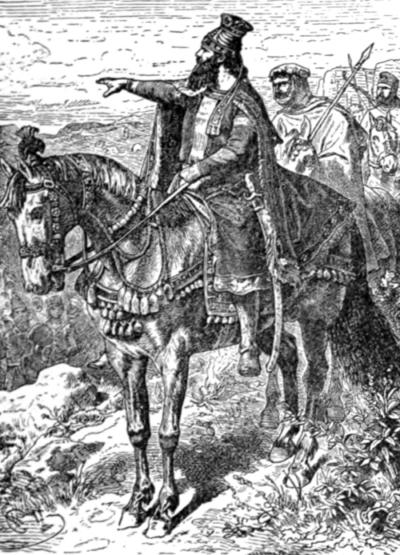
Cyrus the Great
Cyrus the Great was a founder of the Achaemenid Empire. Born 600 BC, in Anshan Persia. Died 530 BC, in Syr Darya. Positions held include Great King (-559–-530) and King of Kings (-559–-530).
Facts
24 facts · 0 confirmed by two sources · 4 cited · 18 from one source · 2 where the sources disagree
What’s different
- Born: we show 600 BC (Sources disagree). Wikipedia says 600
- Died: we show 530 BC (Sources disagree). Wikipedia says 530
Where this comes from
Papalocal keeps its own record. It started from these sources; what each one said is kept here as it was copied, so a change on their side never changes this page by itself. Tap one to read its version.
What Wikidata says · copied November 16, 2026 · revision 2568446432
- Described as
- founder of the Achaemenid Empire (559–529 BC)
- Other names
- King of Persia Kyros, Cyrus II the Elder, King Cyrus, King of Persia Cyrus II, Kabir Kurushi, King of Persia Siroe, King of Persia Cyrus, King of Persia Cyrus the Great, Cyrus II, King Cyrus the Great, Cyrus, Cyrus the Elder
- Born
- 600 BC
- Died
- 530 BC
- Born in
- Anshan Persia
- Died in
- Syr Darya · 1 reference
- Buried in
- Tomb of Cyrus the Great · 1 reference
- Citizen of
- Achaemenid Empire; Anshan Persia
- Occupation
- sovereign; military leader; founder; monarch
- Positions held
- Great King (-559–-530); King of Kings (-559–-530)
- Spouse
- Cassandane; Amytis; Neithiyti
- Children
- Cambyses II · 1 reference; Bardiya; Atossa; Roxane; Artystone
- Father
- Cambyses I · 1 reference
- Mother
- Mandane of Media
- Religion
- Mazdaism
- Wikipedias with a page
- 152
Wikidata item Q8423 (wikidata.org/wiki/Q8423), public domain (CC0). Copied November 16, 2026.
What Wikipedia says · copied November 16, 2026 · revision 1383695257
Cyrus II of Persia (c. 600 – 530 BC), commonly known as Cyrus the Great, was the founder of the Achaemenid Empire. Hailing from Persis, he brought the Achaemenid dynasty to power by defeating the Median Empire and embracing all of the previous civilized states of the ancient Near East, expanding vastly across most of West Asia and much of Central Asia to create what would soon become the largest empire in history at the time. The Achaemenid Empire's greatest territorial extent was achieved under Darius the Great, whose rule stretched from Southeast Europe and Northeast Africa in the west to the Indus Valley in the east.
After absorbing the Median Empire, Cyrus conquered Lydia and eventually the Neo-Babylonian Empire, granting him control of Anatolia and the Fertile Crescent, respectively. He also led a major expedition into Central Asia, where his army brought "into subjection every nation without exception" before he allegedly died in battle with the Massagetae, a nomadic Eastern Iranian people, along the Syr Darya in December 530 BC. However, according to Xenophon of Athens, Cyrus did not die fighting and had instead returned to the capital city of Pasargadae. He was succeeded by his son Cambyses II, whose campaigns led to the conquests of Egypt, Nubia, and Cyrenaica during his short reign.
To the Greeks, he was known as Cyrus the Elder and was particularly renowned among contemporary scholars because of his habitual policy of tolerance for peoples' customs and religions in the lands that he conquered. Similarly, he is exalted in Judaism for his role in freeing the Jewish people from the Babylonian captivity by issuing the Edict of Restoration following the Persian conquest of Babylon. This event is described in the Hebrew Bible as the return to Zion, whereby displaced Jews were repatriated to what had been the Kingdom of Judah, thus enabling the resurgence of Jewish sovereignty in the Land of Israel. Cyrus also facilitated Jewish aspirations for a new Temple in Jerusalem in the Achaemenid Empire's province of Yehud, where the original Solomon's Temple had once stood before being destroyed during the Babylonian siege of Jerusalem. His efforts resulted in the completion of the Second Temple, which marked the beginning of the Second Temple period and Second Temple Judaism. According to the Book of Isaiah, he was anointed by Yahweh and explicitly designated "messiah" for this task; Cyrus is the only non-Jewish figure to be revered in this capacity.
In addition to his influence on traditions in both the East and the West, Cyrus is recognized for his achievements in politics and military strategy. He was influential in developing the system of a central administration at his capital city to govern the Achaemenid Empire's satraps, who worked for the profit of both rulers and subjects. His realm's prestige in the ancient world would gradually reach as far west as Athens, where upper-class Greeks adopted aspects of the culture of the ruling Persian class as their own. Likewise, Cyrus's reign played a crucial role in defining the history of Iran for well over a millennium, as future Persian empires often viewed the Achaemenid era with deference and as the ideal example to emulate. His dynasty was also instrumental in allowing Zoroastrianism to develop and spread as far east as China. To this end, he remains a cult figure in modern Iran, with his Pasargadae tomb serving as a spot of reverence for millions of the country's citizens.
- Born, in its opening lines
- 600
- Died, in its opening lines
- 530
From the Wikipedia article “Cyrus the Great” (en.wikipedia.org/wiki/Cyrus_the_Great), by its contributors, under CC BY-SA 4.0 (creativecommons.org/licenses/by-sa/4.0/). Copied November 16, 2026; not changed.
Confirmed Two sources agree. Cited One source, and it names where it got it. One source One source, without a reference of its own. Sources disagree The sources disagree. We show the best-supported value and keep theirs below.
