
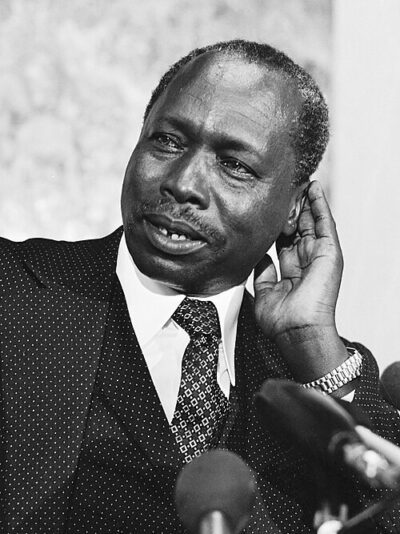
Daniel arap Moi
Daniel arap Moi was a Kenyan President (2nd). Born September 2, 1924, in Sacho. Died February 4, 2020, in Nairobi. Positions held include President of Kenya (1978–2002), chairperson of the Organisation of African Unity (1981–1983) and Vice-President of Kenya (1967–1978). Educated at Tambach Teachers Training College and Kapsabet High School. Awards include Order of the Golden Heart of Kenya.
Facts
21 facts · 2 confirmed by two sources · 5 cited · 14 from one source
Where this comes from
Papalocal keeps its own record. It started from these sources; what each one said is kept here as it was copied, so a change on their side never changes this page by itself. Tap one to read its version.
What Wikidata says · copied November 16, 2026 · revision 2568665760
- Described as
- Kenyan President (2nd) (1924-2020)
- Other names
- Daniel Torotich arap Moi, Daniel Toroitich arap Moi, Daniel Moi, Daniel Arap Moi
- Born
- September 2, 1924 · 4 references
- Died
- February 4, 2020 · 3 references
- Born in
- Sacho · 1 reference
- Died in
- Nairobi · 2 references
- Cause of death
- multiple organ dysfunction syndrome
- Citizen of
- Kenya · 1 reference
- Occupation
- politician · 1 reference; minister · 1 reference
- Positions held
- President of Kenya (1978–2002); chairperson of the Organisation of African Unity (1981–1983); Vice-President of Kenya (1967–1978); Member of the Legislative Council of Kenya (1963–2004); Secretary for the Interior (1964–1978)
- Political party
- Kenya African Democratic Union (1960–1964); Kenya African National Union (1964–)
- Education
- Tambach Teachers Training College; Kapsabet High School
- Awards
- Order of the Golden Heart of Kenya
- Spouse
- Lena Moi
- Children
- Gideon Moi
- Religion
- Christianity
- Wikipedias with a page
- 63
Wikidata item Q193492 (wikidata.org/wiki/Q193492), public domain (CC0). Copied November 16, 2026.
What Wikipedia says · copied November 16, 2026 · revision 1383606785
Daniel Toroitich arap Moi ( MOH-ee; 2 September 1924 – 4 February 2020) was a Kenyan politician who served as the second president of Kenya from 1978 to 2002. He is the country's longest-serving president to date. Moi previously served as the third vice president of Kenya from 1967 to 1978 under President Jomo Kenyatta, becoming the president following the latter's death.
Born into the Tugen sub-group of the Kalenjin people in the Kenyan Rift Valley, Moi studied as a boy at the Africa Inland Mission school before training as a teacher at the Tambach teachers training college, working in that profession until 1955. He then entered politics and was elected a member of the Legislative Council for Rift Valley. As independence approached, Moi joined the Kenyan delegation which travelled to London for the Lancaster House Conferences, where the country's first post-independence constitution was drafted. In 1960, he founded the Kenya African Democratic Union (KADU) as a rival party to Kenyatta's Kenya African National Union (KANU). Following independence in 1963, Kenyatta who became Prime Minister and later President of the new nation, convinced Moi to merge the two parties. Kenyatta appointed Moi to his government in 1964 and then promoted him to vice-president in 1967. Despite opposition from a Kikuyu elite known as the Kiambu Mafia, Kenyatta retained Moi as his vice president. Moi took over as president when Kenyatta died in 1978.
Initially popular both nationally and in Western countries, who saw his regime as countering against influences from the Eastern Bloc-aligned governments of Ethiopia and Tanzania, Moi's popularity fell around 1990 as the economy stagnated after the end of the Cold War. Following the agitation and external pressure, he was forced to allow multiparty elections in 1991. He then led his party, KANU, to victory in the 1992 and 1997 elections, both of which have generally been regarded as neither free nor fair by independent observers. Constitutionally barred from seeking a third term, Moi chose Uhuru Kenyatta as his successor, but Kenyatta was defeated by opposition leader Mwai Kibaki in the 2002 general election, and Kibaki succeeded Moi as president. Kenyatta would eventually win the presidency in the 2013 election.
Moi's regime was deemed dictatorial especially before 1992 when Kenya was a one-party state. Human rights organisations such as Amnesty International, as well as a special investigation by the United Nations, accused Moi of human rights abuses during his presidency. Inquiries held after the end of his presidency found evidence that Moi and his sons had engaged in significant levels of corruption, including the 1990s Goldenberg scandal.
- Born, in its opening lines
- September 2, 1924
- Died, in its opening lines
- February 4, 2020
From the Wikipedia article “Daniel arap Moi” (en.wikipedia.org/wiki/Daniel_arap_Moi), by its contributors, under CC BY-SA 4.0 (creativecommons.org/licenses/by-sa/4.0/). Copied November 16, 2026; not changed.
Confirmed Two sources agree. Cited One source, and it names where it got it. One source One source, without a reference of its own. Sources disagree The sources disagree. We show the best-supported value and keep theirs below.
