
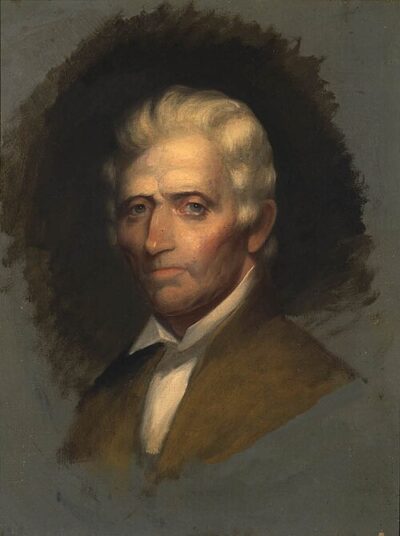
Daniel Boone
Daniel Boone was an American pioneer and frontiersman. Born November 2, 1734, in Oley Valley. Died September 26, 1820, in Daniel Boone Home. Positions held include member of the Virginia House of Delegates.
Facts
20 facts · 2 confirmed by two sources · 10 cited · 8 from one source
Where this comes from
Papalocal keeps its own record. It started from these sources; what each one said is kept here as it was copied, so a change on their side never changes this page by itself. Tap one to read its version.
What Wikidata says · copied November 13, 2026 · revision 2557849827
- Described as
- American pioneer and frontiersman (1734–1820)
- Born
- November 2, 1734 · 4 references
- Died
- September 26, 1820 · 7 references
- Born in
- Oley Valley
- Died in
- Daniel Boone Home
- Buried in
- Frankfort Cemetery
- Citizen of
- United States
- Occupation
- explorer; politician · 1 reference; hunter · 1 reference; traveler · 1 reference
- Positions held
- member of the Virginia House of Delegates · 1 reference
- Field
- resettlement of the Czech Borderlands · 1 reference
- Spouse
- Rebecca Boone
- Children
- Daniel Morgan Boone · 2 references; Susanna Hays · 1 reference; Jesse Boone; Jemima Boone Callaway · 1 reference
- Father
- Squire Boone · 1 reference
- Mother
- Sarah Morgan · 1 reference
- Siblings
- Squire Boone
- Wikipedias with a page
- 42
Wikidata item Q316661 (wikidata.org/wiki/Q316661), public domain (CC0). Copied November 13, 2026.
What Wikipedia says · copied November 13, 2026 · revision 1381305055
Daniel Boone (2 November [O.S. 22 October] 1734 – September 26, 1820) was an American pioneer and frontiersman whose adventures made him one of the first folk heroes of the United States. He became famous for his exploration and settlement of Kentucky, which was then beyond the western borders of the Thirteen Colonies. In 1775, under commission from Judge Richard Henderson's Transylvania Company, Boone blazed the Wilderness Road through the Cumberland Gap and into Kentucky in the face of resistance from nearby Native American tribes. He founded Boonesborough, one of the first English-speaking settlements west of the Appalachian Mountains. By the end of the 18th century, more than 200,000 people had entered Kentucky by following the route marked by Boone.
He served as a militia officer during the Revolutionary War (1775–1783), which in Kentucky was fought primarily between American settlers and British-allied Indians. In 1778, Boone was captured by the Shawnee and was, according to legend, adopted by the Shawnee Chief and given the name "Sheltowee", or Big Turtle. After months of living with the Shawnee, Boone escaped. He was elected to the first of his three terms in the Virginia General Assembly during the war and fought in the Battle of Blue Licks in 1782, one of the last battles of the American Revolution. He worked as a surveyor and merchant after the war, but went deep into debt as a Kentucky land speculator. He resettled in Missouri in 1799, where he spent most of the last two decades of his life, frustrated with legal problems resulting from his land claims.
Boone remains a legendary, if imperfectly remembered, figure in American history. He was celebrated in his own lifetime, especially after an account of his adventures was published in 1784, making him famous in America and Europe. After his death, he became the subject of many heroic tall tales and works of fiction. His adventures—real and mythical—helped create the archetypal frontier hero of American folklore. In American popular culture, Boone is remembered as one of the foremost early frontiersmen, even though mythology often overshadows the historical details of his life.
- Born, in its opening lines
- November 2, 1734
- Died, in its opening lines
- September 26, 1820
From the Wikipedia article “Daniel Boone” (en.wikipedia.org/wiki/Daniel_Boone), by its contributors, under CC BY-SA 4.0 (creativecommons.org/licenses/by-sa/4.0/). Copied November 13, 2026; not changed.
Confirmed Two sources agree. Cited One source, and it names where it got it. One source One source, without a reference of its own. Sources disagree The sources disagree. We show the best-supported value and keep theirs below.
