
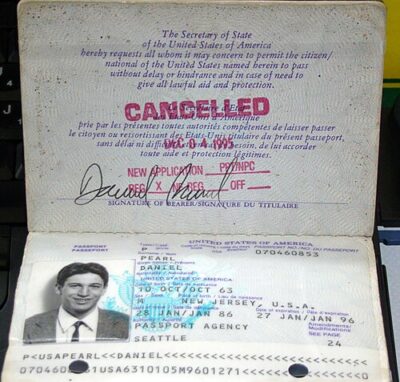
Daniel Pearl
Daniel Pearl was an American journalist. Born October 10, 1963, in Princeton. Died February 1, 2002, in Karachi. Educated at Stanford University. Awards include Elijah Parish Lovejoy Award, International Press Institute World Press Freedom Heroes and Edward R. Murrow Lifetime Achievement Award.
Facts
23 facts · 2 confirmed by two sources · 7 cited · 14 from one source
Where this comes from
Papalocal keeps its own record. It started from these sources; what each one said is kept here as it was copied, so a change on their side never changes this page by itself. Tap one to read its version.
What Wikidata says · copied November 15, 2026 · revision 2567175761
- Described as
- American journalist (1963–2002)
- Born
- October 10, 1963 · 2 references
- Died
- February 1, 2002
- Born in
- Princeton · 1 reference
- Died in
- Karachi · 1 reference
- Buried in
- Mount Sinai Memorial Park Cemetery
- Cause of death
- decapitation
- Citizen of
- United States; Israel
- Occupation
- reporter; writer; journalist · 1 reference
- Worked for
- The Wall Street Journal
- Education
- Stanford University
- Member of
- Phi Beta Kappa Society
- Awards
- Elijah Parish Lovejoy Award (2002) · 1 reference; International Press Institute World Press Freedom Heroes (2011); Edward R. Murrow Lifetime Achievement Award (2003) · 1 reference; Daniel Pearl Award (2002) · 1 reference; Weintal Prize for Diplomatic Reporting (2002) · 1 reference
- Spouse
- Mariane Pearl (1999–2002)
- Father
- Judea Pearl
- Mother
- Ruth Pearl · 1 reference
- Lived in
- Washington, D.C.
- Wikipedias with a page
- 35
Wikidata item Q357936 (wikidata.org/wiki/Q357936), public domain (CC0). Copied November 15, 2026.
What Wikipedia says · copied November 15, 2026 · revision 1383302794
Daniel Pearl (October 10, 1963 – February 1, 2002) was an American journalist who was kidnapped and beheaded by jihadist militants. On January 23, 2002, while on assignment for The Wall Street Journal, Pearl was kidnapped on his way to what he had expected would be an interview with Pakistani Islamic scholar Mubarak Ali Gilani in Karachi, Pakistan. Pearl had entered Pakistan to cover the war on terror, which was launched by the United States in response to the September 11 attacks in 2001. At the time of his abduction, he had been investigating the alleged links between British citizen Richard Reid (a.k.a. the "Shoe Bomber") and al-Qaeda; Reid had reportedly completed his training at a facility owned by Gilani, who had been accused by the United States of being affiliated with the Pakistani terrorist organization Jamaat ul-Fuqra.
A few days after his disappearance, Pearl's captors released a video in which he is recorded condemning American foreign policy and repeatedly telling the camera that he and his family are Jewish and have visited Israel, following which his throat is slit and his head severed from his body. Before killing Pearl, the captors had issued an ultimatum to the federal government of the United States, namely including the demands that all Pakistani terrorists be freed from American prisons and that the United States move forward with a halted shipment of F-16s for the Pakistani government.
Gilani refuted allegations of involvement with Jamaat ul-Fuqra and Pearl's killing. Ahmed Omar Saeed Sheikh, a British citizen of Pakistani origin, was arrested by Pakistani authorities and sentenced to death in July 2002 for the execution, but his conviction was overturned by a Pakistani court in 2020. Sheikh had previously been arrested by Indian authorities for his involvement in the 1994 kidnappings of western tourists in India, and is also an affiliate of Jaish-e-Mohammed and al-Qaeda, among other armed jihadist organizations.
- Born, in its opening lines
- October 10, 1963
- Died, in its opening lines
- February 1, 2002
From the Wikipedia article “Daniel Pearl” (en.wikipedia.org/wiki/Daniel_Pearl), by its contributors, under CC BY-SA 4.0 (creativecommons.org/licenses/by-sa/4.0/). Copied November 15, 2026; not changed.
Confirmed Two sources agree. Cited One source, and it names where it got it. One source One source, without a reference of its own. Sources disagree The sources disagree. We show the best-supported value and keep theirs below.
