
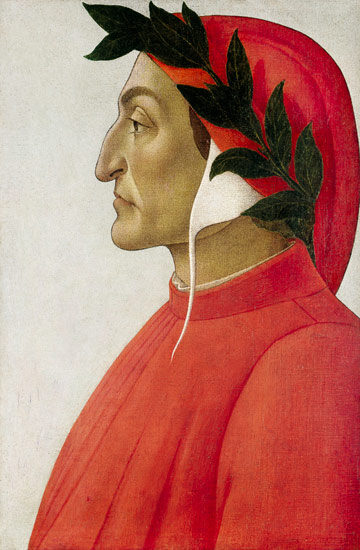
Dante Alighieri
Dante Alighieri was a Florentine poet, writer, and philosopher (c. 1265–1321). Born 1265, in Florence. Died September 14, 1321, in Ravenna. Known for The Divine Comedy, Convivio and De Monarchia.
Facts
48 facts · 2 confirmed by two sources · 31 cited · 15 from one source
Where this comes from
Papalocal keeps its own record. It started from these sources; what each one said is kept here as it was copied, so a change on their side never changes this page by itself. Tap one to read its version.
What Wikidata says · copied November 16, 2026 · revision 2565529467
- Described as
- Florentine poet, writer, and philosopher (c. 1265–1321)
- Other names
- Dante da Alaghiero degli Alaghieri, Durante di Alighiero degli Alighieri, Dante, Durante degli Alighieri
- Born
- 1265 · 3 references
- Died
- September 14, 1321 · 3 references
- Born in
- Florence · 4 references
- Died in
- Ravenna · 4 references
- Buried in
- Dante Alighieri's tomb (1781–1944); Quadrarco di Braccioforte (2 times) (1321–1945)
- Cause of death
- malaria
- Name at birth
- Dante da Alaghiero degli Alaghieri · 1 reference
- Citizen of
- Republic of Florence
- Occupation
- poet · 4 references; writer · 4 references; prose writer; politician · 1 reference; philosopher; political theorist; intellectual; linguist · 1 reference
- Member of
- Doctors and Apothecaries Guild; White Guelphs · 1 reference
- Genre
- long poem · 1 reference; treatise · 1 reference
- Known for
- The Divine Comedy · 1 reference; Convivio · 1 reference; De Monarchia · 1 reference; De vulgari eloquentia · 1 reference; Vita Nuova · 1 reference; Questio de situ et formae aque et terre · 1 reference; Le Rime · 1 reference; Epistles · 1 reference; Eclogues · 1 reference; L'oracion che fe Danti a la morte
- Field
- poetry · 1 reference; literature · 1 reference; linguistics · 1 reference; political philosophy · 1 reference
- Spouse
- Gemma Donati (1285–) · 1 reference
- Children
- Jacopo Alighieri · 1 reference; Pietro Alighieri · 1 reference; Antonia Alighieri · 1 reference
- Father
- Alighiero di Bellincione
- Mother
- Bella degli Abati
- Siblings
- Francesco Alighieri · 1 reference
- Religion
- Catholicism · 1 reference
- Lived in
- Florence · 1 reference; Rome · 1 reference; Ravenna (1318–) · 2 references; Bologna (1286–) · 2 references; Verona (1313–1318) · 2 references
- Wikipedias with a page
- 272
Wikidata item Q1067 (wikidata.org/wiki/Q1067), public domain (CC0). Copied November 16, 2026.
What Wikipedia says · copied November 16, 2026 · revision 1385562754
Dante Alighieri (Italian: [ˈdante aliˈɡjɛːri]; most likely baptized Durante di Alighiero degli Alighieri; c. May 1265 – September 14, 1321), widely known mononymously as Dante, was an Italian poet, writer, and philosopher. His Divine Comedy, originally called Comedìa (modern Italian: Commedia) and later christened Divina by Giovanni Boccaccio, is widely considered one of the most important poems of the Middle Ages and the greatest literary work in the Italian language.
At a time when Latin was still the dominant language for scholarly and literary writing—and when many Italian poets drew inspiration from French or Provençal traditions—Dante broke with both by writing in the vernacular, specifically his native Tuscan dialect. His De vulgari eloquentia (On Eloquence in the Vernacular) was one of the first scholarly defenses of the vernacular as well as a watershed study of the troubadour tradition and its craft of rhyme. His use of the Florentine dialect for works such as The New Life (1295) and Divine Comedy helped establish the modern-day standardized Italian language. His work set a precedent that important Italian writers such as Petrarch and Boccaccio would later follow.
Dante was instrumental in establishing the literature of Italy, and is considered to be among the country's national poets and the Western world's greatest literary icons. His depictions of Hell, Purgatory, and Heaven provided inspiration for the larger body of Western art and literature. He influenced English writers such as Geoffrey Chaucer, John Milton, and Alfred Tennyson, among many others. In addition, the first use of the interlocking three-line rhyme scheme, or the terza rima, is attributed to him. He is described as the "father" of the Italian language, and in Italy he is often referred to as il Sommo Poeta ("the Supreme Poet"). Dante, Petrarch, and Boccaccio are also called the tre corone ("three crowns") of Italian literature.
- Born, in its opening lines
- May 1265
- Died, in its opening lines
- September 14, 1321
From the Wikipedia article “Dante Alighieri” (en.wikipedia.org/wiki/Dante_Alighieri), by its contributors, under CC BY-SA 4.0 (creativecommons.org/licenses/by-sa/4.0/). Copied November 16, 2026; not changed.
Confirmed Two sources agree. Cited One source, and it names where it got it. One source One source, without a reference of its own. Sources disagree The sources disagree. We show the best-supported value and keep theirs below.
