
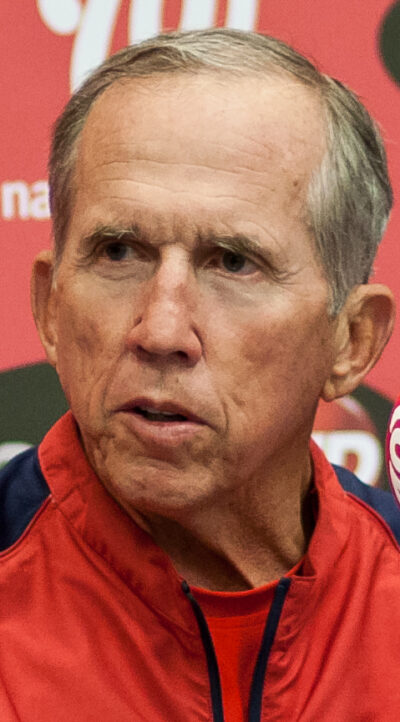
Davey Johnson
Davey Johnson was an American baseball player and manager. Born January 30, 1943, in Orlando. Died September 5, 2025, in Sarasota. Teams include Texas A&M Aggies baseball, Rochester Red Wings and Baltimore Orioles (1965–1972). Educated at Alamo Heights High School and Winter Park High School. Awards include Rawlings Gold Glove Award.
Facts
24 facts · 2 confirmed by two sources · 8 cited · 14 from one source
Where this comes from
Papalocal keeps its own record. It started from these sources; what each one said is kept here as it was copied, so a change on their side never changes this page by itself. Tap one to read its version.
What Wikidata says · copied November 19, 2026 · revision 2534445220
- Described as
- American baseball player and manager (1943–2025)
- Other names
- David Allen Johnson, David A. Johnson, David Allen "Davey" Johnson, Davey Jonhson, Davie Johnson, Dave Johonson, David Johnson
- Born
- January 30, 1943 · 1 reference
- Died
- September 5, 2025 · 2 references
- Born in
- Orlando
- Died in
- Sarasota · 1 reference
- Citizen of
- United States
- Occupation
- baseball player · 1 reference; baseball manager · 2 references; basketball player
- Education
- Alamo Heights High School · 1 reference; Winter Park High School · 1 reference; Texas A&M University · 1 reference; Johns Hopkins University
- Teams
- Texas A&M Aggies baseball · 1 reference; Rochester Red Wings; Baltimore Orioles (1965–1972); Atlanta Braves (1973–1975); Yomiuri Giants (1975–1976); Philadelphia Phillies (1977–1978); Chicago Cubs (1978); Texas A&M Aggies men's basketball (1961–1962) · 1 reference
- Sport
- baseball · 1 reference; basketball · 1 reference
- Awards
- Rawlings Gold Glove Award
- Height
- 1.85 m (6 ft 1 in) · 1 reference
- Wikipedias with a page
- 11
Wikidata item Q1038597 (wikidata.org/wiki/Q1038597), public domain (CC0). Copied November 19, 2026.
What Wikipedia says · copied November 19, 2026 · revision 1383018177
David Allen Johnson (January 30, 1943 – September 5, 2025) was an American professional baseball player and manager. He played as a second baseman from 1965 through 1978, most notably in Major League Baseball (MLB) as a member of the Baltimore Orioles dynasty which won four American League pennants and two World Series championships between 1966 and 1971. Johnson played in MLB from 1965 to 1975, then played for two seasons in Nippon Professional Baseball (NPB) before returning to play in MLB with the Philadelphia Phillies and Chicago Cubs from 1977 to 1978. A three-time Rawlings Gold Glove Award winner, he was selected to four All-Star Game teams during his playing career.
A mathematics major at Trinity University in San Antonio, Texas, Johnson was among the first Major League managers to apply computer-based statistical analysis to decision-making, an approach which later became known as sabermetrics.
After retiring as a player, Johnson became a successful manager. He led the New York Mets to the 1986 World Series title, and to an additional National League East title in 1988. He won the American League's Manager of the Year Award in 1997, when he led the Baltimore Orioles wire-to-wire to the American League East division championship. He won the same award in the National League in 2012, when he led the Washington Nationals to the franchise's first division title since they moved to Washington, D.C., and its first overall since 1981. Johnson managed teams to their respective League Championship Series in three consecutive years – the Cincinnati Reds in 1995 and the Orioles in both 1996 and 1997. He also briefly managed the Los Angeles Dodgers. He led the United States national team at the 2009 World Baseball Classic, earning fourth place.
- Born, in its opening lines
- January 30, 1943
- Died, in its opening lines
- September 5, 2025
From the Wikipedia article “Davey Johnson” (en.wikipedia.org/wiki/Davey_Johnson), by its contributors, under CC BY-SA 4.0 (creativecommons.org/licenses/by-sa/4.0/). Copied November 19, 2026; not changed.
Confirmed Two sources agree. Cited One source, and it names where it got it. One source One source, without a reference of its own. Sources disagree The sources disagree. We show the best-supported value and keep theirs below.
