
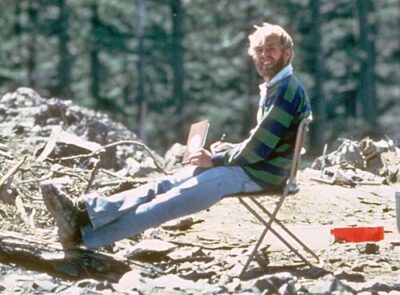
David A. Johnston
David A. Johnston was an American volcanologist. Born December 18, 1949, in Chicago. Died May 18, 1980, in Mount St. Helens. Educated at University of Illinois Urbana-Champaign and University of Washington.
Facts
11 facts · 2 confirmed by two sources · 3 cited · 6 from one source
Where this comes from
Papalocal keeps its own record. It started from these sources; what each one said is kept here as it was copied, so a change on their side never changes this page by itself. Tap one to read its version.
What Wikidata says · copied November 18, 2026 · revision 2567277701
- Described as
- American volcanologist (1949–1980)
- Other names
- David Alexander Johnston
- Born
- December 18, 1949 · 1 reference
- Died
- May 18, 1980 · 1 reference
- Born in
- Chicago · 1 reference
- Died in
- Mount St. Helens · 1 reference
- Cause of death
- 1980 eruption of Mount St. Helens
- Citizen of
- United States
- Occupation
- geologist; volcanologist · 1 reference
- Worked for
- United States Geological Survey
- Education
- University of Illinois Urbana-Champaign; University of Washington
- Wikipedias with a page
- 18
Wikidata item Q1173509 (wikidata.org/wiki/Q1173509), public domain (CC0). Copied November 18, 2026.
What Wikipedia says · copied November 18, 2026 · revision 1384286635
David Alexander Johnston (December 18, 1949 – May 18, 1980) was an American United States Geological Survey (USGS) volcanologist who was killed by the 1980 eruption of Mount St. Helens in the U.S. state of Washington. A principal scientist on the USGS monitoring team, Johnston was killed in the eruption while manning an observation post six miles (10 km) away on the morning of May 18, 1980. He was the first to report the eruption, transmitting "Vancouver! Vancouver! This is it!" before he was swept away by a lateral blast; despite a thorough search, Johnston's body was never found, but state highway workers discovered remnants of his USGS trailer in 1993.
Johnston's career took him across the United States, where he studied the Augustine Volcano in Alaska, the San Juan volcanic field in Colorado, and long-extinct volcanoes in Michigan. Johnston was a meticulous and talented scientist, known for his analyses of volcanic gases and their relationship to eruptions. This, along with his enthusiasm and positive attitude, made him liked and respected by many co-workers. After his death, other scientists lauded his character, both verbally and in dedications and letters. Johnston felt scientists must do what is necessary, including taking risks, to help protect the public from natural disasters. His work, and that of fellow USGS scientists, convinced authorities to close Mount St. Helens to the public before the 1980 eruption. They maintained the closure despite heavy pressure to re-open the area. His story became intertwined with the popular image of volcanic eruptions and their threat to society, and a part of volcanology's history. To date, Johnston is one of two American volcanologists known to have died in a volcanic eruption; the other is his student Harry Glicken.
Following his death, Johnston was commemorated in several ways, including a memorial fund established in his name at the University of Washington to fund graduate-level research. Two volcano observatories were established and named after him: one in Vancouver, Washington, and another on the ridge where he died. Johnston's life and death are featured in several documentaries, films, docudramas and books. A biography of his life, A Hero on Mount St. Helens: The Life and Legacy of David A. Johnston, was published in 2019.
- Born, in its opening lines
- December 18, 1949
- Died, in its opening lines
- May 18, 1980
From the Wikipedia article “David A. Johnston” (en.wikipedia.org/wiki/David_A._Johnston), by its contributors, under CC BY-SA 4.0 (creativecommons.org/licenses/by-sa/4.0/). Copied November 18, 2026; not changed.
Confirmed Two sources agree. Cited One source, and it names where it got it. One source One source, without a reference of its own. Sources disagree The sources disagree. We show the best-supported value and keep theirs below.
