
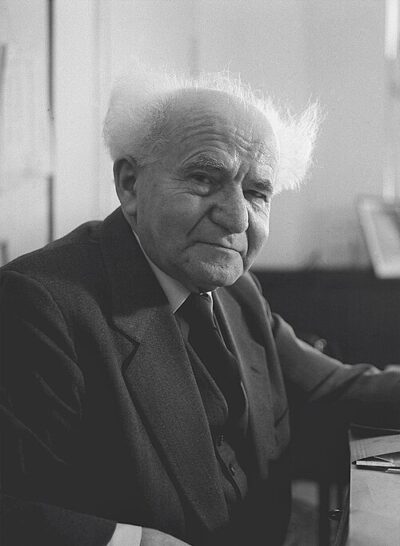
David Ben-Gurion
David Ben-Gurion was an Israeli politician, Zionist leader, prime minister of Israel (1948–1953, 1955–1963) - (born1886–1973). Born October 16, 1886, in Płońsk. Died December 1, 1973, in Ramat Gan. Positions held include Prime Minister of Israel (1948–1963), Minister of Defense of Israel (1948–1963) and Knesset member (1949–1970). Known for Declaration of the Establishment of the State of Israel. Educated at Istanbul University Faculty of Law and University of Warsaw. Awards include Bialik Prize, honorary doctor of Tel Aviv University and honorary citizen of Jerusalem.

Facts
43 facts · 2 confirmed by two sources · 9 cited · 31 from one source · 1 where the sources disagree
What’s different
- Died in: we show Ramat Gan (Sources disagree). Wikidata also lists Jaffa
Where this comes from
Papalocal keeps its own record. It started from these sources; what each one said is kept here as it was copied, so a change on their side never changes this page by itself. Tap one to read its version.
What Wikidata says · copied November 16, 2026 · revision 2567720057
- Described as
- Israeli politician, Zionist leader, prime minister of Israel (1948–1953, 1955–1963) - (born1886–1973)
- Other names
- David Grün, David Ben Gurion, Ben-Gurion
- Born
- October 16, 1886 · 8 references
- Died
- December 1, 1973 · 7 references
- Born in
- Płońsk · 1 reference
- Died in
- Ramat Gan · 1 reference; Jaffa · 1 reference
- Buried in
- Midreshet Ben-Gurion
- Cause of death
- stroke
- Name at birth
- Dawid Józef Grün
- Citizen of
- Russian Empire; Ottoman Empire; Mandatory Palestine; Israel · 1 reference
- Occupation
- politician · 2 references; trade unionist; Zionist · 1 reference
- Positions held
- Prime Minister of Israel (1948–1963); Minister of Defense of Israel (1948–1963) · 1 reference; Knesset member (1949–1970) · 1 reference; general secretary (1921–1973); Education Minister of Israel (1951); Justice Minister of Israel (1956–1958); Minister of Transport and Road Safety (1952); President of the Provisional State Council (1948)
- Political party
- Mapai (1930–1965); Rafi (1965–1968); National List (1969–1973); Workers of Zion (1905–1919)
- Education
- Istanbul University Faculty of Law; University of Warsaw · 1 reference; Istanbul University
- Member of
- Histadrut; Jewish National Council
- Known for
- Declaration of the Establishment of the State of Israel
- Awards
- Bialik Prize (1971); honorary doctor of Tel Aviv University; honorary citizen of Jerusalem
- Field
- politics · 1 reference; Zionism · 1 reference
- Spouse
- Paula Ben-Gurion (1917–1968)
- Children
- Amos Ben-Gurion; Renana Leshem; Geula Ben-Eliezer
- Father
- Avigdor Ben Gurion
- Religion
- Judaism
- Wikipedias with a page
- 134
Wikidata item Q37610 (wikidata.org/wiki/Q37610), public domain (CC0). Copied November 16, 2026.
What Wikipedia says · copied November 16, 2026 · revision 1383604115
David Ben-Gurion ( ben GOOR-ee-ən; Hebrew: דָּוִד בֶּן־גּוּרִיּוֹן [daˈvid ben ɡuʁˈjon] ; born David Grün; 16 October 1886 – 1 December 1973) was the primary national founder and first prime minister of the State of Israel. As head of the Jewish Agency from 1935, and later president of the Jewish Agency Executive, he was the de facto leader of the Jewish community in Palestine, and largely led the movement for an independent Jewish state in Mandatory Palestine.
Born in Płońsk, then part of Congress Poland, to Polish Jewish parents, he immigrated to the Palestine region of the Ottoman Empire in 1906. Adopting the name of Ben-Gurion in 1909, he rose to become the preeminent leader of the Jewish community in British-ruled Mandatory Palestine from 1935 until the establishment of the State of Israel in 1948, which he led until 1963 with a short break in 1954–55. Ben-Gurion's interest for Zionism developed early in his life, leading him to become a major Zionist leader, and the executive head of the World Zionist Organization in 1946.
On 14 May 1948, he formally proclaimed the establishment of Israel, and was the first to sign the Israeli Declaration of Independence, which he had helped to write. Under Ben-Gurion's leadership, the 1948 Arab–Israeli War saw the uniting of the various Jewish militias into the Israel Defense Forces (IDF), the victory of Israel over the Arab League, and the expulsion and flight of a majority of the Palestinian Arab population. Subsequently, he became known as "Israel's founding father". Following the war, Ben-Gurion served as Israel's first prime minister and minister of defence. As prime minister, he helped build state institutions, presiding over national projects aimed at the development of the country. He also oversaw the absorption of Jewish immigrants. A major part of his foreign policy was improving relations with West Germany through a reparations agreement in compensation for Nazi confiscation of Jewish property during the Holocaust.
In 1954, he resigned as prime minister and minister of defence but remained a member of the Knesset. He returned as minister of defence in 1955 after the Lavon Affair and the resignation of Pinhas Lavon. Later that year he became prime minister again, following the 1955 elections. He backed Israel's reprisal operations to Arab guerrilla attacks and its invasion of Egypt, along with Britain and France, during the Suez Crisis in 1956. He stepped down from office in 1963, and retired from political life in 1970. He then moved to his modest "hut" in Sde Boker, a kibbutz in the Negev desert, where he lived until his death. Posthumously, Ben-Gurion was named one of Time magazine's 100 Most Important People of the 20th century.
- Born, in its opening lines
- October 16, 1886
- Died, in its opening lines
- December 1, 1973
From the Wikipedia article “David Ben-Gurion” (en.wikipedia.org/wiki/David_Ben-Gurion), by its contributors, under CC BY-SA 4.0 (creativecommons.org/licenses/by-sa/4.0/). Copied November 16, 2026; not changed.
Confirmed Two sources agree. Cited One source, and it names where it got it. One source One source, without a reference of its own. Sources disagree The sources disagree. We show the best-supported value and keep theirs below.
