
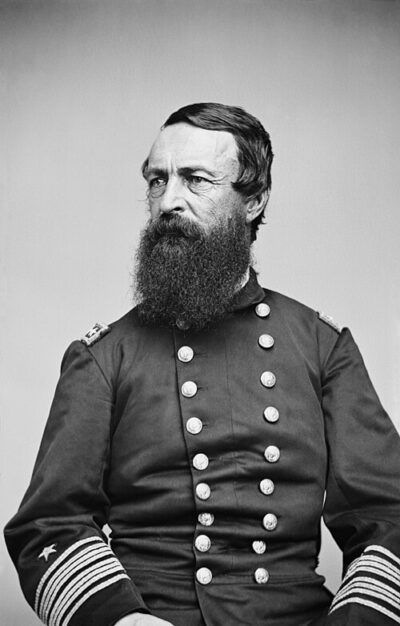
David Dixon Porter
David Dixon Porter was an United States Navy admiral. Born June 8, 1813, in Chester. Died February 13, 1891, in Washington, D.C..
Facts
17 facts · 2 confirmed by two sources · 9 cited · 6 from one source
Where this comes from
Papalocal keeps its own record. It started from these sources; what each one said is kept here as it was copied, so a change on their side never changes this page by itself. Tap one to read its version.
What Wikidata says · copied November 18, 2026 · revision 2532929329
- Described as
- United States Navy admiral (1813-1891)
- Other names
- Adm. David Dixon Porter
- Born
- June 8, 1813 · 7 references
- Died
- February 13, 1891 · 7 references
- Born in
- Chester · 1 reference
- Died in
- Washington, D.C. · 1 reference
- Buried in
- Arlington National Cemetery · 1 reference
- Cause of death
- myocardial infarction
- Citizen of
- United States · 1 reference
- Occupation
- military officer; writer · 2 references
- Spouse
- George Ann Patterson · 1 reference
- Children
- Carlisle Patterson Porter · 1 reference
- Father
- David Porter · 2 references
- Mother
- Evelina Anderson Porter · 1 reference
- Siblings
- William D. Porter
- Military branch
- United States Navy; Union Navy
- Military rank
- admiral
- Wikipedias with a page
- 19
Wikidata item Q387130 (wikidata.org/wiki/Q387130), public domain (CC0). Copied November 18, 2026.
What Wikipedia says · copied November 18, 2026 · revision 1384678907
David Dixon Porter (June 8, 1813 – February 13, 1891) was a United States Navy admiral and a member of one of the most distinguished families in the history of the U.S. Navy. Promoted as the second U.S. Navy officer ever to attain the rank of admiral, after his adoptive brother David G. Farragut, Porter helped improve the Navy as the Superintendent of the U.S. Naval Academy after significant service in the American Civil War.
Porter began naval service as a midshipman at the age of 10 years under his father, Commodore David Porter, on the frigate USS John Adams. For the remainder of his life, he was associated with the sea. Porter served in the Mexican War in the attack on the fort at the City of Vera Cruz. At the outbreak of the Civil War, he was part of a plan to hold Fort Pickens, near Pensacola, Florida, for the Union; its execution disrupted the effort to relieve the garrison at Fort Sumter, leading to Sumter's fall. Porter commanded an independent flotilla of mortar boats at the capture of New Orleans. Later, he was advanced to the rank of (acting) rear admiral in command of the Mississippi River Squadron, which cooperated with the army under Major General Ulysses S. Grant in the Vicksburg Campaign. After the fall of Vicksburg, he led the naval forces in the difficult Red River Campaign in Louisiana. Late in 1864, Porter was transferred from the interior to the Atlantic coast, where he led the U.S. Navy in the joint assaults on Fort Fisher, the final significant naval action of the war.
Porter worked to raise the standards of the U.S. Navy in the position of Superintendent of the Naval Academy when it was restored to Annapolis. He initiated reforms in the curriculum to increase professionalism. In the early days of President Grant's administration, Porter was de facto Secretary of the Navy. When his adoptive brother David G. Farragut was advanced from rank of vice-admiral to admiral, Porter took his previous position; likewise, when Farragut died, Porter became the second man to hold the newly created rank of admiral. He gathered a corps of like-minded officers devoted to naval reform.
Porter's administration of the Navy Department aroused powerful opposition by some in Congress, who forced the Secretary of the Navy Adolph E. Borie to resign. His replacement, George Robeson, curtailed Porter's power and eased him into semi-retirement in 1875.
- Born, in its opening lines
- June 8, 1813
- Died, in its opening lines
- February 13, 1891
From the Wikipedia article “David Dixon Porter” (en.wikipedia.org/wiki/David_Dixon_Porter), by its contributors, under CC BY-SA 4.0 (creativecommons.org/licenses/by-sa/4.0/). Copied November 18, 2026; not changed.
Confirmed Two sources agree. Cited One source, and it names where it got it. One source One source, without a reference of its own. Sources disagree The sources disagree. We show the best-supported value and keep theirs below.
