
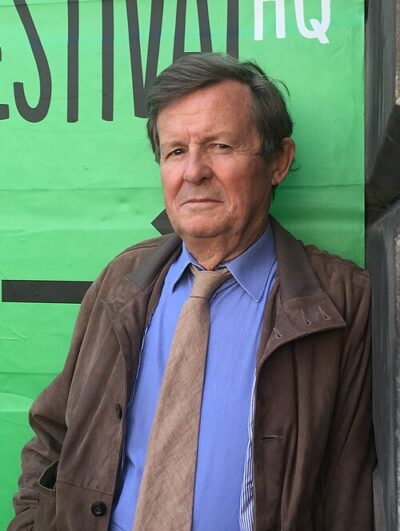
David Hare
David Hare is a British playwright, screenwriter and theatre and film director. Born June 5, 1947, in St Leonards. Educated at Jesus College and Lancing College. Awards include Evening Standard Theatre Awards, British Academy Film Awards and PEN Pinter Prize.
Facts
36 facts · 1 confirmed by two sources · 17 cited · 18 from one source
Where this comes from
Papalocal keeps its own record. It started from these sources; what each one said is kept here as it was copied, so a change on their side never changes this page by itself. Tap one to read its version.
What Wikidata says · copied November 18, 2026 · revision 2562721689
- Described as
- British playwright, screenwriter and theatre and film director (1947- )
- Other names
- Sir David Hare
- Born
- June 5, 1947 · 10 references
- Born in
- St Leonards · 4 references
- Citizen of
- United Kingdom
- Occupation
- playwright · 1 reference; screenwriter · 1 reference; film director; theatre director · 2 references; writer · 1 reference; actor · 2 references; television director · 1 reference; film producer · 2 references
- Education
- Jesus College; Lancing College
- Member of
- American Academy of Arts and Sciences; Royal Society of Literature
- Awards
- Evening Standard Theatre Awards (1995); British Academy Film Awards (1979); PEN Pinter Prize (2011); John Llewellyn Rhys Prize; Laurence Olivier Award for Best New Play (2 times) (1990, 1996); Golden Bear (1985); Drama Desk Award for Outstanding One-Person Show (1999); Writers Guild of America Award for Best Adapted Screenplay (2003); Fellow of the Royal Society of Literature (1985) · 1 reference; Fellow of the American Academy of Arts and Sciences; Knight Bachelor
- Field
- drama · 1 reference; film direction · 1 reference; directing · 1 reference; film screenwriting · 1 reference
- Spouse
- Nicole Farhi (1992–) · 1 reference; Margaret Matheson (1970–1980) · 1 reference
- Children
- Joe Hare · 1 reference; Darcy Hare · 1 reference; Lewis Hare · 1 reference
- Father
- C. T. R. Hare · 1 reference
- Wikipedias with a page
- 21
Wikidata item Q1174676 (wikidata.org/wiki/Q1174676), public domain (CC0). Copied November 18, 2026.
What Wikipedia says · copied November 18, 2026 · revision 1385822384
Sir David Hare (born 5 June 1947) is an English playwright, screenwriter, and director. Known for his work on stage and screen, he has received numerous accolades, including two Laurence Olivier Awards, a British Academy Television Award, and a Writers Guild of America Award, in addition to nominations for three Tony Awards, two Academy Awards, two British Academy Film Awards, and two Golden Globes.
In the West End, he had his greatest success with the plays Plenty (1978), which he adapted into a 1985 film starring Meryl Streep, Racing Demon (1990), Skylight (1997), and Amy's View (1998). The four plays ran on Broadway in 1982–83, 1996, 1998 and 1999 respectively, earning Hare three Tony Award nominations for Best Play for the first three and two Laurence Olivier Awards for Best New Play. His other notable projects on stage include A Map of the World, Pravda (starring Anthony Hopkins at the Royal National Theatre in London), Murmuring Judges, The Absence of War, The Vertical Hour, and Straight Line Crazy starring Ralph Fiennes.
Hare both wrote and directed the BBC's much acclaimed Worricker Trilogy of films — Page Eight (2011), Turks & Caicos (2014), and Salting the Battlefield (2014) — as well as scripting television series for the BBC, Collateral (2018) and Roadkill (2020). For writing Stephen Daldry dramas The Hours (2002) and The Reader (2008), he received Academy Award and BAFTA nominations for Best Adapted Screenplay, and won Writers Guild of America Award in the same category for the former. He has been associate director of the National Theatre since 1984.
- Born, in its opening lines
- June 5, 1947
From the Wikipedia article “David Hare (playwright)” (en.wikipedia.org/wiki/David_Hare_(playwright)), by its contributors, under CC BY-SA 4.0 (creativecommons.org/licenses/by-sa/4.0/). Copied November 18, 2026; not changed.
Confirmed Two sources agree. Cited One source, and it names where it got it. One source One source, without a reference of its own. Sources disagree The sources disagree. We show the best-supported value and keep theirs below.
