
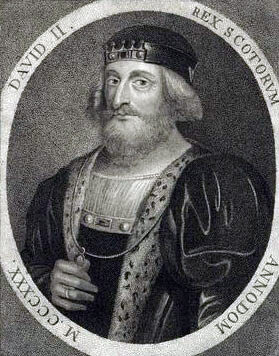
David II of Scotland
David II of Scotland was a King of Scotland from 1329 to 1371. Born March 5, 1324, in Dunfermline Palace. Died February 22, 1371, in Edinburgh Castle. Positions held include Monarch of Scotland (1329–1371).
Facts
15 facts · 2 confirmed by two sources · 4 cited · 9 from one source
Where this comes from
Papalocal keeps its own record. It started from these sources; what each one said is kept here as it was copied, so a change on their side never changes this page by itself. Tap one to read its version.
What Wikidata says · copied November 16, 2026 · revision 2569840988
- Described as
- King of Scotland from 1329 to 1371
- Other names
- David II Bruce, King of Scotland
- Born
- March 5, 1324 · 3 references
- Died
- February 22, 1371 · 3 references
- Born in
- Dunfermline Palace
- Died in
- Edinburgh Castle
- Buried in
- Holyrood Abbey
- Citizen of
- Kingdom of Scotland
- Occupation
- monarch
- Positions held
- Monarch of Scotland (1329–1371)
- Spouse
- Joan of The Tower (1328–) · 2 references; Margaret Drummond, Queen of Scotland · 1 reference
- Father
- Robert I of Scotland · 2 references
- Mother
- Elizabeth de Burgh · 2 references
- Siblings
- Marjorie Bruce; Margaret Bruce · 1 reference
- Religion
- Christianity
- Wikipedias with a page
- 59
Wikidata item Q239486 (wikidata.org/wiki/Q239486), public domain (CC0). Copied November 16, 2026.
What Wikipedia says · copied November 16, 2026 · revision 1364198138
David II (5 March 1324 – 22 February 1371) was King of Scotland from 1329 until his death in 1371. Upon the death of his father, Robert the Bruce, David succeeded to the throne at the age of five and was crowned at Scone in November 1331, becoming the first Scottish monarch to be anointed at his coronation. During his childhood, David was governed by a series of guardians, and Edward III of England sought to take advantage of David's minority by supporting an invasion of Scotland by Edward Balliol, beginning the Second War of Scottish Independence. Following the English victory at the Battle of Halidon Hill in 1333, King David, Queen Joan and the rump of his government were evacuated to France, where he remained in exile until it was safe for him to return to Scotland in 1341.
In 1346, David invaded England in support of France during the Hundred Years' War. His army was defeated at the Battle of Neville's Cross and he was captured and held as a prisoner in England for eleven years, while his nephew Robert Stewart governed Scotland. In 1357 the Treaty of Berwick brought the Second War of Independence to an end, the Scots agreed to pay a ransom of 100,000 merks, and David was allowed to return home. Heavy taxation was needed to pay for the ransom, which was to be paid in instalments, and David alienated his subjects by using the money for his own purposes. By 1363 it was found impossible to raise the remaining ransom, and David sought its cancellation by offering to bequeath the succession to the Scottish throne to Edward III or one of his sons. In 1364, the parliament of Scotland rejected David's proposal to make Lionel of Antwerp, Duke of Clarence, the next king. Despising his nephew, David sought to prevent him from succeeding to his throne by marrying his mistress Margaret Drummond and producing an alternative heir. When his second wife failed to do so, David unsuccessfully attempted to divorce her.
Although David spent long periods in exile or captivity, he managed to ensure the survival of his kingdom, reformed the machinery of government, and left the Scottish monarchy in a strong position. The last male of the House of Bruce, he died childless in 1371 after a reign of 41 years and was succeeded by his nephew Robert II.
- Born, in its opening lines
- March 5, 1324
- Died, in its opening lines
- February 22, 1371
From the Wikipedia article “David II of Scotland” (en.wikipedia.org/wiki/David_II_of_Scotland), by its contributors, under CC BY-SA 4.0 (creativecommons.org/licenses/by-sa/4.0/). Copied November 16, 2026; not changed.
Confirmed Two sources agree. Cited One source, and it names where it got it. One source One source, without a reference of its own. Sources disagree The sources disagree. We show the best-supported value and keep theirs below.
