
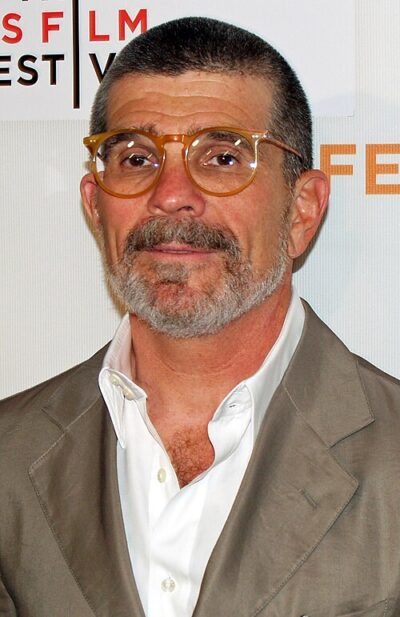
David Mamet
David Mamet is an American playwright, filmmaker and author. Born November 30, 1947, in Chicago. Known for Sexual Perversity in Chicago, American Buffalo and Glengarry Glen Ross. Educated at Goddard College and Neighborhood Playhouse School of the Theatre. Awards include Pulitzer Prize for Drama, Carl Sandburg Literary Award and Hull-Warriner Award.
Facts
30 facts · 1 confirmed by two sources · 9 cited · 20 from one source
Where this comes from
Papalocal keeps its own record. It started from these sources; what each one said is kept here as it was copied, so a change on their side never changes this page by itself. Tap one to read its version.
What Wikidata says · copied November 13, 2026 · revision 2566438056
- Described as
- American playwright, filmmaker and author (born 1947)
- Other names
- David Alan Mamet, David Alen Mamet
- Born
- November 30, 1947 · 9 references
- Born in
- Chicago · 2 references
- Citizen of
- United States
- Occupation
- screenwriter · 1 reference; film director · 1 reference; playwright · 1 reference; film producer; writer · 1 reference; actor · 2 references; novelist · 1 reference; poet · 1 reference
- Worked for
- Columbia University
- Education
- Goddard College; Neighborhood Playhouse School of the Theatre; Francis W. Parker School · 1 reference
- Member of
- American Academy of Arts and Letters; Writers Guild of America East
- Known for
- Sexual Perversity in Chicago; American Buffalo; Glengarry Glen Ross
- Awards
- Pulitzer Prize for Drama (1984) · 1 reference; Carl Sandburg Literary Award (2006) · 1 reference; Hull-Warriner Award; PEN/Laura Pels International Foundation for Theater Award; star on Playwrights' Sidewalk · 1 reference
- Spouse
- Lindsay Crouse (1977–1990); Rebecca Pidgeon (1991–)
- Children
- Zosia Mamet; Clara Mamet
- Religion
- Reform Judaism · 1 reference
- Wikipedias with a page
- 42
Wikidata item Q269927 (wikidata.org/wiki/Q269927), public domain (CC0). Copied November 13, 2026.
What Wikipedia says · copied November 13, 2026 · revision 1385150220
David Alan Mamet (; born November 30, 1947) is an American playwright, author, and filmmaker. He won a Pulitzer Prize and received Tony nominations for his plays Glengarry Glen Ross (1983) and Speed-the-Plow (1988). He first gained critical acclaim for a trio of 1970s off-Broadway plays: The Duck Variations, Sexual Perversity in Chicago, and American Buffalo. His plays, Race and The Penitent, respectively, opened on Broadway in 2009 and previewed off-Broadway in 2017.
Feature films that Mamet both wrote and directed include House of Games (1987), Homicide (1991), The Spanish Prisoner (1997), and his biggest commercial success, Heist (2001). His screenwriting credits include The Postman Always Rings Twice (1981), The Verdict (1982), The Untouchables (1987), Hoffa (1992), Wag the Dog (1997), and Hannibal (2001). Mamet himself wrote the screenplay for the 1992 adaptation of Glengarry Glen Ross, and wrote and directed the 1994 adaptation of his play Oleanna (1992). He created and produced the CBS series The Unit (2006–2009).
Mamet's books include: On Directing Film (1991), a commentary and dialogue about film-making; The Old Religion (1997), a novel about the lynching of Leo Frank; Five Cities of Refuge: Weekly Reflections on Genesis, Exodus, Leviticus, Numbers and Deuteronomy (2004), a Torah commentary with Rabbi Lawrence Kushner; The Wicked Son (2006), a study of Jewish self-hatred and antisemitism; Bambi vs. Godzilla, a commentary on the movie business; The Secret Knowledge: On the Dismantling of American Culture (2011), a commentary on cultural and political issues; Three War Stories (2013), a trio of novellas about the physical and psychological effects of war; and Everywhere an Oink Oink: An Embittered, Dyspeptic, and Accurate Report of Forty Years in Hollywood (2023), an autobiographical account of his experiences in Hollywood.
- Born, in its opening lines
- November 30, 1947
From the Wikipedia article “David Mamet” (en.wikipedia.org/wiki/David_Mamet), by its contributors, under CC BY-SA 4.0 (creativecommons.org/licenses/by-sa/4.0/). Copied November 13, 2026; not changed.
Confirmed Two sources agree. Cited One source, and it names where it got it. One source One source, without a reference of its own. Sources disagree The sources disagree. We show the best-supported value and keep theirs below.
