
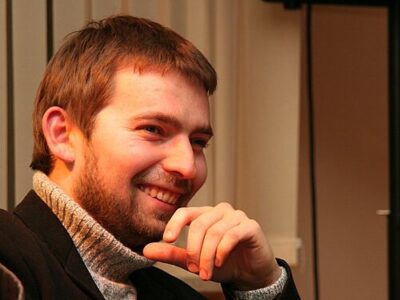
Dawid Jung
Dawid Jung is a Polish poet. Born January 17, 1980, in Kłecko. Awards include Polish Cultural Merit Order, Medal "Guardian of National Memorials" and Medal of the Centenary of Regained Independence.
Facts
14 facts · 0 confirmed by two sources · 4 cited · 10 from one source
Where this comes from
Papalocal keeps its own record. It started from these sources; what each one said is kept here as it was copied, so a change on their side never changes this page by itself. Tap one to read its version.
What Wikidata says · copied November 17, 2026 · revision 2567192209
- Described as
- Polish poet
- Born
- January 17, 1980
- Born in
- Kłecko · 2 references
- Citizen of
- Poland
- Occupation
- poet; literary critic · 1 reference; theatre critic · 1 reference; writer · 1 reference
- Member of
- Bydgoszcz Scientific Society; Stowarzyszenie Pisarzy Polskich · 1 reference; Stowarzyszenie Dziennikarzy Polskich · 1 reference
- Instrument
- voice
- Awards
- Polish Cultural Merit Order; Medal "Guardian of National Memorials" · 1 reference; Medal of the Centenary of Regained Independence · 1 reference
- Wikipedias with a page
- 27
Wikidata item Q150024 (wikidata.org/wiki/Q150024), public domain (CC0). Copied November 17, 2026.
What Wikipedia says · copied November 17, 2026 · revision 1370458644
Dawid Jung (born 1980) is a Polish opera singer, poet, writer, literary and theater critic, publisher, cultural researcher, historian, museum curator, director of the Museum of Polish Electronic Organs, and editor-in-chief of "Zeszyty Poetyckie".
Between 2003 and 2005, he conducted classes on contemporary poetics for students at Collegium Europaeum Gnesnense (Adam Mickiewicz University in Poznań), where he was a legal guardian for the Literary-Philosophical Section named after Władysław Nehring. From 2000 to 2006, he studied solo singing at the Feliks Nowowiejski Music Academy in Bydgoszcz under the guidance of Prof. Bożena Porzyńska, continuing his studies at the Academy of Music in Gdańsk from 2006 to 2008. He further pursued vocal arts in Vienna, performing roles including in Anton Ariensky's "Rafael," and in Rome, where he received a music scholarship.
In 2004, he initiated and re-established one of Gniezno's significant cultural events, the independent culture festival "Festa Fatuorum” (Feast of Fools).
In 2009, he was awarded the Juliusz Słowacki Medal for a fragment of "Poem of Speaking the Truth" by Marian Pankowski at the Ossolineum. He is coordinator of the academic symposium "Rzeczpospolita – mity a rzeczywistość. O poezji polskiej po 1989 roku" (Republic – myths and reality. On Polish poetry after 1989) at Adam Mickiewicz University in Poznań. He is also the chief editor of publishing series: Library of Contemporary Polish Poetry, Library of Old Polish Literature, and Historical Studies within "Zeszyty Poetyckie."
He is a member of the Bydgoszcz Scientific Society, the Association of Polish Journalists, the International Federation of Journalists, and the Stowarzyszenie Pisarzy Polskich.
He is the originator and founder of the Museum of Polish Electronic Organs, possessing the world's largest collection of Polish electronic keyboard instruments.
Since January 2023, he has served as the Vice President of the Stowarzyszenie Pisarzy Polskich in Poznań.
From the Wikipedia article “Dawid Jung” (en.wikipedia.org/wiki/Dawid_Jung), by its contributors, under CC BY-SA 4.0 (creativecommons.org/licenses/by-sa/4.0/). Copied November 17, 2026; not changed.
Confirmed Two sources agree. Cited One source, and it names where it got it. One source One source, without a reference of its own. Sources disagree The sources disagree. We show the best-supported value and keep theirs below.
