
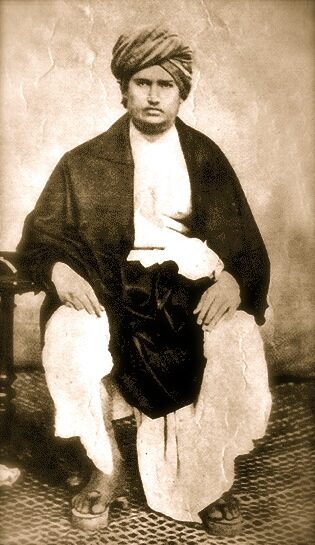
Dayananda Saraswati
Dayananda Saraswati was an Indian social reformer. Born February 12, 1824, in Tankara. Died October 30, 1883, in Ajmer. Known for Arya Samaj, Satyarth Prakash and Rigvedadi Bhashya Bhumika.
Facts
14 facts · 2 confirmed by two sources · 1 cited · 11 from one source
Where this comes from
Papalocal keeps its own record. It started from these sources; what each one said is kept here as it was copied, so a change on their side never changes this page by itself. Tap one to read its version.
What Wikidata says · copied November 16, 2026 · revision 2540583867
- Described as
- Indian social reformer (1824-1883)
- Other names
- Dayanand Saraswati, Dayanand, Swami Dayanand, Swami Dayanand Saraswati, Maharshi Dayanand Saraswati
- Born
- February 12, 1824 · 1 reference
- Died
- October 30, 1883 · 2 references
- Born in
- Tankara · 1 reference
- Died in
- Ajmer
- Name at birth
- मूल शंकर तिवारी
- Citizen of
- British Raj
- Occupation
- philosopher; autobiographer; priest · 1 reference; Swami · 1 reference
- Known for
- Arya Samaj; Satyarth Prakash; Rigvedadi Bhashya Bhumika
- Religion
- Hinduism
- Wikipedias with a page
- 52
Wikidata item Q224906 (wikidata.org/wiki/Q224906), public domain (CC0). Copied November 16, 2026.
What Wikipedia says · copied November 16, 2026 · revision 1383355665
Dayanand Saraswati () born Mool Shankar Tiwari (12 February 1824 – 30 October 1883), was a Hindu philosopher, social leader and founder of the Arya Samaj, a reform movement of Hinduism. His book Satyarth Prakash has remained one of the influential texts on the philosophy of the Vedas and clarifications of various ideas and duties of human beings. He was the first to give the call for Swaraj as "India for Indians" in 1876. The word swaraj in the modern political sense, however, does not appear in his written communications. Denouncing the idolatry and ritualistic worship, he worked towards reviving Vedic religion. Subsequently, the philosopher and President of India, Sarvepalli Radhakrishnan, addressed him one of the "makers of Modern India", as did Sri Aurobindo.
Those who were influenced by and followed Dayananda included Chaudhary Charan Singh, Madam Cama, Pandit Lekh Ram, Swami Shraddhanand, Shyamji Krishna Varma, Kishan Singh, Bhagat Singh, Vinayak Damodar Savarkar, Bhai Parmanand, Lala Hardayal, Madan Lal Dhingra, Ram Prasad Bismil, Mahadev Govind Ranade, Ashfaqullah Khan, Mahatma Hansraj, Lala Lajpat Rai, Yogmaya Neupane, Vallabhbhai Patel and others.
He was a sannyasi (ascetic) from childhood and a scholar. He believed in the infallible authority of the Vedas. Dayananda advocated the doctrines of karma and reincarnation. He emphasised the Vedic ideals of brahmacharya, including celibacy and devotion to God.
Among Dayananda's contributions were his opposition to untouchability, promotion of the equal rights for women, and commentary on the Vedas from Vedic Sanskrit in Sanskrit as well as in Hindi.
- Born, in its opening lines
- February 12, 1824
- Died, in its opening lines
- October 30, 1883
From the Wikipedia article “Dayananda Saraswati” (en.wikipedia.org/wiki/Dayananda_Saraswati), by its contributors, under CC BY-SA 4.0 (creativecommons.org/licenses/by-sa/4.0/). Copied November 16, 2026; not changed.
Confirmed Two sources agree. Cited One source, and it names where it got it. One source One source, without a reference of its own. Sources disagree The sources disagree. We show the best-supported value and keep theirs below.
