
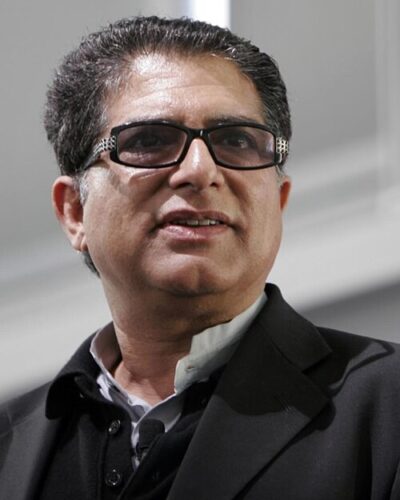
Deepak Chopra
Deepak Chopra is an Indian-born American author and alternative-medicine advocate, physician and public speaker. Born October 22, 1946, in New Delhi. Known for The Seven Spiritual Laws of Success and You Are the Universe: Discovering Your Cosmic Self and Why It Matters. Educated at All India Institutes of Medical Sciences. Awards include Canada India Foundation ("CIF") Chanchlani Global Indian Award, Ig Nobel Prize and Great Immigrants Award.
Facts
23 facts · 1 confirmed by two sources · 8 cited · 14 from one source
Where this comes from
Papalocal keeps its own record. It started from these sources; what each one said is kept here as it was copied, so a change on their side never changes this page by itself. Tap one to read its version.
What Wikidata says · copied November 16, 2026 · revision 2566054980
- Described as
- Indian-born American author and alternative-medicine advocate, physician and public speaker
- Born
- October 22, 1946 · 3 references
- Born in
- New Delhi
- Citizen of
- India
- Occupation
- motivational speaker · 1 reference; writer · 2 references; physician · 1 reference; internist · 2 references; Ayurveda practitioner; documentary participant; wellness guru; non-fiction writer · 1 reference
- Education
- All India Institutes of Medical Sciences
- Known for
- The Seven Spiritual Laws of Success; You Are the Universe: Discovering Your Cosmic Self and Why It Matters
- Awards
- Canada India Foundation ("CIF") Chanchlani Global Indian Award (2012); Ig Nobel Prize; Great Immigrants Award (2006) · 1 reference
- Field
- Ayurveda
- Children
- Mallika Chopra; Gotham Chopra · 1 reference
- Siblings
- Sanjiv Chopra · 1 reference
- Lived in
- La Jolla · 1 reference
- Website
- http://www.deepakchopra.com/
- Wikipedias with a page
- 47
Wikidata item Q318506 (wikidata.org/wiki/Q318506), public domain (CC0). Copied November 16, 2026.
What Wikipedia says · copied November 16, 2026 · revision 1381485204
Deepak Chopra (; Hindi: [diːpək tʃoːpɽa]; born October 22, 1946) is an American author, New Age guru, and alternative medicine advocate. A prominent figure in the New Age movement, his books and videos have made him one of the best-known and wealthiest figures in alternative medicine. In the 1990s, Chopra, a physician by education, became a popular proponent of a pseudoscientific approach to well-being that includes yoga, meditation, and nutrition, among other New Age therapies.
Chopra studied medicine in India before emigrating in 1970 to the United States, where he completed a residency in internal medicine and a fellowship in endocrinology. As a licensed physician, in 1980, he became chief of staff at the New England Memorial Hospital (NEMH). In 1985, he met Maharishi Mahesh Yogi and became involved in the Transcendental Meditation (TM) movement. Shortly thereafter, Chopra resigned from his position at NEMH to establish the Maharishi Ayurveda Health Center. In 1993, Chopra gained a following after he was interviewed about his books on The Oprah Winfrey Show. He then left the TM movement to become the executive director of Sharp HealthCare's Center for Mind-Body Medicine. In 1996, he cofounded the Chopra Center for Wellbeing.
Chopra claims that a person may attain "perfect health", a condition "that is free from disease, that never feels pain", and "that cannot age or die". Seeing the human body as undergirded by a "quantum mechanical body" composed not of matter but energy and information, he believes that "human aging is fluid and changeable; it can speed up, slow down, stop for a time, and even reverse itself", as determined by one's state of mind. He claims that his practices can also treat chronic disease.
The ideas Chopra promotes have regularly been criticized by medical and scientific professionals as pseudoscience. The criticism has been described as ranging "from the dismissive to...damning". Philosopher Robert Carroll writes that Chopra, to justify his teachings, attempts to integrate Ayurveda with quantum mechanics. Chopra says that what he calls "quantum healing" cures any manner of ailments, including cancer, through effects that he claims are literally based on the same principles as quantum mechanics. This has led physicists to object to his use of the term "quantum" in reference to medical conditions and the human body. His discussions of quantum healing have been characterized as technobabble – "incoherent babbling strewn with scientific terms" by those proficient in physics. Evolutionary biologist Richard Dawkins has said that Chopra uses "quantum jargon as plausible-sounding hocus pocus". Chopra's treatments generally elicit nothing but a placebo response, and they have drawn criticism that the unwarranted claims made for them may raise "false hope" and lure sick people away from legitimate medical treatments.
- Born, in its opening lines
- October 22, 1946
From the Wikipedia article “Deepak Chopra” (en.wikipedia.org/wiki/Deepak_Chopra), by its contributors, under CC BY-SA 4.0 (creativecommons.org/licenses/by-sa/4.0/). Copied November 16, 2026; not changed.
Confirmed Two sources agree. Cited One source, and it names where it got it. One source One source, without a reference of its own. Sources disagree The sources disagree. We show the best-supported value and keep theirs below.
