
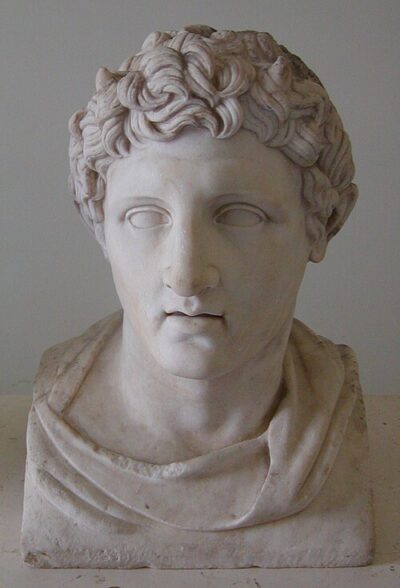
Demetrius I of Macedon
Demetrius I of Macedon was a king of Macedon. Born 337 BC. Died 283 BC, in Apamea. Positions held include king of Macedonia (-294–-288).
Facts
22 facts · 0 confirmed by two sources · 2 cited · 18 from one source · 2 where the sources disagree
What’s different
- Born: we show 337 BC (Sources disagree). Wikidata also lists 336 BC
- Died: we show 283 BC (Sources disagree). Wikipedia says 283
Where this comes from
Papalocal keeps its own record. It started from these sources; what each one said is kept here as it was copied, so a change on their side never changes this page by itself. Tap one to read its version.
What Wikidata says · copied November 16, 2026 · revision 2569087928
- Described as
- king of Macedon
- Other names
- Demetrius the Besieger, Demetrius Poliorcetes, Demetrios Poliorketes
- Born
- 336 BC · 1 reference; 337 BC · 2 references
- Died
- 283 BC · 2 references
- Died in
- Apamea
- Buried in
- Demetrias · 1 reference
- Citizen of
- Macedonia
- Occupation
- politician
- Positions held
- king of Macedonia (-294–-288)
- Spouse
- Ptolémaïs; Phila; Eurydice of Athens; Deidamia I of Epirus; Lanassa · 1 reference
- Children
- Demetrius the Fair; Antigonus II Gonatas · 1 reference; Stratonice of Syria; Demetrius; Alexander; Corragus; Phila
- Father
- Antigonus I Monophthalmus · 3 references
- Mother
- Stratonice
- Siblings
- Philip
- Wikipedias with a page
- 45
Wikidata item Q59734 (wikidata.org/wiki/Q59734), public domain (CC0). Copied November 16, 2026.
What Wikipedia says · copied November 16, 2026 · revision 1381321034
Demetrius I Poliorcetes (; Greek: Δημήτριος Πολιορκητής, Dēmḗtrios Poliorkētḗs, lit. 'the Besieger of Cities'; 337–283 BC) was a Macedonian Greek nobleman and military leader who became king of Asia between 306 and 301 BC, and king of Macedon between 294 and 288 BC. A member of the Antigonid dynasty, he was the son of its founder, Antigonus I Monophthalmus, and his wife Stratonice, as well as the first member of the family to rule Macedon in Hellenistic Greece.
In 307 BC, Demetrius successfully ousted Cassander's governor of Athens and after defeating Ptolemy I at the Battle of Salamis (306 BC) he gave his father the title of basileus ("king") over a land spanning from the Aegean Sea to the Middle East. He acquired the title Poliorcetes ("the besieger") after the unsuccessful siege of Rhodes in 305. While Antigonus I and Demetrius planned a revival of the Hellenic League with themselves as dual hegemons, a coalition of the diadochi; Cassander, Seleucus I, Ptolemy I, and Lysimachus defeated the two at the Battle of Ipsus in 301 BC, in which Antigonus I was killed and the Asian territory of his empire was lost. In 294, Demetrius managed to successfully seize control of Athens and establish himself as king of Macedon. He ruled until 288 when he was eventually driven out by Pyrrhus and Lysimachus and later surrendered to Seleucus I in Cilicia, dying there in 283. After a long period of instability, Demetrius's son, Antigonus II Gonatas, managed to solidify the dynasty in the kingdom and establish its hegemony over much of Hellenistic Greece.
Demetrius was particularly involved in innovations in poliorcetics, and although not all of his sieges were successful—such as the siege of Rhodes—he left his mark on the history of global siege warfare. This was notably through the extensive use of siege engines, the establishment of effective logistical procedures to support sieges on a much larger scale than previously, the widespread use of amphibious warfare, and finally the very quick pace of execution of his sieges. Demetrius also used his skills as a military architect to fortify cities with defensive architectural innovations, such as, notably, Athens, Sicyon and Corinth. He can be considered one of the main Epigoni, the heirs of the Diadochi.
- Born, in its opening lines
- 337
- Died, in its opening lines
- 283
From the Wikipedia article “Demetrius I Poliorcetes” (en.wikipedia.org/wiki/Demetrius_I_Poliorcetes), by its contributors, under CC BY-SA 4.0 (creativecommons.org/licenses/by-sa/4.0/). Copied November 16, 2026; not changed.
Confirmed Two sources agree. Cited One source, and it names where it got it. One source One source, without a reference of its own. Sources disagree The sources disagree. We show the best-supported value and keep theirs below.
