
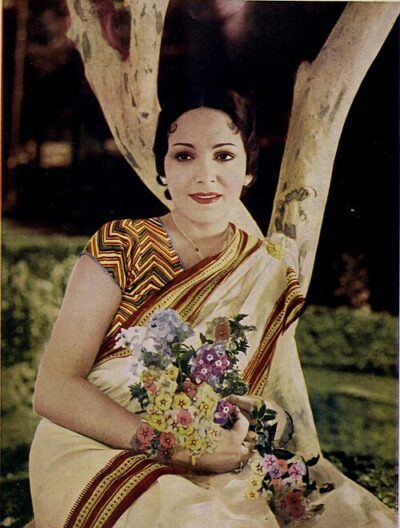
Devika Rani
Devika Rani was an Indian actress. Born March 30, 1908, in Visakhapatnam. Died March 9, 1994, in Bengaluru. Educated at Royal Academy of Music and Royal Academy of Dramatic Art. Awards include Padma Shri in Art and Dadasaheb Phalke Award.
Facts
19 facts · 2 confirmed by two sources · 7 cited · 10 from one source
Where this comes from
Papalocal keeps its own record. It started from these sources; what each one said is kept here as it was copied, so a change on their side never changes this page by itself. Tap one to read its version.
What Wikidata says · copied November 16, 2026 · revision 2568685735
- Described as
- Indian actress (1908-1994)
- Other names
- Devika Rani Chaudhuri, Devika Rani Chaudhari, Devika Rani Choudhuri
- Born
- March 30, 1908 · 2 references
- Died
- March 9, 1994 · 1 reference
- Born in
- Visakhapatnam · 1 reference
- Died in
- Bengaluru · 1 reference
- Citizen of
- British Raj (–1947); India (1950–); Dominion of India (1947–1950)
- Occupation
- film actor · 1 reference; actor; manufacturer · 1 reference
- Education
- Royal Academy of Music; Royal Academy of Dramatic Art; South Hampstead High School
- Awards
- Padma Shri in Art (1958); Dadasaheb Phalke Award (1970)
- Spouse
- Svetoslav Roerich (1945–1993) · 1 reference; Himanshu Rai (1929–1940) · 1 reference
- Father
- Manmathanath Chaudhuri · 1 reference
- Mother
- Leela Devi Chaudhuri · 1 reference
- Wikipedias with a page
- 40
Wikidata item Q465060 (wikidata.org/wiki/Q465060), public domain (CC0). Copied November 16, 2026.
What Wikipedia says · copied November 16, 2026 · revision 1383210603
Devika Rani Chaudhuri (Bengali pronunciation: [debika raɳi]; 30 March 1908 – 9 March 1994), known professionally as Devika Rani, was an Indian actress who worked in Hindi cinema. Widely acknowledged as the First Lady of Indian cinema, Devika Rani is regarded as one of the greatest actresses. She was the first recipient of the Dadasaheb Phalke Award and was awarded the Padma Shri. One of the highest-paid actress of the 1930s and early 1940s, she appeared in Box Office India's "Top Actresses" list in 1940 and 1941.
Born into a wealthy, anglicized Indian family, Devika Rani was sent to boarding school in England at age nine and grew up in that country. In 1928, she met Himanshu Rai, an Indian film-producer, and married him the following year. She assisted in costume design and art direction for Rai's experimental silent film A Throw of Dice (1929), which was directed by German-born director Franz Osten. The husband and wife then went to Germany and received training in film-making at UFA Studios in Berlin. Rai then cast himself as hero and her as heroine in his next production, the bilingual film Karma, made simultaneously in English and Hindi. The film premiered in England in 1933, elicited interest there for a prolonged kissing scene featuring the real-life couple, and flopped badly in India. The couple returned to Bombay, India in 1934, where Himanshu Rai established a production studio, Bombay Talkies, in partnership with certain other people. They changed their studio name. The studio produced several successful films over the next 5–6 years in that time of period, and Devika Rani played the lead role in many of them. Her on-screen pairing with Ashok Kumar became popular in India. But before Ashok Kumar was selected by Bombay Talkies, Devika Rani was embroiled in a passionate affair with Najmul Hussain, the hero of Javani Ki Hawa. She ran away with him and after frantic efforts by Himanshu Rai to get her back she reluctantly came back.
Following Rai's death in 1940, Devika Rani took control of the studio and produced some more films in partnership with her late husband's associates, namely Sashadhar Mukherjee and Ashok Kumar. As she was to recollect in her old age, the films which she supervised tended to flop or be more average hits, while the films supervised by the partners tended to be hits. In 1945, she retired from films, married the Russian painter Svetoslav Roerich and moved to his estate on the outskirts of Bangalore, thereafter leading a very reclusive life for the next five decades. Her persona, no less than her film roles, were considered socially unconventional. Her awards include the Padma Shri (1958), Dadasaheb Phalke Award (1969) and the Soviet Land Nehru Award (1990).
- Born, in its opening lines
- March 30, 1908
- Died, in its opening lines
- March 9, 1994
From the Wikipedia article “Devika Rani” (en.wikipedia.org/wiki/Devika_Rani), by its contributors, under CC BY-SA 4.0 (creativecommons.org/licenses/by-sa/4.0/). Copied November 16, 2026; not changed.
Confirmed Two sources agree. Cited One source, and it names where it got it. One source One source, without a reference of its own. Sources disagree The sources disagree. We show the best-supported value and keep theirs below.
