
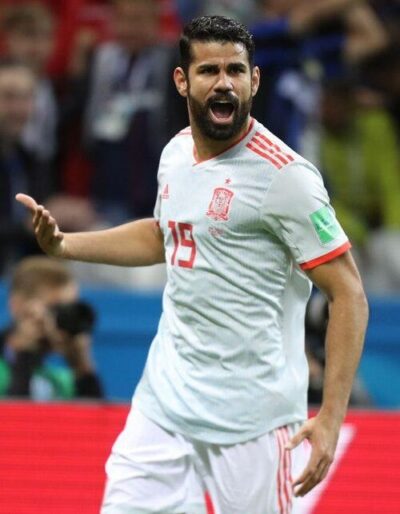
Diego Costa
Diego Costa is a Brazilian association football player. Born October 7, 1988, in Lagarto. Teams include RC Celta de Vigo (2007–2008), F.C. Penafiel (2006) and Albacete Balompié (2008–2009).
Facts
22 facts · 1 confirmed by two sources · 0 cited · 21 from one source
Where this comes from
Papalocal keeps its own record. It started from these sources; what each one said is kept here as it was copied, so a change on their side never changes this page by itself. Tap one to read its version.
What Wikidata says · copied November 16, 2026 · revision 2546170790
- Described as
- Brazilian association football player
- Other names
- Diego da Silva Costa
- Born
- October 7, 1988 · 2 references
- Born in
- Lagarto
- Name at birth
- Diego da Silva Costa
- Citizen of
- Brazil; Spain (2013–)
- Occupation
- association football player (–2026)
- Teams
- RC Celta de Vigo (2007–2008); F.C. Penafiel (2006); Albacete Balompié (2008–2009); Rayo Vallecano (2012); Real Valladolid (2009–2010); Atlético Madrid (2 times) (2007–2020); S.C. Braga (2006–2007); Chelsea F.C. (2014–2017); Brazil men's national football team (2013); Spain men's national football team (2014–2018); Clube Atlético Mineiro (2021); Wolverhampton Wanderers F.C. (2022–2023); Botafogo F.R. (2023–2024); Grêmio FBPA (2024)
- Sport
- association football
- Height
- 1.85 m (6 ft 1 in)
- Wikipedias with a page
- 73
Wikidata item Q459707 (wikidata.org/wiki/Q459707), public domain (CC0). Copied November 16, 2026.
What Wikipedia says · copied November 16, 2026 · revision 1384435724
Diego da Silva Costa (born 7 October 1988) is a former professional footballer who played as a striker. Born in Brazil, he played for the Spain national team.
Costa began his career in his native Brazil before joining Braga in Portugal in 2006, aged 17. He never played for the club but spent time on loan at Penafiel, and signed with La Liga club Atlético Madrid the following year. Over the next two seasons, he had loan periods with Braga, Celta Vigo, and Albacete. His form earned him a move to fellow La Liga club Real Valladolid in 2009, where he spent one season, finishing as their top goalscorer, before returning to Atlético Madrid. Costa struggled to maintain a regular starting role with Atlético, and spent more time on loan, this time at Rayo Vallecano, where he finished as the club's highest scorer that season.
In 2011, Costa returned to Atlético with a greater role. He blossomed as a goalscorer and helped the team win a La Liga title, a Copa del Rey title, and a UEFA Super Cup, as well as reaching the 2014 UEFA Champions League final. In 2014, he was signed by Premier League club Chelsea in a deal worth €35 million (£32 million). In London, Costa won three trophies, including two Premier League titles and a League Cup. In 2018, following a rift with head coach Antonio Conte, Costa returned to Atlético Madrid in a club record transfer worth an initial €56 million, he won a UEFA Europa League title and another UEFA Super Cup as well as a second La Liga title in 2021. He ended his career in Brazil's Campeonato Brasileiro Série A with Atlético Mineiro, Botafogo and Grêmio, as well as a brief return to England with Wolverhampton Wanderers. He won a double of league and Copa do Brasil for Atlético Mineiro in 2021, and was top scorer as Grêmio won the Campeonato Gaúcho in 2024.
Costa is a dual citizen of Brazil and Spain. He played twice for Brazil in 2013, before declaring his desire to represent Spain, having been granted Spanish citizenship in September that year. He made his debut for Spain in March 2014 and has since won 24 caps and scored 10 goals, and has represented them at the 2014 and 2018 FIFA World Cups.
Known for his fiery temperament, Costa has been criticised and punished for several confrontations with opponents.
- Born, in its opening lines
- October 7, 1988
From the Wikipedia article “Diego Costa” (en.wikipedia.org/wiki/Diego_Costa), by its contributors, under CC BY-SA 4.0 (creativecommons.org/licenses/by-sa/4.0/). Copied November 16, 2026; not changed.
Confirmed Two sources agree. Cited One source, and it names where it got it. One source One source, without a reference of its own. Sources disagree The sources disagree. We show the best-supported value and keep theirs below.
