
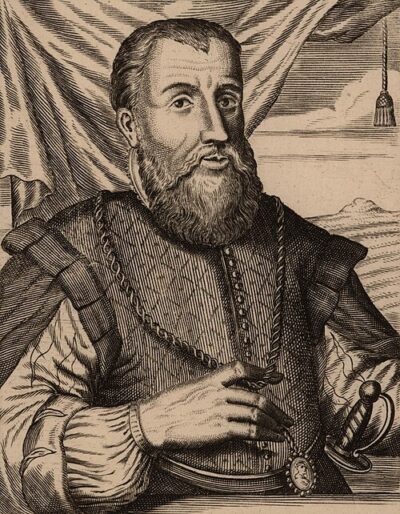
Diego Velazquez de Cuéllar
Diego Velazquez de Cuéllar was a Spanish military officer and first ruler of Cuba. Born 1465, in Cuéllar. Died June 12, 1524, in Santiago de Cuba. Positions held include Governor of Cuba.
Facts
12 facts · 0 confirmed by two sources · 0 cited · 12 from one source
Where this comes from
Papalocal keeps its own record. It started from these sources; what each one said is kept here as it was copied, so a change on their side never changes this page by itself. Tap one to read its version.
What Wikidata says · copied November 16, 2026 · revision 2560746933
- Described as
- Spanish military officer and first ruler of Cuba
- Other names
- Diego Velazquez de Cuellar, Diego Velázquez
- Born
- 1465
- Died
- June 12, 1524
- Born in
- Cuéllar
- Died in
- Santiago de Cuba
- Cause of death
- fever
- Citizen of
- Spain
- Occupation
- conquistador; military personnel
- Positions held
- Governor of Cuba
- Member of
- Columbus conquistador force
- Religion
- Catholicism
- Military rank
- general
- Wikipedias with a page
- 42
Wikidata item Q310566 (wikidata.org/wiki/Q310566), public domain (CC0). Copied November 16, 2026.
What Wikipedia says · copied November 16, 2026 · revision 1371948608
Diego Velázquez de Cuéllar (1465 – c. June 12, 1524) was a Spanish conquistador and adelantado who was first governor of Cuba. In 1511 he led the successful conquest and colonization of Cuba. As the first governor of the island, he established several municipalities that remain important to this day and positioned Cuba as a center of trade and a staging point for expeditions of conquest elsewhere. From Cuba, he chartered important expeditions that led to the Spanish discovery and conquest of the Aztec Empire.
From the Wikipedia article “Diego Velázquez de Cuéllar” (en.wikipedia.org/wiki/Diego_Velázquez_de_Cuéllar), by its contributors, under CC BY-SA 4.0 (creativecommons.org/licenses/by-sa/4.0/). Copied November 16, 2026; not changed.
Confirmed Two sources agree. Cited One source, and it names where it got it. One source One source, without a reference of its own. Sources disagree The sources disagree. We show the best-supported value and keep theirs below.
