
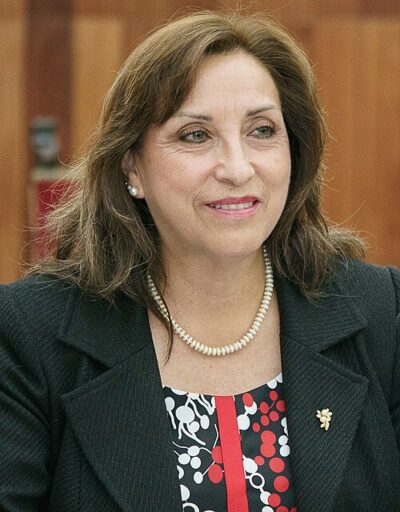
Dina Boluarte
Dina Boluarte is a Peruvian lawyer and politician, president of Peru from 2022 to 2025. Born May 31, 1962, in Chalhuanca. Positions held include Vice President of Peru (2021–2022), Minister of Development and Social Inclusion of Peru (2021–2022) and President of Peru (2022–2025). Educated at University of San Martín de Porres.
Facts
13 facts · 1 confirmed by two sources · 8 cited · 4 from one source
Where this comes from
Papalocal keeps its own record. It started from these sources; what each one said is kept here as it was copied, so a change on their side never changes this page by itself. Tap one to read its version.
What Wikidata says · copied November 16, 2026 · revision 2557361879
- Described as
- Peruvian lawyer and politician, president of Peru from 2022 to 2025
- Other names
- Dina Boluarte Zegarra, Dina Ercilia Boluarte Zegarra
- Born
- May 31, 1962 · 2 references
- Born in
- Chalhuanca · 1 reference
- Name at birth
- Dina Ercilia Boluarte Zegarra · 1 reference
- Citizen of
- Peru
- Occupation
- lawyer · 1 reference; politician · 1 reference; jurist · 1 reference
- Positions held
- Vice President of Peru (2021–2022); Minister of Development and Social Inclusion of Peru (2021–2022) · 2 references; President of Peru (2022–2025) · 1 reference
- Political party
- Free Peru (2018–2022) · 1 reference
- Worked for
- National Registry of Identification and Civil Status (2007–2022) · 2 references
- Education
- University of San Martín de Porres
- Wikipedias with a page
- 68
Wikidata item Q106474688 (wikidata.org/wiki/Q106474688), public domain (CC0). Copied November 16, 2026.
What Wikipedia says · copied November 16, 2026 · revision 1385439529
Dina Ercilia Boluarte Zegarra (born 31 May 1962) is a Peruvian politician, civil servant, and lawyer who served as the president of Peru from 7 December 2022 until she was removed from office on 10 October 2025. She had previously served as the first vice president and minister at the Ministry of Development and Social Inclusion under President Pedro Castillo. She served as an officer at the National Registry of Identification and Civil Status (RENIEC) from 2007 until 2022.
Boluarte is the first woman to become President of Peru. She was a member of Free Peru but never fully embraced the party's Marxism–Leninism, and was sworn in following Castillo's attempt to dissolve Congress and subsequent impeachment and arrest. Despite describing herself as a "progressive and moderate leftist", observers labeled Boluarte's administration as conservative, opportunistic, and illiberal. Boluarte aligned herself with the right-wing majority of the Peruvian Congress, and received support from the Peruvian Armed Forces. Boluarte's use of military and the police against protestors has been controversial.
During her first months as president, protests against her government emerged across Peru, during which authorities perpetrated the Ayacucho massacre and Juliaca massacre. Analysts said that Boluarte's crackdown on protestors has undermined democracy. Despite international concerns, Boluarte praised the actions of the armed forces. At the same time the protests occurred, she faced the impact of Cyclone Yaku, the dengue epidemic, the diplomatic conflict with various Latin American countries calling for Castillo’s reinstatement as president, the earthquake in Tumbes, and the migration crisis on the border with Chile.
During her administration, measures were promoted to stimulate economic recovery and unblock stalled infrastructure projects (such as Chavimochic III and Majes-Siguas I), and the San Martín Solar Power Plant and the Quebrada Huaycoloro Project were inaugurated. Social programs were created (such as “Ciclo Olímpico” and “Gratitud”) while others were restructured and social strategies were promoted (such as “Wasiymi”); the registration of FENATE (Pedro Castillo's union) was revoked; the so-called “Bicentennial Schools” were built, along with sanitation projects; the defense industry was modernized; the National Infrastructure Authority (ANIN) was created and infrastructure management was restructured;
The network of public pharmacies (FARMAMINSA) and MINSA Móvil were created; the New Social Housing Program (Nueva VIS) was launched, along with the “Centennial Hospitals,” “Mil,” and “Wolbachia” initiatives;
A neutral foreign policy was maintained although bilateral relations with the People’s Republic of China were strengthened and efforts were made to attract foreign investment; APEC 2024 was held (where she inaugurated the Port of Chancay alongside Xi Jinping);
Mental health was incorporated into the national education curriculum, and suicide prevention among students was promoted; the removal of teaching staff indicted or convicted of sexual abuse or terrorism was promoted; Peru’s claim to Santa Rosa Island was defended during the border incident with Colombia, and efforts were made to establish a Peruvian spaceport and implement railway development measures (such as the modernization of the Macho Train).
However, tensions arose with international organizations and NGOs (which she accused, using nationalist and sovereignty-based rhetoric, of pursuing a policy of interference), and crime—which had been on the rise since the previous administration—spired out of control. In response, she pushed for measures that were deemed insufficient and sparked protests against her. At the same time, scandals emerged that implicated both her (such as the “Rolex” case) and her inner circle (including her brother). In the face of these scandals, President Boluarte has been evasive with the press and has accused the “powers that be”—referred to as the “caviares”—of engaging in judicial and media activism and politicizing the justice system through “lawfare,” in addition to employing rhetoric that has been described as demagogic.
She became chronically unpopular, with a historic low of 2% approval as of March 2025. As such, she was labeled "the world's least popular leader" and the "most unpopular leader in the world". On 10 October 2025, Boluarte was impeached and removed from office by the Peruvian Congress in a 122–0 vote amidst a security crisis and renewed civil unrest against her rule. She was succeeded as President of Peru by José Jerí, the president of Congress.
- Born, in its opening lines
- May 31, 1962
From the Wikipedia article “Dina Boluarte” (en.wikipedia.org/wiki/Dina_Boluarte), by its contributors, under CC BY-SA 4.0 (creativecommons.org/licenses/by-sa/4.0/). Copied November 16, 2026; not changed.
Confirmed Two sources agree. Cited One source, and it names where it got it. One source One source, without a reference of its own. Sources disagree The sources disagree. We show the best-supported value and keep theirs below.
