
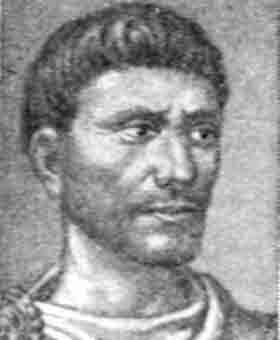
Diophantus of Alexandria
Diophantus of Alexandria was the 3rd century Alexandrian Greek mathematician. Born 200, in Alexandria. Died 284, in Alexandria. Known for Arithmetica.
Facts
9 facts · 0 confirmed by two sources · 3 cited · 6 from one source
Where this comes from
Papalocal keeps its own record. It started from these sources; what each one said is kept here as it was copied, so a change on their side never changes this page by itself. Tap one to read its version.
What Wikidata says · copied November 16, 2026 · revision 2567592141
- Described as
- 3rd century Alexandrian Greek mathematician
- Other names
- Diophantus
- Born
- 200 · 2 references
- Died
- 284 · 1 reference
- Born in
- Alexandria
- Died in
- Alexandria · 1 reference
- Name at birth
- Διόφαντος
- Citizen of
- Ancient Rome
- Occupation
- mathematician
- Known for
- Arithmetica
- Field
- number theory
- Wikipedias with a page
- 81
Wikidata item Q178217 (wikidata.org/wiki/Q178217), public domain (CC0). Copied November 16, 2026.
What Wikipedia says · copied November 16, 2026 · revision 1384220743
Diophantus of Alexandria (; Ancient Greek: Διόφαντος, romanized: Diophantos; fl. 250 CE) was a Greek mathematician who was the author of the Arithmetica in thirteen books, of which ten are extant, made up of arithmetical problems that are solved through algebraic equations.
Joseph-Louis Lagrange called Diophantus "the inventor of algebra"; his exposition became the standard within the Neoplatonic schools of Late antiquity, and its translation into Arabic in the 9th century AD and had influence in the development of later algebra: Diophantus' method of solution matches medieval Arabic algebra in its concepts and overall procedure. The 1621 edition of Arithmetica by Bachet gained fame after Pierre de Fermat wrote his famous "Last Theorem" in the margins of his copy.
In modern use, Diophantine equations are algebraic equations with integer coefficients for which integer solutions are sought. Diophantine geometry and Diophantine approximations are two other subareas of number theory that are named after him. Some problems from the Arithmetica have inspired modern work in both abstract algebra and number theory. As a result of his work, he has sometimes been referred to as the father of algebra.
From the Wikipedia article “Diophantus” (en.wikipedia.org/wiki/Diophantus), by its contributors, under CC BY-SA 4.0 (creativecommons.org/licenses/by-sa/4.0/). Copied November 16, 2026; not changed.
Confirmed Two sources agree. Cited One source, and it names where it got it. One source One source, without a reference of its own. Sources disagree The sources disagree. We show the best-supported value and keep theirs below.
