
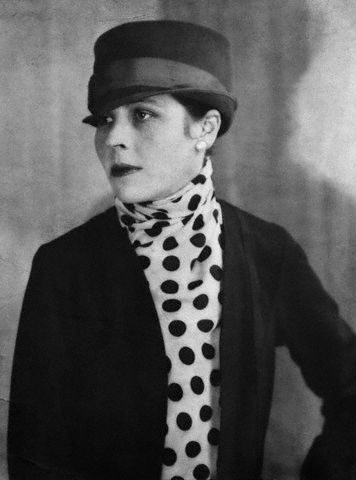
Djuna Barnes
Djuna Barnes was an American Modernist writer, poet and artist. Born June 12, 1892, in Cornwall-on-Hudson. Died June 18, 1982, in Greenwich Village. Known for Ladies Almanack, Nightwood and The Book of Repulsive Women. Educated at Pratt Institute and Art Students League of New York.
Facts
25 facts · 2 confirmed by two sources · 11 cited · 12 from one source
Where this comes from
Papalocal keeps its own record. It started from these sources; what each one said is kept here as it was copied, so a change on their side never changes this page by itself. Tap one to read its version.
What Wikidata says · copied November 13, 2026 · revision 2566662820
- Described as
- American Modernist writer, poet and artist (1892-1982)
- Other names
- Lydia Steptoe
- Born
- June 12, 1892 · 12 references
- Died
- June 18, 1982 · 8 references
- Born in
- Cornwall-on-Hudson · 1 reference
- Died in
- Greenwich Village
- Buried in
- Greenwich Village · 1 reference
- Citizen of
- United States
- Occupation
- poet · 1 reference; novelist · 1 reference; writer · 3 references; playwright · 1 reference; journalist · 2 references; painter; illustrator · 1 reference; satirical novelist
- Education
- Pratt Institute · 1 reference; Art Students League of New York · 1 reference
- Member of
- American Academy of Arts and Letters
- Genre
- lesbian literature
- Known for
- Ladies Almanack; Nightwood; The Book of Repulsive Women · 1 reference
- Field
- poetry
- Father
- Henry Budington
- Siblings
- Saxon Barnes · 1 reference; Muriel Barnes · 1 reference
- Wikipedias with a page
- 50
Wikidata item Q234721 (wikidata.org/wiki/Q234721), public domain (CC0). Copied November 13, 2026.
What Wikipedia says · copied November 13, 2026 · revision 1383128296
Djuna Barnes ( JOO-nah; June 12, 1892 – June 18, 1982) was an American artist, illustrator, journalist, and writer who is best known for her novel Nightwood (1936), a cult classic of lesbian fiction and an important work of modernist literature.
In 1913, Barnes began her career as a freelance journalist and illustrator for the Brooklyn Daily Eagle. By early 1914, Barnes was a highly sought feature reporter, interviewer, and illustrator whose work appeared in the city's leading newspapers and periodicals. Later, Barnes's talent and connections with prominent Greenwich Village bohemians afforded her the opportunity to publish her prose, poems, illustrations, and one-act plays in both avant-garde literary journals and popular magazines, and publish an illustrated volume of poetry, The Book of Repulsive Women (1915).
In 1921, a lucrative commission with McCall's took Barnes to Paris, where she lived for the next 10 years. In this period she published A Book (1923), a collection of poetry, plays, and short stories, which was later reissued, with the addition of three stories, as A Night Among the Horses (1929), Ladies Almanack (1928), and Ryder (1928).
During the 1930s, Barnes spent time in England, Paris, New York, and North Africa. It was during this restless time that she wrote and published Nightwood. In October 1939, after nearly two decades living mostly in Europe, Barnes returned to New York. She published her last major work, the verse play The Antiphon, in 1958, and she died in her apartment at Patchin Place, Greenwich Village, in June 1982.
- Born, in its opening lines
- June 12, 1892
- Died, in its opening lines
- June 18, 1982
From the Wikipedia article “Djuna Barnes” (en.wikipedia.org/wiki/Djuna_Barnes), by its contributors, under CC BY-SA 4.0 (creativecommons.org/licenses/by-sa/4.0/). Copied November 13, 2026; not changed.
Confirmed Two sources agree. Cited One source, and it names where it got it. One source One source, without a reference of its own. Sources disagree The sources disagree. We show the best-supported value and keep theirs below.
