
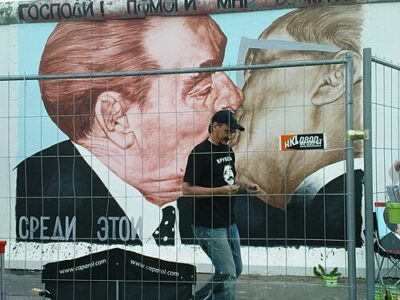
Dmitri Vrubel
Dmitri Vrubel was a Russian painter. Born July 14, 1960, in Moscow. Died August 13, 2022, in Berlin. Known for My God, Help Me to Survive This Deadly Love. Educated at Moscow Pedagogical State University.
Facts
12 facts · 2 confirmed by two sources · 2 cited · 8 from one source
Where this comes from
Papalocal keeps its own record. It started from these sources; what each one said is kept here as it was copied, so a change on their side never changes this page by itself. Tap one to read its version.
What Wikidata says · copied November 18, 2026 · revision 2568693764
- Described as
- Russian painter (1960–2022)
- Other names
- Dimitry Vrubel, Dmitri Vladimirovich Vrubel
- Born
- July 14, 1960
- Died
- August 13, 2022 · 1 reference
- Born in
- Moscow · 1 reference
- Died in
- Berlin · 1 reference
- Citizen of
- Soviet Union; Russia; Germany · 1 reference
- Occupation
- graffiti artist; painter · 1 reference
- Political party
- Pirate Party Germany (2011–)
- Education
- Moscow Pedagogical State University
- Known for
- My God, Help Me to Survive This Deadly Love
- Wikipedias with a page
- 21
Wikidata item Q1232803 (wikidata.org/wiki/Q1232803), public domain (CC0). Copied November 18, 2026.
What Wikipedia says · copied November 18, 2026 · revision 1386061795
Dmitri Vladimirovich Vrubel (Russian: Дмитрий Владимирович Врубель; 14 July 1960 – 13 August 2022) was a Russian painter. He was best known for his satirical East Side Gallery-painting My God, Help Me to Survive This Deadly Love, depicting the kissing communist leaders Leonid Brezhnev and Erich Honecker.
Vrubel was born in Moscow, Soviet Union. His surname is a russification of the common Polish surname Wróbel.
- Born, in its opening lines
- July 14, 1960
- Died, in its opening lines
- August 13, 2022
From the Wikipedia article “Dmitri Vrubel” (en.wikipedia.org/wiki/Dmitri_Vrubel), by its contributors, under CC BY-SA 4.0 (creativecommons.org/licenses/by-sa/4.0/). Copied November 18, 2026; not changed.
Confirmed Two sources agree. Cited One source, and it names where it got it. One source One source, without a reference of its own. Sources disagree The sources disagree. We show the best-supported value and keep theirs below.
