
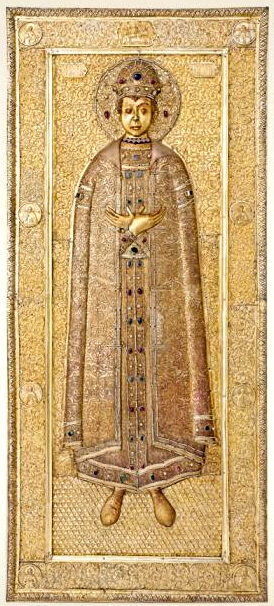
Dmitry of Uglich
Dmitry of Uglich was a Russian tsarevich. Born October 19, 1582, in Moscow. Died May 15, 1591, in Uglich.
Facts
14 facts · 1 confirmed by two sources · 0 cited · 12 from one source · 1 where the sources disagree
What’s different
- Born: we show October 19, 1582 (Sources disagree). Wikipedia says October 29, 1582
Where this comes from
Papalocal keeps its own record. It started from these sources; what each one said is kept here as it was copied, so a change on their side never changes this page by itself. Tap one to read its version.
What Wikidata says · copied November 16, 2026 · revision 2569207620
- Described as
- Russian tsarevich (1582–1591)
- Other names
- Tsarevich Dmitry
- Born
- October 19, 1582
- Died
- May 15, 1591
- Born in
- Moscow
- Died in
- Uglich
- Buried in
- Cathedral of the Archangel
- Citizen of
- Tsardom of Russia
- Occupation
- politician
- Father
- Ivan the Terrible
- Mother
- Maria Nagaya
- Siblings
- Anna Ivanovna of Russia; Tsarevich Ivan Ivanovich of Russia; Feodor I of Russia; Dmitry Ivanovich of Russia
- Religion
- Eastern Orthodoxy · 1 reference
- Wikipedias with a page
- 29
Wikidata item Q14980 (wikidata.org/wiki/Q14980), public domain (CC0). Copied November 16, 2026.
What Wikipedia says · copied November 16, 2026 · revision 1379372254
Dmitry Ivanovich (Russian: Дмитрий Иванович; 29 October [O.S. 19 October] 1582 – 15 May 1591) was the youngest son of Russian tsar Ivan the Terrible. He was the tsarevich (heir apparent) for close to seven years of his half-brother Feodor I's reign (though his legitimacy as an heir could have been contested by the Russian Orthodox Church). After his death, he was impersonated by a number of imposters to the throne, during the Time of Troubles.
- Born, in its opening lines
- October 29, 1582
- Died, in its opening lines
- May 15, 1591
From the Wikipedia article “Dmitry of Uglich” (en.wikipedia.org/wiki/Dmitry_of_Uglich), by its contributors, under CC BY-SA 4.0 (creativecommons.org/licenses/by-sa/4.0/). Copied November 16, 2026; not changed.
Confirmed Two sources agree. Cited One source, and it names where it got it. One source One source, without a reference of its own. Sources disagree The sources disagree. We show the best-supported value and keep theirs below.
