
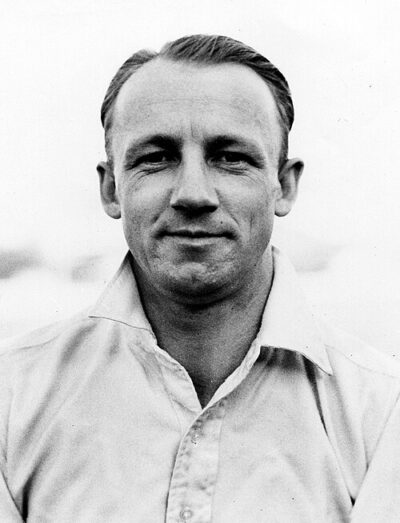
Don Bradman
Don Bradman was an Australian cricketer. Born August 27, 1908, in Cootamundra. Died February 25, 2001, in Kensington Park. Teams include New South Wales cricket team (1927–1934), South Australia cricket team (1935–1949) and Australia national cricket team (1928–1948). Educated at Bowral High School. Awards include Athlete Member of the Sport Australia Hall of Fame, Wisden Cricketer of the Year and Knight Bachelor.
Facts
27 facts · 2 confirmed by two sources · 15 cited · 10 from one source
Where this comes from
Papalocal keeps its own record. It started from these sources; what each one said is kept here as it was copied, so a change on their side never changes this page by itself. Tap one to read its version.
What Wikidata says · copied November 16, 2026 · revision 2564862011
- Described as
- Australian cricketer (1908–2001)
- Other names
- Sir Donald George Bradman, The Boy from Bowral, White Headley, Braddles, The Don, Donald George Bradman, Donald Bradman, Bradman, Sir Donald
- Born
- August 27, 1908 · 5 references
- Died
- February 25, 2001 · 5 references
- Born in
- Cootamundra · 2 references
- Died in
- Kensington Park · 2 references
- Buried in
- Centennial Park Cemetery · 1 reference
- Cause of death
- pneumonia
- Citizen of
- Australia
- Occupation
- cricketer; actor · 1 reference
- Education
- Bowral High School · 1 reference
- Teams
- New South Wales cricket team (1927–1934); South Australia cricket team (1935–1949); Australia national cricket team (1928–1948)
- Sport
- cricket
- Awards
- Athlete Member of the Sport Australia Hall of Fame (1985) · 1 reference; Wisden Cricketer of the Year (1931) · 1 reference; Knight Bachelor (1949) · 1 reference; Australian Sports Medal (2001); Companion of the Order of Australia (1979) · 1 reference; Australian National Living Treasure; South Australian Sport Hall of Fame (2010) · 1 reference; Legend of Australian Sport (1993) · 1 reference
- Children
- John Bradman · 1 reference
- Nickname
- The Don · 1 reference; The Boy from Bowral · 1 reference; White Headley · 1 reference
- Height
- 1.73 m (5 ft 8 in)
- Wikipedias with a page
- 57
Wikidata item Q313591 (wikidata.org/wiki/Q313591), public domain (CC0). Copied November 16, 2026.
What Wikipedia says · copied November 16, 2026 · revision 1385116950
Sir Donald George Bradman (27 August 1908 – 25 February 2001), nicknamed "the Don", was an Australian international cricketer, widely acknowledged as the greatest batsman of all time. His cricketing successes have been claimed by Shane Warne, among others, to make Bradman the "greatest sportsperson" in history. Bradman's career Test batting average of 99.94 is considered by some to be the greatest achievement by any sportsman in any major sport.
The story that the young Bradman practised alone with a cricket stump and a golf ball is part of Australian folklore. His meteoric rise from bush cricket to the Australian Test team took just over two years. Before his 22nd birthday, he had set many records for top-scoring, some of which still stand, and became Australia's sporting idol at the height of the Great Depression. This hero status grew and continued through the Second World War.
During a 20-year playing career, Bradman consistently scored at a level that made him, in the words of former Australia captain Bill Woodfull, "worth three batsmen to Australia". A controversial set of tactics, known as Bodyline, was specially devised by the England team to curb his scoring. As a captain and administrator, Bradman was committed to attacking, entertaining cricket; he drew spectators in record numbers. He hated the constant adulation, however, and it affected how he dealt with others. The focus of attention on Bradman's individual performances strained relationships with some teammates, administrators and journalists, who thought him aloof and wary. Following an enforced hiatus due to the Second World War, he made a dramatic comeback, captaining an Australian team known as "the Invincibles" on a record-breaking unbeaten tour of England.
A complex and highly driven man, not given to close personal relationships, Bradman retained a pre-eminent position in the game by acting as an administrator, selector and writer for three decades following his retirement. Even after he became reclusive in his declining years, Bradman's opinion was highly sought, and his status as a national icon was still recognised. Almost fifty years after his retirement as a Test player, in 1997, Prime Minister John Howard called him the "greatest living Australian". Bradman's image has appeared on postage stamps and coins, and a museum dedicated to his life was opened while he was still living. On the centenary of his birth, 27 August 2008, the Royal Australian Mint issued a $5 commemorative gold coin with Bradman's image. In 2009, he was inducted posthumously as an inaugural member into the ICC Cricket Hall of Fame.
- Born, in its opening lines
- August 27, 1908
- Died, in its opening lines
- February 25, 2001
From the Wikipedia article “Don Bradman” (en.wikipedia.org/wiki/Don_Bradman), by its contributors, under CC BY-SA 4.0 (creativecommons.org/licenses/by-sa/4.0/). Copied November 16, 2026; not changed.
Confirmed Two sources agree. Cited One source, and it names where it got it. One source One source, without a reference of its own. Sources disagree The sources disagree. We show the best-supported value and keep theirs below.
