
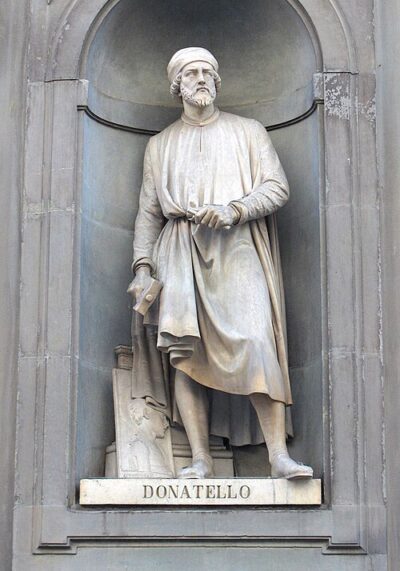
Donatello
Donatello was an Early Renaissance Italian sculptor. Born 1386, in Florence. Died December 13, 1466, in Florence. Known for Tomb of Giovanni Pecci, Candelabra Angels and David.
Facts
26 facts · 2 confirmed by two sources · 9 cited · 15 from one source
Where this comes from
Papalocal keeps its own record. It started from these sources; what each one said is kept here as it was copied, so a change on their side never changes this page by itself. Tap one to read its version.
What Wikidata says · copied November 16, 2026 · revision 2564121895
- Described as
- Early Renaissance Italian sculptor (1386–1466)
- Other names
- Donatello Donato, Donato di Niccolo di Betto Bardi, Donato di Niccolò di Betto Bardi
- Born
- 1386 · 5 references
- Died
- December 13, 1466 · 3 references
- Born in
- Florence · 3 references
- Died in
- Florence · 3 references
- Buried in
- Basilica of San Lorenzo
- Name at birth
- Donato di Niccolò di Betto Bardi
- Citizen of
- Republic of Florence · 1 reference
- Occupation
- sculptor · 4 references; painter · 3 references; artist · 1 reference
- Worked for
- Lorenzo Ghiberti · 1 reference
- Genre
- religious art · 1 reference; equestrian portrait · 1 reference; portrait · 1 reference; mythological painting · 1 reference
- Known for
- Tomb of Giovanni Pecci; Candelabra Angels; David; Donatello's Crucifix of Santa Croce; Zuccone; Bearded Head · 1 reference; Crucifixion · 1 reference; Saint Massimo and Saint Prosdocimo · 1 reference; Forzori Altar · 1 reference; Martelli coat of arms · 1 reference
- Field
- art of sculpture
- Wikipedias with a page
- 108
Wikidata item Q37562 (wikidata.org/wiki/Q37562), public domain (CC0). Copied November 16, 2026.
What Wikipedia says · copied November 16, 2026 · revision 1382308495
Donato di Niccolò di Betto Bardi (c. 1386 – 13 December 1466), known mononymously as Donatello (English: ; Italian: [donaˈtɛllo]), was an Italian sculptor of the Renaissance period. Born in Florence, he studied classical sculpture and used his knowledge to develop an Early Renaissance style of sculpture. He spent time in other cities, where he worked on commissions and taught others; his periods in Rome, Padua, and Siena introduced to other parts of Italy the techniques he had developed in the course of a long and productive career. His David was the first freestanding nude male sculpture since antiquity; like much of his work, it was commissioned by the Medici family.
He worked with stone, bronze, wood, clay, stucco, and wax, and used glass in inventive ways. He had several assistants, with four perhaps being a typical number. Although his best-known works are mostly statues executed in the round, he developed a new, very shallow, type of bas-relief for small works, and a good deal of his output was architectural reliefs for pulpits, altars and tombs, as well as Madonna and Childs for homes.
Broad, overlapping phases can be seen in his style, beginning with the development of expressiveness and classical monumentality in statues, then developing energy and charm, mostly in smaller works. Early on, he veered away from the International Gothic style he learned from Lorenzo Ghiberti, with classically informed pieces, and further on a number of stark, even brutal pieces. The sensuous eroticism of his most famous work, the bronze David, is very rarely seen in other pieces.
- Born, in its opening lines
- c. 1386
- Died, in its opening lines
- December 13, 1466
From the Wikipedia article “Donatello” (en.wikipedia.org/wiki/Donatello), by its contributors, under CC BY-SA 4.0 (creativecommons.org/licenses/by-sa/4.0/). Copied November 16, 2026; not changed.
Confirmed Two sources agree. Cited One source, and it names where it got it. One source One source, without a reference of its own. Sources disagree The sources disagree. We show the best-supported value and keep theirs below.
