
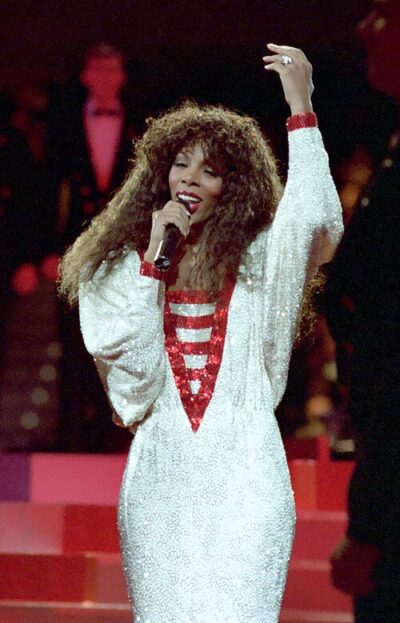
Donna Summer
Donna Summer was an American singer. Born December 31, 1948, in Boston. Died May 17, 2012, in Naples. Awards include star on Hollywood Walk of Fame, Grammy Award for Best Female R&B Vocal Performance and Grammy Award for Best Female Rock Vocal Performance.
Facts
38 facts · 2 confirmed by two sources · 13 cited · 23 from one source
Where this comes from
Papalocal keeps its own record. It started from these sources; what each one said is kept here as it was copied, so a change on their side never changes this page by itself. Tap one to read its version.
What Wikidata says · copied November 13, 2026 · revision 2565501521
- Described as
- American singer (1948–2012)
- Other names
- LaDonna Gaines, Donna Sommer, Donna Gaines, Donna Gains, LaDonna Adrian Gaines, Donna Adrian Gaines
- Born
- December 31, 1948 · 6 references
- Died
- May 17, 2012 · 7 references
- Born in
- Boston · 4 references
- Died in
- Naples · 2 references
- Buried in
- Harpeth Hills Memory Gardens · 1 reference
- Cause of death
- lung cancer
- Name at birth
- LaDonna Adrian Gaines
- Citizen of
- United States · 1 reference
- Occupation
- singer · 3 references; songwriter; composer · 2 references; recording artist; musician · 3 references; actor · 1 reference; pop singer · 1 reference
- Genre
- disco; rock music; contemporary R&B; synth-pop; house music; pop music
- Instrument
- piano; voice
- Record label
- Geffen Records; Atlantic Records; Mercury Records; Epic Records
- Awards
- star on Hollywood Walk of Fame · 1 reference; Grammy Award for Best Female R&B Vocal Performance (1979) · 1 reference; Grammy Award for Best Female Rock Vocal Performance (1980) · 1 reference; Grammy Award for Best Inspirational Performance (2 times) (1984, 1985) · 1 reference; Grammy Award for Best Dance/Electronic Recording (1985) · 1 reference; Rock and Roll Hall of Fame (2013) · 1 reference
- Field
- music composing
- Spouse
- Bruce Sudano (1980–2012) · 1 reference
- Children
- Brooklyn Sudano; Amanda Sudano
- Website
- http://www.donnasummer.com/
- Wikipedias with a page
- 79
Wikidata item Q908933 (wikidata.org/wiki/Q908933), public domain (CC0). Copied November 13, 2026.
What Wikipedia says · copied November 13, 2026 · revision 1384359462
Donna Adrian Gaines (December 31, 1948 – May 17, 2012), known professionally as Donna Summer, was an American singer and songwriter. She gained prominence during the disco era of the 1970s and became known as the "Queen of Disco", while her music gained a global following.
Born and raised in Boston, Summer dropped out of high school before graduating and began her career as the lead singer of a blues rock band named Crow and moved to New York City. In 1968, she joined the German production of the musical Hair in Munich, where she spent several years acting, and singing. There, she met music producers Giorgio Moroder and Pete Bellotte, and recorded her first album, Lady of the Night, released in 1974 only to the European market. Following the recording and European release of the groundbreaking disco anthem, "Love to Love You Baby", she signed with Casablanca Records in 1975, where it was released in North America. In the US, the single became her first top five hit on the Billboard Hot 100, peaking at number 2 in 1976. Summer's first three Casablanca albums—Love to Love You Baby, A Love Trilogy and Four Seasons of Love—all went gold in the US and led to her informal title "First Lady of Love" in the popular music media. Her fourth Casablanca release, I Remember Yesterday (1977), launched the top ten US and number one UK hit "I Feel Love", which has since been hailed as one of the most important records in pop music history. After recording much of her first six albums in Munich with Moroder and Belotte, Summer and the producers relocated to the United States, where Summer would continue to record successful singles such as "Last Dance", "MacArthur Park", "Heaven Knows", "Hot Stuff", "Bad Girls", "Dim All the Lights", "No More Tears (Enough Is Enough)" with Barbra Streisand, and "On the Radio".
Beginning in 1978, Summer first topped the Billboard 200 with the live album, Live and More, thus beginning a streak of three consecutive number one albums, including Bad Girls (1979) and the compilation album, On the Radio: Greatest Hits Volumes I & II (1980). In achieving this, Summer became the first and only artist to have three number one double albums. All three albums were certified platinum or higher in the United States, with Bad Girls selling over two million copies. Summer was the first female artist to record three number one singles in one calendar year, doing so in 1979. Summer's success was interrupted by the late 1970s social backlash against disco music, and in 1980, she left Casablanca Records for Geffen Records. As a response, her next album, The Wanderer, found Summer recording mostly rock and new wave music, as well as inspirational music inspired by her newfound Christian faith. However, her Geffen Records recordings were not as successful as predicted. Summer returned to the top of the pop charts in 1983 with the single, "She Works Hard for the Money", off the album of the same name, which was released off of Mercury Records after it was found she owed Casablanca one more album. Despite this success, Summer's recordings began foundering not too long afterwards. Rumors of homophobic comments she allegedly made at a 1983 concert led to a falling-out with Summer's gay fanbase. In 1989, Summer worked with the team of Stock Aitken Waterman and scored her first top ten US hit in six years with "This Time I Know It's for Real", which would be her fourteenth and final top ten hit of her career. Summer would make the Hot 100 one last time in 1999 with her rendition of "I Will Go with You (Con te partirò)".
Summer continued to record music up until her death in 2012 from lung cancer at her home in Naples, Florida. In her obituary in The Times of London, she was described as the "undisputed queen of the Seventies disco boom" who reached the status of "one of the world's leading female singers." Moroder described Summer's work on the song "I Feel Love" as "really the start of electronic dance" music. Summer has been inducted into several musical institutions during her lifetime and posthumously, including the Hollywood Walk of Fame, the Dance Music Hall of Fame and the National Rhythm & Blues Hall of Fame. In 2013, a year after her death, Summer was inducted into the Rock and Roll Hall of Fame. In December 2016, Billboard ranked her sixth on its list of the "Greatest of All Time Top Dance Club Artists". In 2025, she was inducted into the Songwriters Hall of Fame.
- Born, in its opening lines
- December 31, 1948
- Died, in its opening lines
- May 17, 2012
From the Wikipedia article “Donna Summer” (en.wikipedia.org/wiki/Donna_Summer), by its contributors, under CC BY-SA 4.0 (creativecommons.org/licenses/by-sa/4.0/). Copied November 13, 2026; not changed.
Confirmed Two sources agree. Cited One source, and it names where it got it. One source One source, without a reference of its own. Sources disagree The sources disagree. We show the best-supported value and keep theirs below.
