
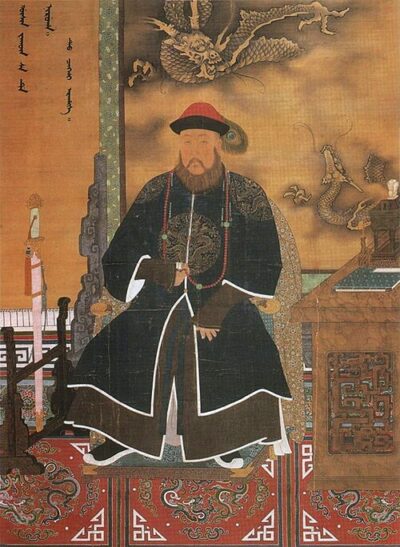
Dorgon
Dorgon was a Prince Rui of the First Rank and regent of the Qing Dynasty. Born November 17, 1612, in Hetu Ala City. Died December 31, 1650, in Chengde.
Facts
22 facts · 2 confirmed by two sources · 3 cited · 17 from one source
Where this comes from
Papalocal keeps its own record. It started from these sources; what each one said is kept here as it was copied, so a change on their side never changes this page by itself. Tap one to read its version.
What Wikidata says · copied November 16, 2026 · revision 2512503113
- Described as
- Prince Rui of the First Rank and regent of the Qing Dynasty (1612-1650)
- Other names
- Taixingkehan, Zhong, Amawang, Chengzongyihuangdi, Maodexiudaoguangyedinggonganminlizhengchengjingyihuangdi, Chengzong, Moergenwang, Aixinjueluo Duoergun, Jiuwang, Heshuoruizhongqinwang, Moergendaiqing, Ruiwang
- Born
- November 17, 1612 · 1 reference
- Died
- December 31, 1650 · 1 reference
- Born in
- Hetu Ala City
- Died in
- Chengde
- Citizen of
- Qing dynasty · 1 reference
- Occupation
- politician
- Spouse
- Empress Jingxiaoyi; Princess Uisun; Empress Dowager Xiaozhuang
- Father
- Nurhaci · 1 reference
- Mother
- Empress Xiaoliewu
- Siblings
- Princess Donggo; Princess Nunje; Mangguji; Princess Mukushen; fifth daughter of Nurhaci; sixth daughter of Nurhaci; seventh daughter of Nurhaci; Songgutu; Hong Taiji · 1 reference; Ajige
- Military rank
- general
- Wikipedias with a page
- 33
Wikidata item Q380573 (wikidata.org/wiki/Q380573), public domain (CC0). Copied November 16, 2026.
What Wikipedia says · copied November 16, 2026 · revision 1383350458
Dorgon (17 November 1612 – 31 December 1650) was a Manchu prince and regent of the early Qing dynasty. Born in the House of Aisin-Gioro as the 14th son of Nurhaci (the founder of the Later Jin dynasty, which was the predecessor of the Qing), Dorgon started his career in military campaigns against the Mongols, the Koreans, and the Ming dynasty during the reign of Hong Taiji (his eighth brother) who succeeded their father.
After Hong Taiji's death in 1643, he was involved in a power struggle against Hong Taiji's eldest son, Hooge, over the succession to the throne. Both of them eventually came to a compromise by backing out and letting Hong Taiji's ninth son, Fulin, become the emperor; Fulin was installed on the throne as the Shunzhi Emperor. Dorgon served as Prince-Regent from 1643 to 1650, throughout the Shunzhi Emperor's early reign. In 1645, he was given the honorary title "Emperor's Uncle and Prince-Regent" (皇叔父攝政王); the title was changed to "Emperor's Father and Prince-Regent" (皇父攝政王) in 1649.
Under Dorgon's regency, Qing forces occupied Beijing, the capital of the fallen Ming dynasty, and gradually conquered the rest of the Ming in a series of battles against Ming loyalists and other opposing forces around China. Dorgon also introduced the policy of forcing all Han Chinese men to shave the front of the heads and wear their hair in queues just like the Manchus. He died in 1650 during a hunting trip and was posthumously honoured as an emperor even though he was never an emperor during his lifetime. A year after Dorgon's death, however, the Shunzhi Emperor accused Dorgon of several crimes, stripped him of his titles, and ordered his remains to be exhumed and flogged in public. Dorgon was posthumously rehabilitated and restored of his honorary titles by the Qianlong Emperor in 1778.
- Born, in its opening lines
- November 17, 1612
- Died, in its opening lines
- December 31, 1650
From the Wikipedia article “Dorgon” (en.wikipedia.org/wiki/Dorgon), by its contributors, under CC BY-SA 4.0 (creativecommons.org/licenses/by-sa/4.0/). Copied November 16, 2026; not changed.
Confirmed Two sources agree. Cited One source, and it names where it got it. One source One source, without a reference of its own. Sources disagree The sources disagree. We show the best-supported value and keep theirs below.
