
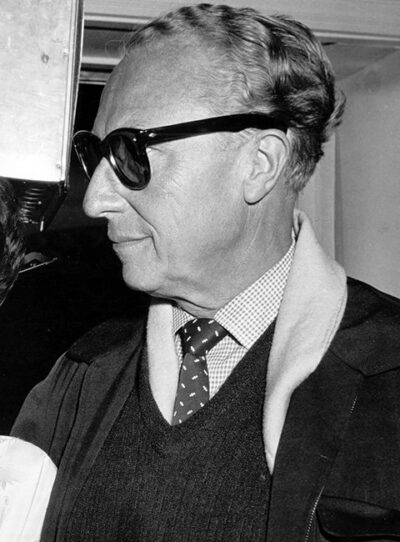
Douglas Sirk
Douglas Sirk was a German film director. Born April 26, 1897, in Hamburg. Died January 14, 1987, in Lugano. Educated at LMU Munich. Awards include German Film Award.
Facts
15 facts · 2 confirmed by two sources · 7 cited · 6 from one source
Where this comes from
Papalocal keeps its own record. It started from these sources; what each one said is kept here as it was copied, so a change on their side never changes this page by itself. Tap one to read its version.
What Wikidata says · copied November 16, 2026 · revision 2568965595
- Described as
- German film director (1897–1987)
- Other names
- Hans Detlef Sierck, Detlef Sierck
- Born
- April 26, 1897 · 9 references
- Died
- January 14, 1987 · 9 references
- Born in
- Hamburg · 2 references
- Died in
- Lugano · 2 references
- Citizen of
- Weimar Republic; Kingdom of Denmark; West Germany
- Occupation
- film director · 1 reference; screenwriter · 2 references; film producer · 1 reference; director · 1 reference
- Education
- LMU Munich
- Awards
- German Film Award
- Spouse
- Hilde Jary · 1 reference
- Children
- Klaus Detlef Sierck · 1 reference
- Wikipedias with a page
- 38
Wikidata item Q60858 (wikidata.org/wiki/Q60858), public domain (CC0). Copied November 16, 2026.
What Wikipedia says · copied November 16, 2026 · revision 1368642819
Douglas Sirk (born Hans Detlef Sierck; 26 April 1897 – 14 January 1987) was a German film director best known for the film melodramas he directed in Hollywood during the 1950s. However, he also directed comedies, westerns, and war films. Sirk started his career in Germany during the Weimar period as a stage and screen director, but he left for Hollywood in 1937 after his Jewish wife was persecuted by the Nazis.
In the 1950s, he achieved his greatest commercial success with the films Magnificent Obsession, All That Heaven Allows, Written on the Wind, A Time to Love and a Time to Die, and Imitation of Life. While those films were initially panned by critics as sentimental women's pictures, they are today widely regarded by film directors, critics, and scholars as masterpieces. His work is seen as a "critique of the bourgeoisie in general and of 1950s America in particular", while painting a "compassionate portrait of characters trapped by social conditions". Beyond the surface of the film, Sirk worked with complex mise-en-scène and lush Technicolor to underline his statements.
- Born, in its opening lines
- April 26, 1897
- Died, in its opening lines
- January 14, 1987
From the Wikipedia article “Douglas Sirk” (en.wikipedia.org/wiki/Douglas_Sirk), by its contributors, under CC BY-SA 4.0 (creativecommons.org/licenses/by-sa/4.0/). Copied November 16, 2026; not changed.
Confirmed Two sources agree. Cited One source, and it names where it got it. One source One source, without a reference of its own. Sources disagree The sources disagree. We show the best-supported value and keep theirs below.
