
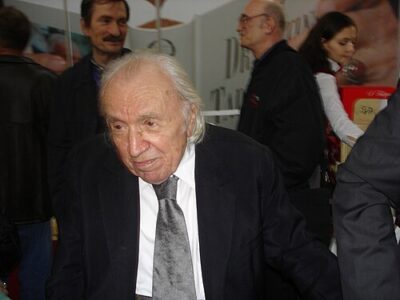
Dragutin Tadijanović
Dragutin Tadijanović was a Croatian poet. Born November 4, 1905, in Slavonski Brod. Died June 27, 2007, in Zagreb. Educated at Faculty of Forestry and Wood Technology, Zagreb and Faculty of Humanities and Social Sciences, University of Zagreb. Awards include Zmajeva prize, Vladimir Nazor Award and Goran's wreath.
Facts
25 facts · 2 confirmed by two sources · 1 cited · 22 from one source
Where this comes from
Papalocal keeps its own record. It started from these sources; what each one said is kept here as it was copied, so a change on their side never changes this page by itself. Tap one to read its version.
What Wikidata says · copied November 18, 2026 · revision 2531456308
- Described as
- Croatian poet (1905–2007)
- Born
- November 4, 1905 · 2 references
- Died
- June 27, 2007 · 2 references
- Born in
- Slavonski Brod
- Died in
- Zagreb
- Buried in
- Mirogoj Cemetery · 1 reference
- Citizen of
- Hungary; Kingdom of Serbs, Croats and Slovenes; Kingdom of Yugoslavia; Independent State of Croatia
- Occupation
- linguist; poet; translator; writer
- Worked for
- Narodne novine (1935–1940)
- Education
- Faculty of Forestry and Wood Technology, Zagreb (1925–1928); Faculty of Humanities and Social Sciences, University of Zagreb (1928–1937)
- Member of
- Croatian Academy of Sciences and Arts
- Awards
- Zmajeva prize (1963); Vladimir Nazor Award (1968); Goran's wreath (1982); Tin Ujević Award (1987); Order of Duke Trpimir (1995); honorary citizen of Zagreb (2000); Order of the cavalier of Madara 1st degree (2001); star on Croatian Walk of Fame (2005)
- Wikipedias with a page
- 21
Wikidata item Q960984 (wikidata.org/wiki/Q960984), public domain (CC0). Copied November 18, 2026.
What Wikipedia says · copied November 18, 2026 · revision 1380875544
Dragutin Tadijanović (4 November 1905 – 27 June 2007) was a Croatian poet, and in his native Croatia he is referred to as a "Bard."
Tadijanović was born in the village of Rastušje close to Slavonski Brod in the region of Slavonia. He published his first poem in 1922. He graduated in literature and philosophy at the University of Zagreb in 1937.
He worked as the lector of the official paper Narodne novine (1935–1940), taught at the Academy of Arts in Zagreb (1939–1945). Later he worked at the publishing houses "Zora" and "Hrvatski pjesnici", and Matica hrvatska.
He joined the Yugoslav Academy of Sciences and Arts's Literary Institute, where he became the director in 1953 and served until his retirement in 1973. He was the president of the Society of Croatian Writers in 1964–1965, and he also became an academician of the academy.
Tadijanović holds distinction as one of the most popular and most influential Croatian poets of 20th century. His poem Balada o zaklanim ovcama ("Ballad of Slaughtered Sheep"), written in the 1930s, is one of the most powerful works of Croatian literature. His works were translated into over 20 languages, and he published over 500 poems in some twenty collections.
He was crowned by an olive wreath and so became poeta oliveatus at Croatia rediviva poetry manifestation in Selca on the island of Brač in 2001. His verses are carved at the marble plaque on the Wall of poetry.
Before he died at the age of 101, he was among the longest-living writers in Croatian history with generations having to study his poems in school. His last couple of birthdays were marked with reports on national TV, awards and other special events and his commemoration ceremony was held at the Old City Hall on uphill Zagreb attended by the Mayor of Zagreb and other political and cultural officials. His funeral was performed by auxiliary bishop of Zagreb Vlado Košić.
An award has been named after him and granted since 2008 by the Croatian Academy of Sciences and Arts (HAZU) for the life achievement in poetry.
- Born, in its opening lines
- November 4, 1905
- Died, in its opening lines
- June 27, 2007
From the Wikipedia article “Dragutin Tadijanović” (en.wikipedia.org/wiki/Dragutin_Tadijanović), by its contributors, under CC BY-SA 4.0 (creativecommons.org/licenses/by-sa/4.0/). Copied November 18, 2026; not changed.
Confirmed Two sources agree. Cited One source, and it names where it got it. One source One source, without a reference of its own. Sources disagree The sources disagree. We show the best-supported value and keep theirs below.
