
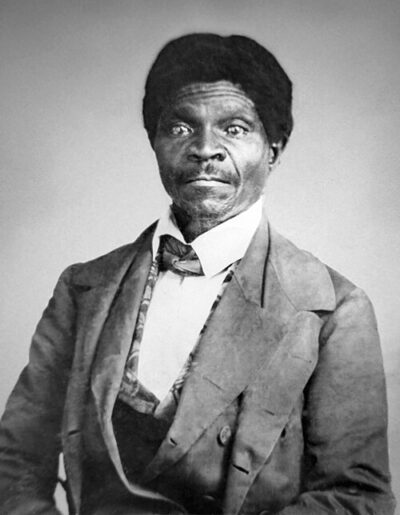
Dred Scott
Dred Scott was an African-American plaintiff in freedom suit (c.1799–1858). Born 1799, in Southampton County. Died September 17, 1858, in St. Louis.
Facts
11 facts · 2 confirmed by two sources · 4 cited · 5 from one source
Where this comes from
Papalocal keeps its own record. It started from these sources; what each one said is kept here as it was copied, so a change on their side never changes this page by itself. Tap one to read its version.
What Wikidata says · copied November 15, 2026 · revision 2568603241
- Described as
- African-American plaintiff in freedom suit (c.1799–1858)
- Born
- 1799 · 1 reference
- Died
- September 17, 1858 · 2 references
- Born in
- Southampton County
- Died in
- St. Louis
- Buried in
- Calvary Cemetery · 1 reference
- Cause of death
- tuberculosis
- Citizen of
- United States
- Occupation
- activist; slave · 1 reference
- Spouse
- Harriet Robinson Scott · 1 reference
- Children
- Eliza Scott · 1 reference
- Wikipedias with a page
- 28
Wikidata item Q480427 (wikidata.org/wiki/Q480427), public domain (CC0). Copied November 15, 2026.
What Wikipedia says · copied November 15, 2026 · revision 1382650610
Dred Scott (c. 1799 – September 17, 1858) was an enslaved African-American man who, along with his wife, Harriet Robinson Scott, unsuccessfully sued for the freedom of themselves and their two daughters, Eliza and Lizzie, in the Dred Scott v. Sandford case of 1857, popularly known as the "Dred Scott decision". The Scotts claimed they should be granted freedom because Dred had lived in Illinois and the Wisconsin Territory for four years, where slavery was illegal, and laws in those jurisdictions said that slaveholders gave up their rights to slaves if they stayed for an extended period.
In a landmark case, the United States Supreme Court decided 7–2 against Scott, finding that neither he nor any other person of African ancestry could claim citizenship in the United States, and therefore Scott could not sue in federal court under the diversity of citizenship rules. Scott's temporary residence in free territory outside Missouri did not bring about his emancipation because the Missouri Compromise, which made that territory free by prohibiting slavery north of the 36°30′ parallel, was unconstitutional because it "deprives citizens of their [slave] property without due process of law".
Although Chief Justice Roger B. Taney had hoped to settle issues related to slavery and congressional authority by this decision, it instead aroused public outrage, deepened sectional tensions between the northern and southern states, and hastened the eventual explosion of their differences into the American Civil War. President Abraham Lincoln's Emancipation Proclamation in 1863 and the post-Civil War Reconstruction Amendments—the Thirteenth and Fourteenth amendments—respectively nullified and abrogated the decision. Private arrangement manumitted the Scotts in May 1857, and Scott died of tuberculosis a year later.
- Born, in its opening lines
- c. 1799
- Died, in its opening lines
- September 17, 1858
From the Wikipedia article “Dred Scott” (en.wikipedia.org/wiki/Dred_Scott), by its contributors, under CC BY-SA 4.0 (creativecommons.org/licenses/by-sa/4.0/). Copied November 15, 2026; not changed.
Confirmed Two sources agree. Cited One source, and it names where it got it. One source One source, without a reference of its own. Sources disagree The sources disagree. We show the best-supported value and keep theirs below.
