
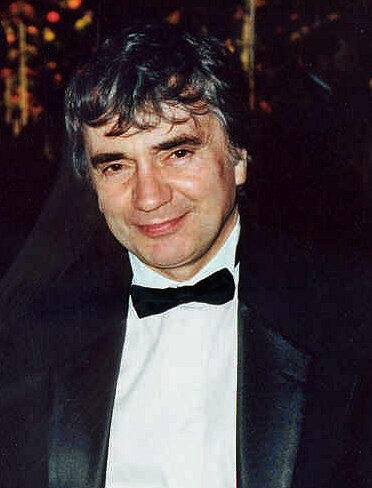
Dudley Moore
Dudley Moore was a British actor, comedian, composer and musician. Born April 19, 1935, in Hammersmith. Died March 27, 2002, in Plainfield. Educated at Magdalen College. Awards include Commander of the Order of the British Empire, Golden Globe Award for Best Actor – Motion Picture Musical or Comedy (2 times) and Grammy Awards.
Facts
31 facts · 2 confirmed by two sources · 9 cited · 19 from one source · 1 where the sources disagree
What’s different
- Cause of death: we show progressive supranuclear palsy (Sources disagree). Wikidata also lists pneumonia
Where this comes from
Papalocal keeps its own record. It started from these sources; what each one said is kept here as it was copied, so a change on their side never changes this page by itself. Tap one to read its version.
What Wikidata says · copied November 16, 2026 · revision 2561289230
- Described as
- British actor, comedian, composer and musician (1935–2002)
- Other names
- Dudley Stuart John Moore
- Born
- April 19, 1935 · 10 references
- Died
- March 27, 2002 · 10 references
- Born in
- Hammersmith
- Died in
- Plainfield · 2 references
- Buried in
- Hillside Cemetery · 1 reference
- Cause of death
- progressive supranuclear palsy · 1 reference; pneumonia · 1 reference
- Name at birth
- Dudley Stuart John Moore · 1 reference
- Citizen of
- United Kingdom
- Occupation
- actor · 2 references; comedian; composer · 2 references; jazz musician; screenwriter; pianist · 1 reference; film actor; film director · 1 reference
- Education
- Magdalen College
- Member of
- Panhandle
- Instrument
- piano; organ
- Record label
- Black Lion Records
- Awards
- Commander of the Order of the British Empire; Golden Globe Award for Best Actor – Motion Picture Musical or Comedy (2 times) (1982, 1985); Grammy Awards; Special Tony Award (1963); star on Hollywood Walk of Fame · 1 reference
- Spouse
- Suzy Kendall (1968–1972); Tuesday Weld (1975–1980); Brogan Lane (1988–1991) · 1 reference; Nicole Rothschild (1994–1998) · 1 reference
- Lived in
- London · 1 reference
- Wikipedias with a page
- 50
Wikidata item Q310343 (wikidata.org/wiki/Q310343), public domain (CC0). Copied November 16, 2026.
What Wikipedia says · copied November 16, 2026 · revision 1377040846
Dudley Stuart John Moore (19 April 1935 – 27 March 2002) was an English actor, comedian, musician and composer. He first came to prominence in the UK as a leading figure in the British satire boom of the 1960s. He was one of the four writer-performers in the groundbreaking satirical comedy revue Beyond the Fringe from 1960 to 1964. With another member of that team, Peter Cook, Moore collaborated on the BBC television series Not Only... But Also from 1965 to 1970. In their popular double act, Moore's buffoonery contrasted with Cook's deadpan monologues. They jointly received the 1966 British Academy Television Award for Best Entertainment Performance and worked together on other projects, such as the hit film Bedazzled (1967) and the Derek and Clive series of comedy albums. Moore and Cook ceased working together regularly after 1978, by which time Moore had settled in Los Angeles, California, to concentrate on his film career.
Following Bedazzled, Moore's work as a comedy film actor was marked by further hit films, particularly Foul Play (1978), 10 (1979) and Arthur (1981). For Arthur, Moore was nominated for the Academy Award for Best Actor and won a Golden Globe Award. He received a second Golden Globe for his performance in Micki & Maude (1984). Moore was awarded a star on the Hollywood Walk of Fame in 1987 and was made a CBE by Queen Elizabeth II at Buckingham Palace on 16 November 2001 in what was his last public appearance.
- Born, in its opening lines
- April 19, 1935
- Died, in its opening lines
- March 27, 2002
From the Wikipedia article “Dudley Moore” (en.wikipedia.org/wiki/Dudley_Moore), by its contributors, under CC BY-SA 4.0 (creativecommons.org/licenses/by-sa/4.0/). Copied November 16, 2026; not changed.
Confirmed Two sources agree. Cited One source, and it names where it got it. One source One source, without a reference of its own. Sources disagree The sources disagree. We show the best-supported value and keep theirs below.
