
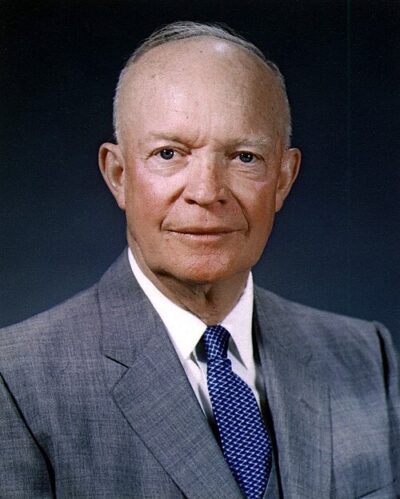
Dwight D. Eisenhower
Dwight D. Eisenhower was a president of the United States from 1953 to 1961. Born October 14, 1890, in Eisenhower Birthplace State Historic Site. Died March 28, 1969, in Walter Reed Army Medical Center. Positions held include President of the United States (1953–1961), Chief of Staff of the United States Army (1945–1948) and Supreme Allied Commander Europe (1951–1952). Educated at United States Military Academy and United States Army Command and General Staff College. Awards include Atoms for Peace Award, Companion of the Liberation and Grand Cross of the Order of the Oak Crown.

Facts
57 facts · 2 confirmed by two sources · 18 cited · 36 from one source · 1 where the sources disagree
What’s different
- Height: we show 1.80 m (5 ft 11 in) (Sources disagree). Wikidata also lists 1.79 m (5 ft 10 in)
Where this comes from
Papalocal keeps its own record. It started from these sources; what each one said is kept here as it was copied, so a change on their side never changes this page by itself. Tap one to read its version.
What Wikidata says · copied November 13, 2026 · revision 2567578036
- Described as
- president of the United States from 1953 to 1961 (1890–1969)
- Other names
- Eisenhower, Ike, Dwight David "Ike" Eisenhower, President Eisenhower, Ike Eisenhower, D. Eisenhower, David Dwight Eisenhower, Dwight Eisenhower, Dwight David Eisenhower
- Born
- October 14, 1890 · 20 references
- Died
- March 28, 1969 · 18 references
- Born in
- Eisenhower Birthplace State Historic Site · 1 reference
- Died in
- Walter Reed Army Medical Center
- Buried in
- Dwight D. Eisenhower Presidential Library, Museum and Boyhood Home
- Cause of death
- myocardial infarction
- Name at birth
- David Dwight Eisenhower
- Citizen of
- United States
- Occupation
- politician · 3 references; writer; military officer · 1 reference; statesperson; military personnel · 1 reference; army officer
- Positions held
- President of the United States (1953–1961); Chief of Staff of the United States Army (1945–1948); Supreme Allied Commander Europe (1951–1952); President-elect of the United States (1952–1953)
- Political party
- Republican Party
- Education
- United States Military Academy (1911–1915); United States Army Command and General Staff College (1925–1926); United States Army War College; Abilene High School
- Member of
- American Legion; Veterans of Foreign Wars
- Teams
- Army Black Knights football
- Awards
- Atoms for Peace Award; Companion of the Liberation; Grand Cross of the Order of the Oak Crown (1945) · 1 reference; Knight Grand Cross of the Order of the Bath (1943); Grand Cross of the Order of Wissam Alaouite (1943) · 1 reference; Legionnaire of Legion of Merit (1943) · 1 reference; Order of Victory (1945) · 1 reference; Africa Star (1943) · 1 reference; Distinguished Service Medal; Mexican Border Service Medal (1918) · 1 reference; World War I Victory Medal (United States) (1919) · 1 reference; American Defense Service Medal (1947) · 1 reference; European-African-Middle Eastern Campaign Medal (1947) · 1 reference; World War II Victory Medal (1947) · 1 reference; Army of Occupation Medal (1947) · 1 reference
- Field
- politics of the United States
- Spouse
- Mamie Eisenhower (1916–1969) · 1 reference
- Children
- Doud Eisenhower; John Eisenhower · 1 reference
- Father
- David Jacob Eisenhower
- Mother
- Ida Stover Eisenhower
- Siblings
- Milton Stover Eisenhower; Earl D. Eisenhower; Edgar Newton Eisenhower
- Religion
- Mennonites; Jehovah's Witnesses
- Military branch
- United States Army (2 times) (1915–1969)
- Military rank
- General of the Army · 1 reference; general · 1 reference
- Nickname
- Ike
- Height
- 1.80 m (5 ft 11 in); 1.79 m (5 ft 10 in)
- Wikipedias with a page
- 192
Wikidata item Q9916 (wikidata.org/wiki/Q9916), public domain (CC0). Copied November 13, 2026.
What Wikipedia says · copied November 13, 2026 · revision 1385222909
Dwight David Eisenhower (born David Dwight Eisenhower; October 14, 1890 – March 28, 1969) was the 34th president of the United States, serving from 1953 to 1961. A member of the Republican Party, he was renowned as a World War II general who commanded Allied forces in Operation Torch and Operation Overlord. He attained the five-star rank of General of the Army in 1944.
Eisenhower graduated from West Point in 1915. During World War I, he was denied a request to serve in Europe and instead commanded a unit that trained tank crews. Between the wars he served in staff positions in the US and the Philippines, reaching the rank of brigadier general shortly before the entry of the US into World War II in 1941. After further promotion Eisenhower oversaw the Allied invasions of North Africa and Sicily before supervising the invasions of France and Germany. After the war ended in Europe, he served as military governor of the American-occupied zone of Germany (1945), as Army Chief of Staff (1945–1948), president of Columbia University (1948–1953), and as the first supreme commander of NATO (1951–1952).
In 1952, Eisenhower entered the presidential race as a Republican, in part to block the presidential prospects of Senator Robert A. Taft, who opposed NATO and sought to undo the New Deal. Eisenhower won that year's election and the 1956 election in landslides, both times defeating Adlai Stevenson II. Eisenhower's main goals in office were to contain the spread of communism and reduce federal deficits.
In 1953, Eisenhower considered using nuclear weapons to end the Korean War and may have threatened China with nuclear attack if an armistice was not reached quickly. China did agree and an armistice resulted, which remains in effect. His New Look policy of nuclear deterrence prioritized "inexpensive" nuclear weapons while reducing funding for expensive Army divisions. He continued Harry S. Truman's policy of recognizing Taiwan as the legitimate government of China, and he won congressional approval of the Formosa Resolution. His administration provided aid to help the French try to fight Vietnamese Communists in the First Indochina War. After the French left, he gave strong financial support to the new state of South Vietnam.
Eisenhower supported regime-changing military coups in Iran and Guatemala orchestrated by his own administration. During the Suez Crisis of 1956, he condemned the Israeli, British, and French invasion of Egypt, and he forced them to withdraw. He also condemned the Soviet invasion during the Hungarian Revolution of 1956 but took no action. He deployed 15,000 soldiers during the 1958 Lebanon crisis. Near the end of his term, a summit meeting with the Soviet leader Nikita Khrushchev was cancelled when a US spy plane was shot down over the Soviet Union. Eisenhower approved the Bay of Pigs Invasion, which was left to John F. Kennedy to carry out.
Eisenhower continued New Deal agencies and expanded Social Security. He covertly opposed Joseph McCarthy and contributed to the end of McCarthyism by openly invoking executive privilege. He signed the Civil Rights Act of 1957 and sent Army troops to enforce federal court orders which integrated schools in Little Rock, Arkansas. His administration undertook the development and construction of the Interstate Highway System, which remains the largest construction of roadways in American history.
In 1957, following the Soviet launch of Sputnik, Eisenhower led the American response which included the creation of NASA and the establishment of a stronger, science-based education via the National Defense Education Act. The Soviet Union began to reinforce their own space program, escalating the Space Race. His two terms saw unprecedented economic prosperity except for a minor recession in 1958. In his farewell address, he expressed his concerns about the dangers of massive military spending, particularly deficit spending and government contracts to private military manufacturers, which he dubbed "the military–industrial complex". Historical evaluations of his presidency place him among the upper tier of US presidents.
- Born, in its opening lines
- October 14, 1890
- Died, in its opening lines
- March 28, 1969
From the Wikipedia article “Dwight D. Eisenhower” (en.wikipedia.org/wiki/Dwight_D._Eisenhower), by its contributors, under CC BY-SA 4.0 (creativecommons.org/licenses/by-sa/4.0/). Copied November 13, 2026; not changed.
Confirmed Two sources agree. Cited One source, and it names where it got it. One source One source, without a reference of its own. Sources disagree The sources disagree. We show the best-supported value and keep theirs below.
