
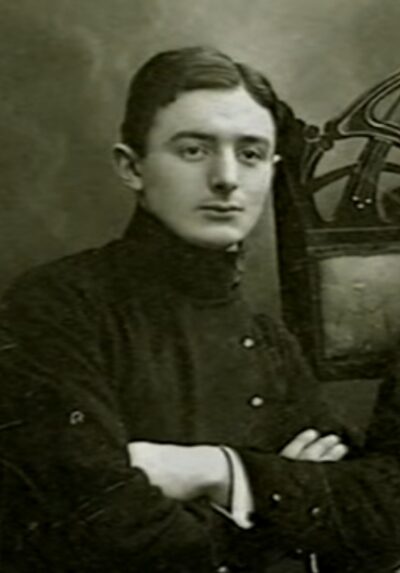
Dziga Vertov
Dziga Vertov was a Russian-Soviet documentary/avantgarde filmmaker. Born January 2, 1896, in Białystok. Died February 12, 1954, in Moscow. Known for Man with a Movie Camera and Kino-Pravda. Educated at Bekhterev Research Institute and Lomonosov Moscow State University. Awards include Order of the Red Star, Medal "For Valiant Labour in the Great Patriotic War 1941–1945" and Medal "In Commemoration of the 800th Anniversary of Moscow".
Facts
32 facts · 2 confirmed by two sources · 5 cited · 25 from one source
Where this comes from
Papalocal keeps its own record. It started from these sources; what each one said is kept here as it was copied, so a change on their side never changes this page by itself. Tap one to read its version.
What Wikidata says · copied November 16, 2026 · revision 2569143079
- Described as
- Russian-Soviet documentary/avantgarde filmmaker (1896-1954)
- Other names
- David Kaufman, Dsiga Werthoff, Dsiga Wertow, Denis Arkadovic, Dsiga Wertoff, Denis Kaufman, Dzyga Vertov, Denis Arkad'evič Kaufman, David Abelevich Kaufman, Denis Abramovich Kaufman, Denis Arkadyevich Kaufman, David Abelovych Kaufman
- Born
- January 2, 1896 · 8 references
- Died
- February 12, 1954 · 9 references
- Born in
- Białystok · 1 reference
- Died in
- Moscow · 2 references
- Buried in
- Novodevichy Cemetery
- Cause of death
- cancer
- Name at birth
- Дави́д А́белевич Ка́уфман
- Citizen of
- Russian Empire (–1917); Russian Socialist Federative Soviet Republic (1917–1922); Russian Soviet Federative Socialist Republic (1922–); Soviet Union (1922–)
- Occupation
- screenwriter · 1 reference; film director · 1 reference; film editor; cinematographer; director · 1 reference
- Worked for
- All-Ukrainian Photo-Cinema Administration (1927–1930) · 1 reference; Mezhrabpom-Film · 1 reference; Russian Central Studio of Documentary Films · 1 reference
- Education
- Bekhterev Research Institute (1916–1917); Lomonosov Moscow State University (–1917)
- Member of
- Kinoks · 1 reference
- Genre
- documentary film
- Instrument
- piano
- Known for
- Man with a Movie Camera; Kino-Pravda · 1 reference
- Awards
- Order of the Red Star; Medal "For Valiant Labour in the Great Patriotic War 1941–1945"; Medal "In Commemoration of the 800th Anniversary of Moscow"
- Spouse
- Yelizaveta Ignatevna Svilova (1929–1954)
- Siblings
- Mikhail Kaufman; Boris Kaufman
- Wikipedias with a page
- 58
Wikidata item Q55193 (wikidata.org/wiki/Q55193), public domain (CC0). Copied November 16, 2026.
What Wikipedia says · copied November 16, 2026 · revision 1385785606
Denis Arkadyevich Vertov (born David Abelevich Kaufman; 2 January 1896 [O.S. 21 December 1895] – 12 February 1954), better known as Dziga Vertov, was a Soviet pioneer documentary film and newsreel director, as well as a cinema theorist. His filming practices and theories influenced the cinéma vérité style of documentary movie-making and the Dziga Vertov Group, a radical film-making cooperative which was active from 1968 to 1972. He was a member of the Kinoks collective, with Elizaveta Svilova and Mikhail Kaufman.
In the 2012 Sight & Sound poll, critics voted Vertov's Man with a Movie Camera (1929) the eighth-greatest film ever made.
Vertov's younger brothers Boris Kaufman and Mikhail Kaufman were also noted filmmakers, as was his wife, Yelizaveta Svilova. He worked with Boris Kaufman and cinematographer Mikhail Kaufman on his most famous film Man with a Movie Camera.
- Born, in its opening lines
- January 2, 1896
- Died, in its opening lines
- February 12, 1954
From the Wikipedia article “Dziga Vertov” (en.wikipedia.org/wiki/Dziga_Vertov), by its contributors, under CC BY-SA 4.0 (creativecommons.org/licenses/by-sa/4.0/). Copied November 16, 2026; not changed.
Confirmed Two sources agree. Cited One source, and it names where it got it. One source One source, without a reference of its own. Sources disagree The sources disagree. We show the best-supported value and keep theirs below.
