
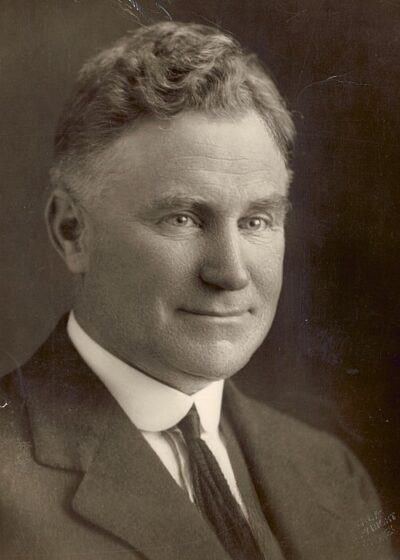
Earle Page
Earle Page was an Australian politician, 11th Prime Minister of Australia. Born August 8, 1880, in Grafton. Died December 20, 1961, in Sydney. Positions held include Prime Minister of Australia (1939), member of the Australian House of Representatives (1919–1961) and Minister for Health (1949–1956). Educated at Sydney Medical School and University of Sydney. Awards include Knight Grand Cross of the Order of St Michael and St George, Companion of Honour and Fellow of the Royal Australasian College of Surgeons.
Facts
25 facts · 2 confirmed by two sources · 6 cited · 17 from one source
Where this comes from
Papalocal keeps its own record. It started from these sources; what each one said is kept here as it was copied, so a change on their side never changes this page by itself. Tap one to read its version.
What Wikidata says · copied November 16, 2026 · revision 2567619990
- Described as
- Australian politician, 11th Prime Minister of Australia (1880-1961)
- Other names
- Sir Earle Page, Sir Earle Christmas Grafton Page, The Right Honourable Sir Earle Page
- Born
- August 8, 1880 · 5 references
- Died
- December 20, 1961 · 5 references
- Born in
- Grafton
- Died in
- Sydney · 1 reference
- Cause of death
- lung cancer
- Citizen of
- Australia
- Occupation
- politician; surgeon · 1 reference; head of government · 1 reference; minister · 1 reference
- Positions held
- Prime Minister of Australia (1939); member of the Australian House of Representatives (1919–1961); Minister for Health (1949–1956); Australian Minister for Agriculture (1940–1941); Treasurer of Australia (1923–1929)
- Political party
- National Party of Australia
- Education
- Sydney Medical School; University of Sydney · 1 reference
- Awards
- Knight Grand Cross of the Order of St Michael and St George (1938) · 1 reference; Companion of Honour (1942) · 1 reference; Fellow of the Royal Australasian College of Surgeons; Honorary Fellow of the Royal College of Surgeons (1941) · 1 reference
- Spouse
- Ethel Page
- Siblings
- Harold Page; Rodger Page
- Wikipedias with a page
- 42
Wikidata item Q370926 (wikidata.org/wiki/Q370926), public domain (CC0). Copied November 16, 2026.
What Wikipedia says · copied November 16, 2026 · revision 1381497821
Sir Earle Christmas Grafton Page (8 August 1880 – 20 December 1961) served as the 11th prime minister of Australia from 7 to 26 April 1939, in a caretaker capacity following the death of Joseph Lyons. He was the leader of the Country Party from 1921 to 1939, and was the most influential figure in its later years.
Page was born in Grafton, New South Wales. He entered the University of Sydney at the age of 15, and completed a degree in medicine at the age of 21. After completing his medical residency at Royal Prince Alfred Hospital in Sydney, he moved back to Grafton and opened a private hospital. He soon became involved in local politics, and in 1915 purchased a part-share in The Daily Examiner, a local newspaper. He also briefly was a military surgeon during World War I. Page gained prominence as an advocate of various development schemes for the Northern Rivers region, especially those involving hydroelectricity. He also helped found a movement for New England statehood.
At the 1919 Australian federal election, Page was elected to the Parliament of Australia representing the Division of Cowper. He joined the new Country Party the following year as its inaugural whip, and then replaced William McWilliams as party leader in 1921. Page opposed the economic policies of Prime Minister Billy Hughes, and when the Country Party gained the balance of power at the 1922 election, he demanded Hughes' resignation as the price for a coalition with the Nationalist Party. He was subsequently made Treasurer of Australia under the new prime minister, Stanley Bruce, serving in that role from 1923 to 1929. He had a significant degree of influence on domestic policy, with Bruce concentrating on international issues.
Page returned to cabinet after the 1934 election, when the Country Party entered a new coalition with Joseph Lyons' United Australia Party (UAP). He was appointed Minister for Commerce, and concentrated on agricultural issues. When Lyons died in office in April 1939, Page was commissioned as his successor in a caretaker capacity while the UAP elected a new leader, Robert Menzies. Page subsequently denounced Menzies and refused to serve in his cabinet, withdrawing the Country Party from the coalition, but this proved unpopular and he resigned the party leadership after a few months. The coalition was eventually reconstituted, and Page served again as Minister for Commerce under Menzies and Arthur Fadden until the government's defeat in October 1941.
Page's last major role was as Minister for Health (1949–1956) in the post-war Menzies Government. He retired from cabinet at the age of 76, and died a short time after losing his seat at the 1961 election. Page served in parliament for almost 42 years, the third longest-serving Australian parliamentarian of all time; only Menzies lasted longer as the leader of a major Australian political party. He secured his party's independence by refusing overtures to merge with the Nationalists and the UAP, and the policies that he favoured – decentralisation, agrarianism, and government support of primary industry – have remained the basis of its platform up to the present day. The coalitions that he established and maintained with Bruce and Lyons have served as a model for all subsequent coalition governments.
- Born, in its opening lines
- August 8, 1880
- Died, in its opening lines
- December 20, 1961
From the Wikipedia article “Earle Page” (en.wikipedia.org/wiki/Earle_Page), by its contributors, under CC BY-SA 4.0 (creativecommons.org/licenses/by-sa/4.0/). Copied November 16, 2026; not changed.
Confirmed Two sources agree. Cited One source, and it names where it got it. One source One source, without a reference of its own. Sources disagree The sources disagree. We show the best-supported value and keep theirs below.
