
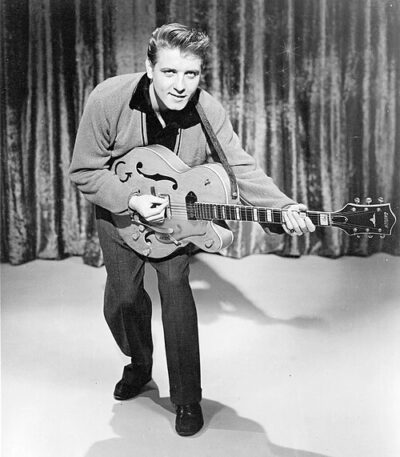
Eddie Cochran
Eddie Cochran was an American rock and roll pioneer. Born October 3, 1938, in Albert Lea. Died April 17, 1960, in Bath. Educated at Bell Gardens High School. Awards include Rock and Roll Hall of Fame.
Facts
25 facts · 2 confirmed by two sources · 6 cited · 17 from one source
Where this comes from
Papalocal keeps its own record. It started from these sources; what each one said is kept here as it was copied, so a change on their side never changes this page by itself. Tap one to read its version.
What Wikidata says · copied November 13, 2026 · revision 2568843113
- Described as
- American rock and roll pioneer (1938–1960)
- Other names
- Edward Raymond Cochran, Edward Raymond 'Eddie' Cochran, Ray Edward Cochran, Ray Edward Cochrane, Edward Ray Cochran, Edward Cochran
- Born
- October 3, 1938 · 7 references
- Died
- April 17, 1960 · 7 references
- Born in
- Albert Lea · 1 reference
- Died in
- Bath · 1 reference
- Buried in
- Cypress · 1 reference
- Cause of death
- traffic collision
- Citizen of
- United States
- Occupation
- guitarist; singer · 1 reference; singer-songwriter; composer · 1 reference; rock musician; recording artist; bandleader · 1 reference
- Education
- Bell Gardens High School · 1 reference
- Genre
- rock music; country music · 1 reference
- Instrument
- guitar; voice
- Record label
- Liberty Records; Cash Records; Crest Records; Ekko Records
- Awards
- Rock and Roll Hall of Fame (1987) · 1 reference
- Website
- http://www.eddie-cochran.info
- Wikipedias with a page
- 40
Wikidata item Q5969 (wikidata.org/wiki/Q5969), public domain (CC0). Copied November 13, 2026.
What Wikipedia says · copied November 13, 2026 · revision 1385263500
Edward Ray Cochran ( KOK-rən; October 3, 1938 – April 17, 1960) was an American rock and roll musician. His songs, such as "Twenty Flight Rock", "Summertime Blues", "C'mon Everybody" and "Somethin' Else", captured teenage frustration and desire in the mid-1950s and early 1960s. He experimented with multitrack recording, distortion techniques and overdubbing, even on his earliest singles. Cochran played the guitar, piano, bass, and drums. His image as a sharply dressed and attractive young man with a rebellious attitude epitomized the stance of the 1950s rocker, and in death, he achieved iconic status.
Cochran was involved with music from an early age, playing in the school band and teaching himself to play blues guitar. In 1955, Cochran formed a duo with the guitarist Hank Cochran (no relation) and became known as the Cochran Brothers. When they split the following year, Eddie began a song-writing career with Jerry Capehart. His first success came when he performed "Twenty Flight Rock" in the film The Girl Can't Help It, which starred Jayne Mansfield. Soon afterward, he signed a recording contract with Liberty Records and his first record for the label, "Sittin' in the Balcony", rose to number 18 on the Billboard charts.
Cochran died in April 1960 in St Martin's Hospital, Bath, Somerset, after a car accident in Chippenham, Wiltshire, at the end of his British tour with Gene Vincent. On April 16, after they had just performed at the Bristol Hippodrome, and when they were on their way to Heathrow Airport to fly home, Vincent, Cochran, their tour manager Patrick Tompkins, and the songwriter Sharon Sheeley were involved in a high-speed traffic accident in a private-hire taxi. The other three passengers survived (albeit with significant injuries); but Cochran, who had been thrown from the vehicle, suffered more serious brain injuries and died the following day.
Though Cochran's best-known songs were released during his lifetime, more of his songs were released posthumously. In 1987, he was inducted into the Rock and Roll Hall of Fame. A wide variety of recording artists have recorded his songs. Paul McCartney chose Cochran's "Twenty Flight Rock" as his audition piece, confident that his performance would impress John Lennon, which it did, and was hired as a member of Lennon's skiffle group, the Quarrymen, which later became the Beatles.
- Born, in its opening lines
- October 3, 1938
- Died, in its opening lines
- April 17, 1960
From the Wikipedia article “Eddie Cochran” (en.wikipedia.org/wiki/Eddie_Cochran), by its contributors, under CC BY-SA 4.0 (creativecommons.org/licenses/by-sa/4.0/). Copied November 13, 2026; not changed.
Confirmed Two sources agree. Cited One source, and it names where it got it. One source One source, without a reference of its own. Sources disagree The sources disagree. We show the best-supported value and keep theirs below.
