
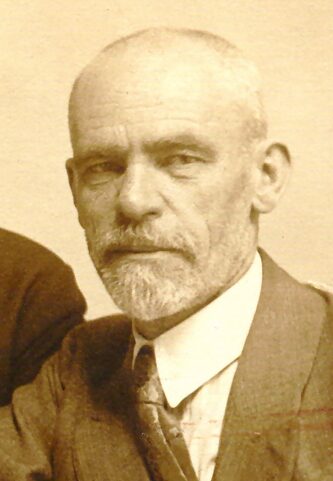
Edgar de Wahl
Edgar de Wahl was an Estonian teacher and linguist. Born August 11, 1867, in Olviopol. Died March 9, 1948, in Tallinn. Educated at Saint Petersburg State University and Imperial Academy of Arts.
Facts
22 facts · 1 confirmed by two sources · 2 cited · 18 from one source · 1 where the sources disagree
What’s different
- Born: we show August 11, 1867 (Sources disagree). Wikipedia says August 23, 1867
Where this comes from
Papalocal keeps its own record. It started from these sources; what each one said is kept here as it was copied, so a change on their side never changes this page by itself. Tap one to read its version.
What Wikidata says · copied November 16, 2026 · revision 2522958294
- Described as
- Estonian teacher and linguist (1867–1948)
- Other names
- Edgar von Wahl, Edgar Alexei Robert von Wahl
- Born
- August 11, 1867 · 1 reference
- Died
- March 9, 1948 · 1 reference
- Born in
- Olviopol
- Died in
- Tallinn
- Buried in
- Alexander Nevsky cemetery
- Citizen of
- Estonia (1918–); Russian Empire (–1918)
- Occupation
- linguist · 1 reference; Esperantist; Idist; teacher; politician; mathematician · 1 reference
- Worked for
- Tallinn Secondary School of Science
- Education
- Saint Petersburg State University; Imperial Academy of Arts
- Field
- linguist; interlinguistics
- Spouse
- Marie Elisabeth von Hübbenet
- Father
- Oskar von Wahl
- Mother
- Lydia Amalie Marie von Husen
- Military branch
- Imperial Russian Navy (–1894)
- Wikipedias with a page
- 109
Wikidata item Q327195 (wikidata.org/wiki/Q327195), public domain (CC0). Copied November 16, 2026.
What Wikipedia says · copied November 16, 2026 · revision 1367866851
Edgar von Wahl (Interlingue: Edgar de Wahl; born Edgar Alexis Robert von Wahl; 23 August 1867 – 9 March 1948) was a Baltic German mathematics and physics teacher who lived in Tallinn, Estonia. He also used the pseudonym Julian Prorók, and is best known as the creator of Interlingue, an international auxiliary language that was known as Occidental throughout his life.
He was born to the Baltic German noble von Wahl family in the then Russian Empire and spent most of his childhood in Tallinn (Reval) and the capital Saint Petersburg. He studied at the University of Saint Petersburg and at the Saint Petersburg Academy of Arts. During and after his studies he served in the navy. After completing the military service in 1894 he lived permanently in Tallinn and worked as a teacher. During World War II, when most Baltic Germans left Estonia in 1939–1941, he decided to stay. He was arrested in 1943 by the Nazi German occupation authorities and placed in a psychiatric clinic because of alleged dementia. He stayed there until his death in 1948.
Wahl was engaged with interlinguistics from an early age. He was first introduced to Volapük by his father's colleague Waldemar Rosenberger and even started to compose a lexicon of marine terminology for the language, before turning to Esperanto in 1888. After the failure of Reformed Esperanto in 1894, of which Wahl had been a proponent, he started work to find an ideal form of an international language. In 1922, he published a "key" to a new language, Occidental, and the first edition of the periodical Kosmoglott (later Cosmoglotta). Wahl developed the language over several decades on the advice of its speakers, but became isolated from the movement (then centred in Switzerland) from 1939 after the start of World War II.
- Born, in its opening lines
- August 23, 1867
- Died, in its opening lines
- March 9, 1948
From the Wikipedia article “Edgar de Wahl” (en.wikipedia.org/wiki/Edgar_de_Wahl), by its contributors, under CC BY-SA 4.0 (creativecommons.org/licenses/by-sa/4.0/). Copied November 16, 2026; not changed.
Confirmed Two sources agree. Cited One source, and it names where it got it. One source One source, without a reference of its own. Sources disagree The sources disagree. We show the best-supported value and keep theirs below.
