
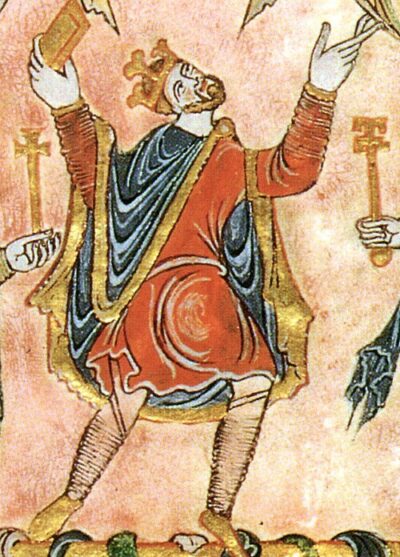
Edgar of England
Edgar of England was a King of the English (r. 959–975). Born 944, in Kingdom of Wessex. Died July 8, 975, in Winchester. Positions held include Monarch of England (959–975) and King of Mercia (957–959).
Facts
20 facts · 2 confirmed by two sources · 12 cited · 6 from one source
What’s different
- Born: we show 944 (Confirmed). Wikidata also lists 943
Where this comes from
Papalocal keeps its own record. It started from these sources; what each one said is kept here as it was copied, so a change on their side never changes this page by itself. Tap one to read its version.
What Wikidata says · copied November 16, 2026 · revision 2567076975
- Described as
- King of the English (r. 959–975)
- Other names
- Eadgar the Peaceable, Eadgar of Wessex, Eadgar the Peaceful, Eadgar of England, Edgar the Peaceful, Edgar the Peaceable, Eadgar the Peaceful, King of England, Edgar, Edgar, King of Mercia, Eadgar, King of Mercia, Edgar the Saxon, King of England, Eadgar
- Born
- 943 · 1 reference; 944 · 2 references
- Died
- July 8, 975 · 5 references
- Born in
- Kingdom of Wessex · 2 references
- Died in
- Winchester · 1 reference
- Buried in
- Glastonbury Abbey
- Citizen of
- Kingdom of England
- Occupation
- politician; monarch
- Positions held
- Monarch of England (959–975); King of Mercia (957–959) · 1 reference
- Spouse
- Ælfthryth · 2 references; Æthelflæd · 2 references; Wulthryth · 2 references
- Children
- Edward the Martyr · 2 references; Edith of Wilton · 2 references; Æthelred the Unready · 1 reference; Edmund Ætheling · 1 reference
- Father
- Edmund I · 1 reference
- Mother
- Ælfgifu of Shaftesbury · 1 reference
- Siblings
- Eadwig · 1 reference
- Wikipedias with a page
- 59
Wikidata item Q192925 (wikidata.org/wiki/Q192925), public domain (CC0). Copied November 16, 2026.
What Wikipedia says · copied November 16, 2026 · revision 1380953505
Edgar (or Eadgar; c. 944 – 8 July 975), also known as Edgar the Peaceful, the Peacemaker and the Peaceable, was King of the English from 959 until his death in 975. He became king of all England on his brother Eadwig's death. He was the younger son of King Edmund I and his first wife, Ælfgifu. A detailed account of Edgar's reign is not possible, because only a few events were recorded by chroniclers and monastic writers, who were more interested in recording the activities of the leaders of the church.
Edgar mainly followed the political policies of his predecessors, but there were major changes in the religious sphere. The English Benedictine Reform, which he strongly supported, became a dominant religious and social force. It is seen by historians as a major achievement, and it was accompanied by a literary and artistic flowering, mainly associated with Æthelwold, Bishop of Winchester. Monasteries aggressively acquired estates from lay landowners with Edgar's assistance, leading to disorder when he died and former owners sought to recover their lost property, sometimes by force. Edgar's major administrative reform was the introduction of a standardised coinage in the early 970s to replace the previous decentralised system. He also issued legislative codes which mainly concentrated on improving procedures for enforcement of the law.
England had suffered from Viking invasions for over a century when Edgar came to power, but there were none during his reign, which fell in a lull in attacks between the mid-950s and the early 980s. After his death the throne was disputed between the supporters of his two surviving sons; the elder one, Edward the Martyr, was chosen with the support of Dunstan, the Archbishop of Canterbury. Three years later Edward was murdered; he was succeeded by his younger half-brother, Æthelred the Unready. Later chroniclers presented Edgar's reign as a golden age when England was free from external attacks and internal disorder, especially compared with Æthelred's disastrous rule. Modern historians see Edgar's reign as the pinnacle of Anglo-Saxon culture, but they disagree about his political legacy, and some see the disorders following his death as a natural reaction to his overbearing control.
- Born, in its opening lines
- c. 944
- Died, in its opening lines
- July 8, 975
From the Wikipedia article “Edgar, King of England” (en.wikipedia.org/wiki/Edgar,_King_of_England), by its contributors, under CC BY-SA 4.0 (creativecommons.org/licenses/by-sa/4.0/). Copied November 16, 2026; not changed.
Confirmed Two sources agree. Cited One source, and it names where it got it. One source One source, without a reference of its own. Sources disagree The sources disagree. We show the best-supported value and keep theirs below.
