
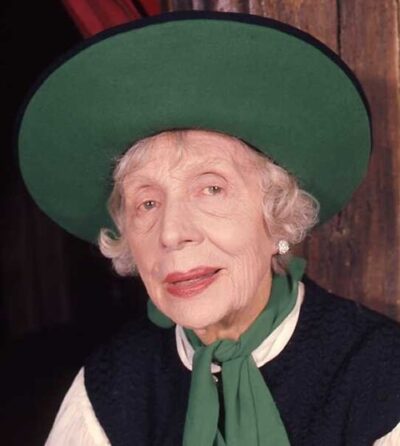
Edith Evans
Edith Evans was a British actress. Born February 8, 1888, in London. Died October 14, 1976, in Cranbrook. Awards include Dame Commander of the Order of the British Empire, Silver Bear for Best Actress and Golden Globe Award for Best Actress – Motion Picture Drama.
Facts
15 facts · 2 confirmed by two sources · 3 cited · 10 from one source
Where this comes from
Papalocal keeps its own record. It started from these sources; what each one said is kept here as it was copied, so a change on their side never changes this page by itself. Tap one to read its version.
What Wikidata says · copied November 16, 2026 · revision 2563931588
- Described as
- British actress (1888–1976)
- Other names
- Edith Mary Evans, Dame Edith Evans, Dame Edith Mary Evans, Dame Edith (Mary) Evans
- Born
- February 8, 1888 · 12 references
- Died
- October 14, 1976 · 13 references
- Born in
- London · 2 references
- Died in
- Cranbrook
- Buried in
- St Paul's Church, Covent Garden · 1 reference
- Citizen of
- United Kingdom; United Kingdom of Great Britain and Ireland (–1927)
- Occupation
- stage actor; film actor; actor · 1 reference
- Political party
- California Republican Party
- Awards
- Dame Commander of the Order of the British Empire (1946); Silver Bear for Best Actress (1967); Golden Globe Award for Best Actress – Motion Picture Drama (1968); BAFTA Award for Best Actress in a Leading Role (1968)
- Wikipedias with a page
- 50
Wikidata item Q236718 (wikidata.org/wiki/Q236718), public domain (CC0). Copied November 16, 2026.
What Wikipedia says · copied November 16, 2026 · revision 1379349570
Dame Edith Mary Evans (8 February 1888 – 14 October 1976) was an English actress. She was best known for her work on the West End stage, but also appeared in films at the beginning and towards the end of her career. Between 1964 and 1968, she was nominated for three Academy Awards.
Evans's stage career spanned sixty years, during which she played more than 100 roles, in classics by Shakespeare, Congreve, Goldsmith, Sheridan and Wilde, and plays by contemporary writers including Bernard Shaw, Enid Bagnold, Christopher Fry and Noël Coward. She created roles in two of Shaw's plays: Orinthia in The Apple Cart (1929), and Epifania in The Millionairess (1940) and was in the British premières of two others: Heartbreak House (1921) and Back to Methuselah (1923).
Evans became widely known for portraying haughty aristocratic women, as in two of her most famous roles as Lady Bracknell in The Importance of Being Earnest, and Miss Western in the 1963 film of Tom Jones. During her performance as Lady Bracknell, her elongated delivery of the line 'A handbag' has become synonymous with the Oscar Wilde play. By contrast, she played a downtrodden maid in The Late Christopher Bean (1933), an eccentric, impoverished old woman in The Whisperers (1967) and – one of her most celebrated roles – Nurse in Romeo and Juliet, which she played in four productions between 1926 and 1961.
- Born, in its opening lines
- February 8, 1888
- Died, in its opening lines
- October 14, 1976
From the Wikipedia article “Edith Evans” (en.wikipedia.org/wiki/Edith_Evans), by its contributors, under CC BY-SA 4.0 (creativecommons.org/licenses/by-sa/4.0/). Copied November 16, 2026; not changed.
Confirmed Two sources agree. Cited One source, and it names where it got it. One source One source, without a reference of its own. Sources disagree The sources disagree. We show the best-supported value and keep theirs below.
