
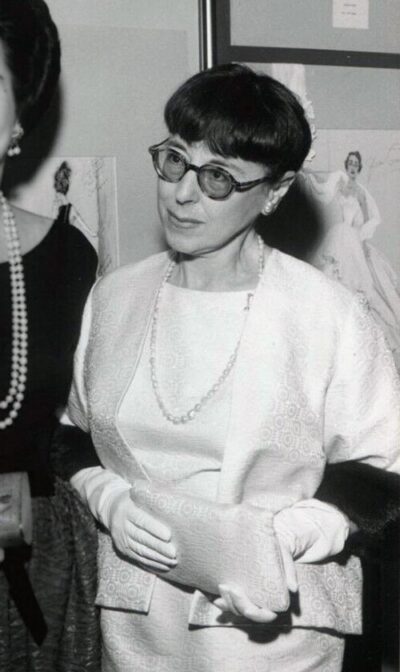
Edith Head
Edith Head was an American film and television costumer. Born October 28, 1897, in San Bernardino. Died October 24, 1981, in Los Angeles. Educated at University of California, Berkeley and Stanford University. Awards include Academy Award for Best Costume Design, Black-and-White (6 times), Academy Award for Best Costume Design, Color and Academy Award for Best Costume Design.
Facts
20 facts · 2 confirmed by two sources · 8 cited · 10 from one source
Where this comes from
Papalocal keeps its own record. It started from these sources; what each one said is kept here as it was copied, so a change on their side never changes this page by itself. Tap one to read its version.
What Wikidata says · copied November 15, 2026 · revision 2569773481
- Described as
- American film and television costumer (1897-1981)
- Other names
- Edith Claire Head
- Born
- October 28, 1897 · 5 references
- Died
- October 24, 1981 · 6 references
- Born in
- San Bernardino · 1 reference
- Died in
- Los Angeles · 2 references
- Buried in
- Forest Lawn Memorial Park
- Cause of death
- cancer
- Citizen of
- United States
- Occupation
- costume designer · 1 reference; fashion designer · 1 reference; art director · 1 reference
- Education
- University of California, Berkeley; Stanford University; Otis College of Art and Design; Chouinard Art Institute
- Awards
- Academy Award for Best Costume Design, Black-and-White (6 times) (1950, 1951, 1952, 1954, 1955, 1961) · 1 reference; Academy Award for Best Costume Design, Color (1951) · 1 reference; Academy Award for Best Costume Design (1974) · 1 reference; Los Angeles Times Women of the Year Silver Cup · 1 reference; star on Hollywood Walk of Fame · 1 reference
- Spouse
- Wiard Ihnen (1940–1979)
- Wikipedias with a page
- 36
Wikidata item Q234961 (wikidata.org/wiki/Q234961), public domain (CC0). Copied November 15, 2026.
What Wikipedia says · copied November 15, 2026 · revision 1381455370
Edith Claire Head (née Posener; October 28, 1897 – October 24, 1981) was an American film costume designer. With a total of 8 wins out of 35 nominations, she is the most decorated woman at the Academy Awards. She also holds the Guinness World Record for most-credited costume designer in film history, with a total of 432 credits.
Raised between California and Nevada, Head earned degrees from the University of California, Berkeley and Stanford University before beginning a career as a French and Spanish languages teacher. After taking courses at the Chouinard Art Institute in Los Angeles, she was hired in 1923 as a costume sketch artist at Famous Players–Lasky, which later became Paramount Pictures. She won acclaim for her design of Dorothy Lamour’s trademark sarong in the 1936 film The Jungle Princess, and became a household name after the Academy Award for Best Costume Design was created in 1948. Head was considered exceptional for her close working relationships with her subjects, with whom she consulted extensively; these included virtually every top female star in Hollywood.
Head worked at Paramount for 44 years, and was frequently loaned out by the studio for work on projects for other studios. While under contract at Paramount, she designed the costumes for several films by Alfred Hitchcock, including Notorious (1946), Vertigo (1958), The Birds (1963), and Marnie (1964). In 1968, after Paramount declined to renew her contract, Hitchcock invited her to join Universal Pictures. There she earned her eighth and final Academy Award for her work on The Sting in 1973.
Outside of film, Head was commissioned to design the official women's uniform for the United States Coast Guard in the 1970s, due to the increasing number of women in the Coast Guard, for which she received the Meritorious Public Service Award.
- Born, in its opening lines
- October 28, 1897
- Died, in its opening lines
- October 24, 1981
From the Wikipedia article “Edith Head” (en.wikipedia.org/wiki/Edith_Head), by its contributors, under CC BY-SA 4.0 (creativecommons.org/licenses/by-sa/4.0/). Copied November 15, 2026; not changed.
Confirmed Two sources agree. Cited One source, and it names where it got it. One source One source, without a reference of its own. Sources disagree The sources disagree. We show the best-supported value and keep theirs below.
