
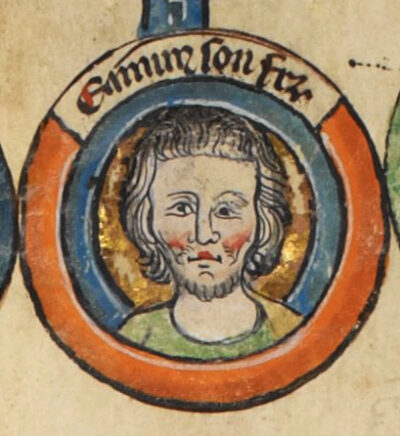
Edmund Crouchback
Edmund Crouchback was an English noble. Born January 16, 1245, in London. Died June 5, 1296, in Bayonne. Positions held include Lord High Steward (1274–1296).
Facts
20 facts · 2 confirmed by two sources · 8 cited · 10 from one source
Where this comes from
Papalocal keeps its own record. It started from these sources; what each one said is kept here as it was copied, so a change on their side never changes this page by itself. Tap one to read its version.
What Wikidata says · copied November 16, 2026 · revision 2559731423
- Described as
- English noble (1245-1296)
- Other names
- Edmund Plantagenet
- Born
- January 16, 1245
- Died
- June 5, 1296
- Born in
- London
- Died in
- Bayonne
- Buried in
- Westminster Abbey
- Citizen of
- Kingdom of England
- Occupation
- politician
- Positions held
- Lord High Steward (1274–1296)
- Spouse
- Blanche of Artois · 2 references; Aveline de Forz (1269–) · 1 reference
- Children
- Thomas, 2nd Earl of Lancaster · 1 reference; Henry, 3rd Earl of Lancaster · 1 reference; John of Lancaster; Mary Plantagenet · 1 reference
- Father
- Henry III of England · 1 reference
- Mother
- Eleanor of Provence · 1 reference
- Siblings
- Edward I of England · 1 reference; Margaret of England · 1 reference; Beatrice of England; Katherine of England
- Wikipedias with a page
- 29
Wikidata item Q447802 (wikidata.org/wiki/Q447802), public domain (CC0). Copied November 16, 2026.
What Wikipedia says · copied November 16, 2026 · revision 1382867364
Edmund Crouchback (16 January 1245 – 5 June 1296) was a member of the royal Plantagenet dynasty and the founder of the House of Lancaster. He was Earl of Leicester (1265–1296), Lancaster (1267–1296) and Derby (1269–1296) in England and Count Palatine of Champagne (1276–1284) in France.
Named after the 9th-century saint, Edmund was the second surviving son of King Henry III of England and Eleanor of Provence and the younger brother of King Edward I of England, to whom he was loyal as a diplomat and warrior. In 1254, the 9-year-old Edmund became involved in the "Sicilian business", in which his father accepted a papal offer granting the Kingdom of Sicily to Edmund, who made preparations to become king. However, Henry III could not provide funds for the operation, prompting the Papacy to withdraw the grant and give it to Edmund's uncle, Charles I of Anjou. The "Sicilian business" outraged the barons led by the Earl of Leicester and Edmund's uncle, Simon de Montfort, 6th Earl of Leicester, and was cited as one of the reasons for limiting Henry's power. Deterioration of relations between the barons and the king resulted in the Second Barons' War, in which the royal government, supported by Edmund, triumphed over the baronage following the death of Montfort in the Battle of Evesham in 1265.
Edmund received the lands and titles of Montfort and the defeated barons Nicholas Segrave, 1st Baron Segrave, and Robert de Ferrers, 6th Earl of Derby, and became Earl of Lancaster, Leicester and Derby. Primarily known as the earl of the first county, he eventually became the most powerful baron of England. Later, Edmund accompanied his elder brother Edward on his crusade in the Holy Land, where his epithet "Crouchback" originated from a corruption of 'cross back', referring to him wearing a stitched cross on his garments. Following the death of his first wife, Aveline de Forz, Edmund's aunt and Dowager Queen of France Margaret of Provence arranged his second marriage to Blanche of Artois, the recently widowed Queen Dowager of Navarre and the Countess of Champagne. With his second wife Blanche, Edmund governed Champagne as count palatine in the name of his stepdaughter Joan until she came of age. Edmund was active in supporting his family members, such as assisting Edward in conquering Wales, advocating for the claims of his aunt Margaret against his uncle Charles I of Anjou in his mother and aunt's homeland of Provence and managing Ponthieu on behalf of his sister-in-law, Eleanor of Castile.
When Edmund's stepson-in-law, King Philip IV of France, demanded Edward, who was also his vassal through Gascony, to come to Paris to answer charges of damages caused by English mariners in 1293, Edward sent Edmund to mediate the crisis to avert war. Edmund negotiated an agreement with Philip where France would occupy Gascony for 40 days, and Edward would marry Philip's half-sister, Margaret. When the 40 days were over, Philip tricked Edward and Edmund by refusing to relinquish control over Gascony, calling Edward to again answer for his charges. Edmund and Edward then renounced their homages to Philip and prepared for war against France. Edmund sailed for Gascony with his army and besieged the city of Bordeaux. Unable to pay his troops, Edmund was deserted by his army and retreated to Bayonne, where he died from illness in 1296. Edmund's body was brought back to England, where he was buried in Westminster Abbey in 1301.
- Born, in its opening lines
- January 16, 1245
- Died, in its opening lines
- June 5, 1296
From the Wikipedia article “Edmund Crouchback” (en.wikipedia.org/wiki/Edmund_Crouchback), by its contributors, under CC BY-SA 4.0 (creativecommons.org/licenses/by-sa/4.0/). Copied November 16, 2026; not changed.
Confirmed Two sources agree. Cited One source, and it names where it got it. One source One source, without a reference of its own. Sources disagree The sources disagree. We show the best-supported value and keep theirs below.
